House On The Crescent

All Posts By Elody Von

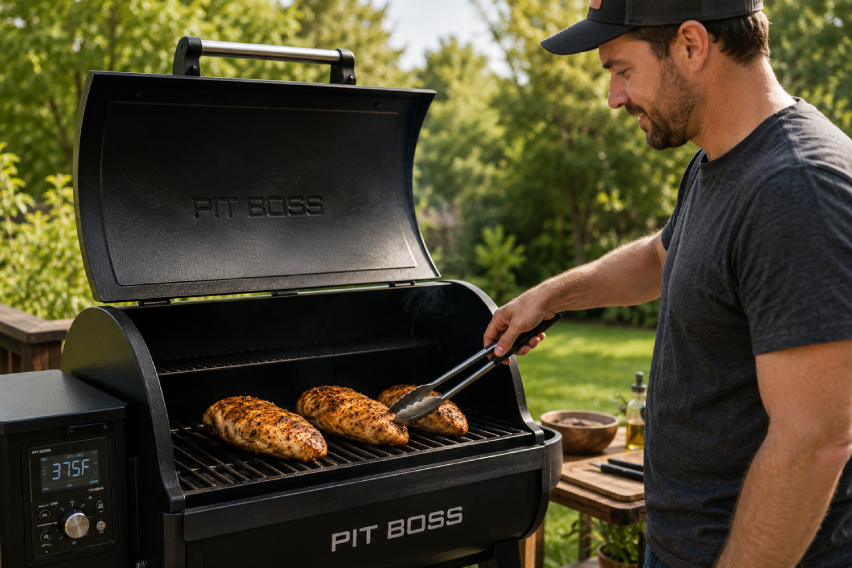
Chicken Breast on a Pit Boss Pellet Grill — The Guide to Juicy Every Single Time

By Posted on 0 Comments7min read0 views

Chicken Breast on a Pit Boss Pellet Grill — The Guide to Juicy Every Single Time

Chicken Breast on a Pit Boss Pellet Grill — The Guide to Juicy Every Single Time

Chicken breast has a reputation problem and I get it. It’s the protein people default to when they’re trying to eat healthy, and because of that it gets cooked in a hurry, at the wrong temperature, with no preparation, and it comes out dry and flavorless and somehow gets blamed on the chicken rather than the technique. The chicken breast itself is fine. The cooking is usually the problem.

On a Pit Boss pellet grill, chicken breast can be something genuinely special — juicy with smoke flavor working all the way through, a slight char on the outside, and enough texture contrast to make it interesting rather than the protein you’re eating because you feel like you should. But it requires understanding a few things that most grilling guides skip over because they’re writing for people who are okay with mediocre chicken.

The Fundamental Problem with Chicken Breast

Chicken breast is lean, boneless, and completely unforgiving of overcooking. There’s no fat marbling inside the muscle to provide moisture as the temperature rises, and no bone to slow down the heat transfer. When chicken breast hits 165°F, the USDA says it’s done. When it hits 175°F, it’s dry. The window between done and too dry is about 10 degrees and can close in less than 5 minutes at high heat.

The solution is two-fold: prepare the chicken correctly before it goes on (brine), and cook it to the correct temperature while monitoring it constantly (thermometer).

Brining the Chicken Breast

This is the step that makes the biggest single difference to the end result. A brined chicken breast holds moisture through the cook in a way that unbrined chicken simply doesn’t.

Simple brine:

  • 4 cups cold water
  • 3 tablespoons kosher salt
  • 1 tablespoon sugar
  • Optional: garlic cloves, peppercorns, fresh thyme

Dissolve the salt and sugar in the water (you can use a cup of warm water to dissolve them and then add cold water to bring it to volume). Submerge the chicken breasts completely and refrigerate for at least 30 minutes. 1 to 2 hours is ideal. More than 4 hours and the texture starts to get mushy from the salt.
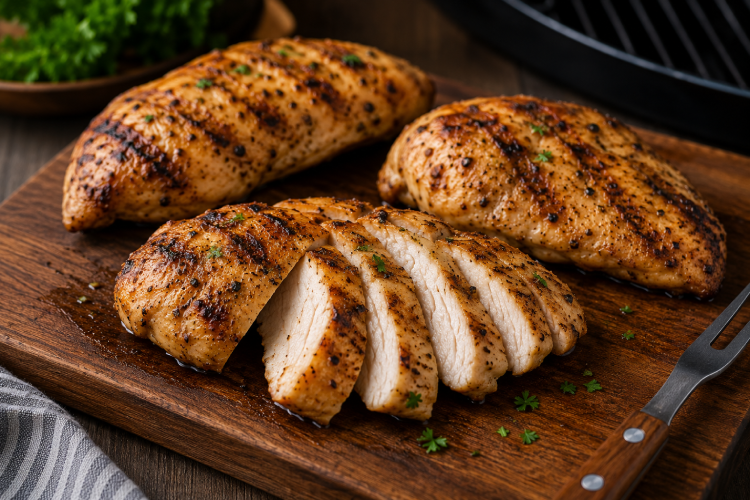
After brining, remove the chicken from the brine and pat completely dry with paper towels. Dry surface is important for getting any color or texture on the exterior.

If you don’t have time to brine: At minimum, season the chicken generously and let it sit at room temperature for 20 to 30 minutes before grilling. Cold chicken straight from the refrigerator onto the grill means the outside is cooking while the center is still catching up, which increases the risk of the exterior overcooking before the interior is done.

Getting the Chicken Breasts the Same Thickness

This is a step almost no home cook does and almost every good cook does. Chicken breasts taper from thick at one end to thin at the other. The thin end cooks twice as fast as the thick end. If you cook to the right temperature at the thick end, the thin end has been overcooked for 10 minutes. If you cook to the thick end’s timing, the thin end is dry and tough.

The fix is simple: pound the chicken breast to an even thickness using a meat mallet or rolling pin. Place each breast between two pieces of plastic wrap or in a zip-lock bag, and pound from the center outward until the entire breast is a consistent ¾ inch to 1 inch thick.

This is five minutes of work that produces dramatically more consistent results than any other single step besides brining.

Seasoning Options

Simple everyday seasoning:

  • 1 teaspoon kosher salt
  • ½ teaspoon black pepper
  • ½ teaspoon garlic powder
  • ½ teaspoon onion powder
  • ½ teaspoon smoked paprika
  • Drizzle of olive oil to help the seasoning stick and promote browning

Mix together and coat both sides of each chicken breast thoroughly. The olive oil also helps the exterior get some color on the grill rather than staying pale.

BBQ approach:
Start with the basic seasoning above and finish with a coat of your favorite barbecue sauce applied during the last 5 minutes of cooking. The sugar in BBQ sauce burns if applied too early, so brush it on at the end and let it caramelize rather than char.

Italian herb approach:

  • Salt, pepper, garlic powder
  • Dried oregano
  • Dried basil
  • Dried rosemary
  • Lemon zest if you have it

All of these work. The pellet grill adds smoke flavor that works as a fifth seasoning regardless of what you put on the outside, so simple seasonings often produce the best results because they let the smoke contribute without fighting it.

Pellet Selection

Chicken breast is mild enough that it can handle a range of smoke woods without being overpowered.

Apple or cherry wood pellets are the most popular choice for chicken. The mild, slightly sweet smoke complements poultry and produces good color on the exterior. Apple is the safer, more neutral choice; cherry gives a slightly darker color and a fraction more smoke intensity.

Pecan pellets work beautifully with chicken — slightly nuttier smoke, a little more depth than apple without being heavy.

Hickory: Use carefully with chicken breast. Hickory is strong enough that a full cook of chicken breast in heavy hickory smoke can produce a result that tastes more like smoke than chicken. If you like hickory, mix it 50/50 with apple to moderate the intensity.

Cooking Methods on the Pit Boss

There are two approaches that work well for chicken breast on a Pit Boss, and which you choose depends on whether you prioritize maximum smoke flavor or a grilled exterior.

Method 1: Low and slow, then sear

This is the “reverse sear” approach for chicken breast.

Start at 225°F. Place the chicken breast on the grill and smoke until the internal temperature hits 145°F to 150°F. This takes approximately 45 minutes to an hour depending on the size of the breast. At this point the chicken has absorbed significant smoke flavor and is close to done but not there yet.

Then crank the Pit Boss to its highest temperature setting (typically 450°F to 500°F) and sear the chicken for 2 to 3 minutes per side to develop color and texture on the exterior. Pull when internal temperature hits 160°F to 165°F.

This method gives you the best of both approaches — real smoke flavor from the low temperature phase, and good exterior texture from the high heat sear.

Method 2: Medium-high and direct

Set the Pit Boss at 375°F to 400°F and cook the chicken directly on the grates. At this temperature, the chicken develops color on the exterior while the interior cooks to temperature in approximately 15 to 20 minutes.

This method produces less smoke flavor than the reverse sear approach but takes half the time and still produces good results — the pellet grill ambient smoke during any cook contributes flavor even at higher temperatures.

Temperature Monitoring

Get a reliable instant-read thermometer and use it without apology. Cooking chicken breast without temperature monitoring is how you end up with dry chicken breast and a burned reputation for grilling.

Target internal temperature: 165°F at the thickest part of the breast. This is the USDA safe temperature. If you want to be more precise and are using a reliable thermometer, you can pull at 160°F — carryover cooking during the 5-minute rest will bring it to 165°F.
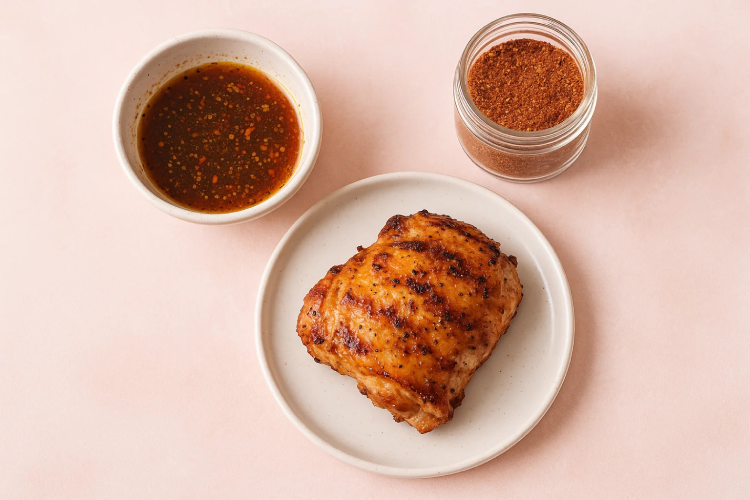
Insert the thermometer into the thickest part of the breast, parallel to the surface rather than straight down, to get a reading from the center of the meat rather than the underside. Keep the probe tip away from the grill grates or it’ll read the grate temperature rather than the meat temperature.

Resting

Chicken breast needs a rest of 3 to 5 minutes before cutting. This is less critical than with large cuts like brisket or turkey, but it’s still worthwhile — the juices redistribute during rest rather than running out onto the cutting board when you cut in immediately.

Tent the chicken loosely with foil while it rests. Tight foiling traps steam and softens any crust that formed on the exterior.

Serving

Slice against the grain of the chicken breast for the most tender result. The grain runs lengthwise through the breast; cutting perpendicular to this produces shorter, more tender mouthfuls.

A squeeze of fresh lemon over sliced smoked chicken breast makes the smoke flavor pop in a way that’s surprising if you’ve never tried it. The acid brightens everything.

Smoked chicken breast works in a dozen applications beyond serving whole — sliced over salads, chopped for tacos, folded into pasta, used in sandwiches. The smoke flavor carries through however you use it.

Troubleshooting

Chicken is dry: Almost always overcooked. Invest in a good thermometer and start checking at 155°F internal.

No color on the exterior: Skin or surface was wet before grilling. Pat completely dry and add a thin coat of olive oil or avocado oil before seasoning.

Rubbery texture: Could be undercooked, or the chicken went straight from the fridge to the grill. Let it come to room temperature before cooking.

No smoke flavor: Cook temperature was too high. Smoke absorption is most efficient at lower temperatures — cook at 225°F for at least the first half of the cook.

Quick Reference

  • Brine time: 30 minutes minimum, 2 hours ideal
  • Pound to: ¾ to 1 inch even thickness
  • Pellets: Apple, cherry, or pecan
  • Method 1: 225°F to 145°F, then sear at 450°F to 165°F
  • Method 2: 375°F to 400°F directly, 15 to 20 minutes
  • Done temperature: 165°F internal
  • Rest time: 3 to 5 minutes

Smoking Brisket on a Pit Boss Pellet Grill — How to Actually Get It Right

By Posted on 0 Comments9min read0 views

Smoking Brisket on a Pit Boss Pellet Grill — How to Actually Get It Right

Smoking Brisket on a Pit Boss Pellet Grill — How to Actually Get It Right

Brisket is the cook that sorts people into two groups. The first group tried it once, pulled a tough, dry, grey slab off the grill after eight hours and never went back to it. The second group figured out what went wrong, adjusted, and discovered that properly smoked brisket is the best thing you will ever eat off a grill. The gap between those two outcomes is almost entirely process.

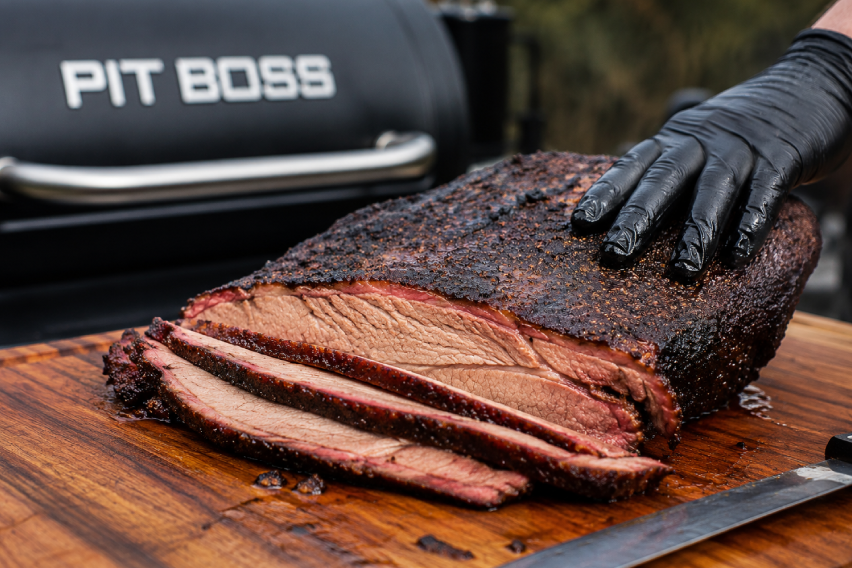
Brisket is unforgiving of shortcuts in a way that other cuts aren’t. A chicken breast you pull 10 degrees too early is still edible. Brisket pulled too early is shoe leather. But when brisket comes off the Pit Boss exactly right — the flat sliceable and moist, the point falling apart, the smoke ring pink through the first quarter inch of meat, the bark dark and slightly crusty on the outside — it’s worth every hour it took.

This guide covers everything from buying the right brisket to slicing it correctly. Read through it completely before you start. Brisket is the one cook where you really need to understand the full picture before the meat hits the grill.

Choosing the Brisket

Brisket is a primal cut from the lower chest of the cow. The full packer brisket includes two distinct muscles: the flat (the leaner, thinner portion that most people picture when they think of brisket slices) and the point (sometimes called the deckle — a thicker, fattier muscle that sits on top of the flat and is the source of burnt ends if you’re making them separately).

Buy the full packer, not just the flat. A flat-only brisket cooked on a smoker almost always dries out because it lacks the fat protection of the point. The full packer allows the point’s fat cap to baste the flat during the cook. If you can only find a flat at your butcher, ask them to leave as much fat on it as possible.

Grade matters:

USDA Select is the minimum grade brisket in most grocery stores. The fat marbling is minimal and the results on a smoker are variable at best.

USDA Choice is what most competition pitmasters use and what you should aim for. Better marbling, more moisture in the flat, more consistent results.

USDA Prime is the top tier, with the most fat marbling. If you can find it at a price you’re comfortable with, it’s worth it — the additional intramuscular fat makes the flat significantly more forgiving during the long cook.

Wagyu brisket exists and is extraordinary if you have the budget. It’s also expensive enough that most people rightfully decide to get their technique sorted on Choice grade before spending Wagyu money.

Size: A full packer brisket typically runs 12 to 18 pounds. After trimming and shrinkage during the cook, you’ll lose roughly 30 to 40 percent of the raw weight. A 15-pound raw brisket yields approximately 9 to 10 pounds of finished meat. Plan for about ½ pound of cooked brisket per person.

Trimming the Brisket

This step takes 15 to 20 minutes and makes a meaningful difference to the finished result. Don’t skip it.

The fat cap — the thick layer of fat on one side of the brisket — needs to be trimmed down to approximately ¼ inch thick. This is enough fat to protect the flat during the cook and render down into flavor. More than ¼ inch and the fat doesn’t fully render, leaving a waxy, unpleasant layer. Less than ¼ inch and you lose the protection.

Smoking Brisket on a Pit Boss Pellet Grill — How to Actually Get It Right

Use a sharp boning knife or a flexible fillet knife. A dull knife on a brisket is genuinely dangerous because you end up using more pressure and losing control. Sharp knife, slow careful strokes.

Also trim off any hard, white fat chunks that you can see — particularly on the sides and underneath where the flat and point meet. Hard fat doesn’t render well and should be removed.

The brisket will look uneven after trimming. That’s fine. You’re going for a consistent fat cap thickness, not cosmetic perfection.

The Rub

Brisket in Texas — where the smoked brisket tradition is most deeply established — is cooked with nothing but salt and coarse black pepper. This “SPG” (salt, pepper, garlic) approach lets the beef flavor and the smoke do the talking, and it produces extraordinary results.

Classic Texas rub:

  • 2 parts kosher salt
  • 2 parts coarse black pepper (16 mesh is the standard — this is the grind you want, not fine ground)
  • 1 part garlic powder (optional, but most pitmasters include it)

Mix and apply generously to every surface of the brisket. Be more generous than you think is necessary — the brisket is a large piece of meat and a thin application of rub disappears into the bark without contribution.

Some people add additional spices — smoked paprika, onion powder, cayenne. These all work. But if this is your first brisket on the Pit Boss, start simple. Understand what the beef and smoke taste like together before you start adding complexity.

Apply the rub and let the brisket sit at room temperature for 30 minutes before it goes on the grill, or apply the rub the night before and refrigerate overnight uncovered. The overnight approach helps develop bark by drying the surface slightly.

Pellet Selection

Brisket is the cook where oak or hickory belongs.

Post oak: The traditional Texas smoke wood. Medium intensity, slightly nutty, no sweetness. Post oak complements beef without fighting it and has been the pit wood at the great Texas barbecue joints for generations. If you can find post oak pellets, use them.

Hickory: Stronger than oak, with a more pronounced smoke flavor. Works extremely well with brisket. If this is your first brisket cook, hickory produces the “this smells like barbecue” smoke that most people associate with the style.

Oak and cherry blend: Some pitmasters use a 70/30 oak and cherry blend. The cherry adds a slight sweetness and a darker bark color without changing the fundamental beef-and-oak flavor profile.

Avoid: Fruit woods alone (apple, peach) on brisket — they’re too mild for a 12-hour cook and the smoke flavor gets lost. Mesquite has too much intensity for a cook this long and can produce a bitter result.

Setting Up the Pit Boss

Fill the hopper completely. A brisket cook will run 12 to 16 hours. You’ll probably need to refill the hopper at least once — check it every 4 to 5 hours and refill before it runs low. Running out of pellets mid-cook and having the temperature drop significantly is the mistake you most want to avoid.

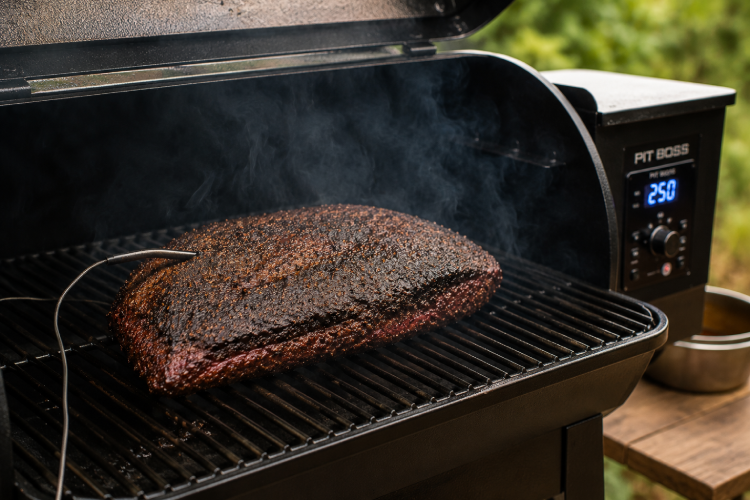
Temperature: 225°F to 250°F. This is the cooking temperature you’ll maintain through the majority of the cook. Some pitmasters cook entirely at 225°F for maximum smoke absorption. Some cook at 250°F to shorten the overall time slightly. 225°F gives you more time in the smoke and a slightly more pronounced smoke flavor; 250°F shaves an hour or two off the total time. Both approaches produce excellent brisket.

Let the Pit Boss fully preheat to temperature before the brisket goes on. This takes 15 to 20 minutes. Make sure you’re at stable temperature, not still climbing.

Read our full Pit Boss Grill Review!

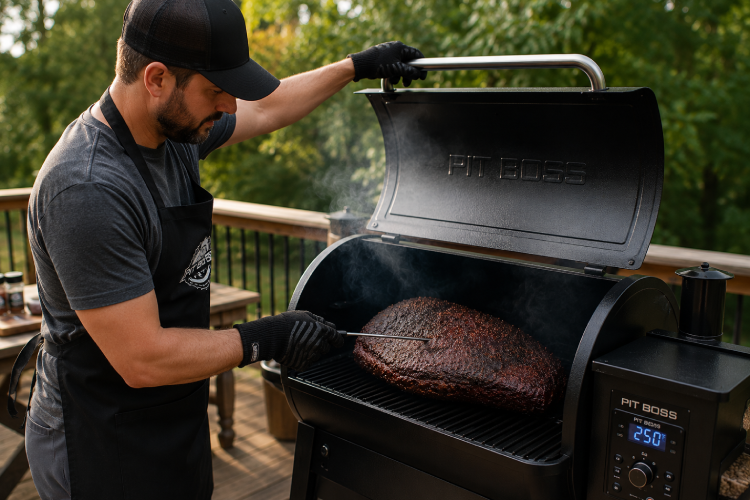
Probe placement: Insert a leave-in probe thermometer into the thickest part of the flat, angled toward the center of the muscle. This is where the flat is slowest to cook and where you’re going to track the temperature through the stall and to the finish.

Placement on the grates: Put the brisket fat-side up or fat-side down? This is one of the most argued questions in barbecue. Fat-side up lets the rendering fat baste the meat as it drips down. Fat-side down creates a barrier between the direct heat from below and the flat. On a Pit Boss pellet grill with its convection-style heat, the heat source isn’t primarily from below the way it is on an offset smoker, so fat-side up works well and is the common recommendation.

The Cook — Phase by Phase

Phase 1: The Smoke (225°F, first 4 to 6 hours)

This is where the magic happens. The brisket is absorbing smoke at maximum efficiency during this phase because the surface is still cool and moist enough to attract smoke particles. Don’t open the lid unnecessarily during this phase — every lid lift drops the temperature 25 to 30°F and extends the cook time. Trust the process.

The bark is beginning to form during this phase. You’ll see the surface darken from the rub and the smoke exposure. This is good. You’re building the exterior crust that’s the defining feature of great smoked brisket.

Phase 2: The Stall

At some point between 150°F and 175°F internal temperature, the thermometer will stop moving. It will sit at the same temperature for what can feel like an alarming amount of time — sometimes 2 hours, sometimes 4 hours. This is completely normal and has a known explanation.

As the surface of the brisket heats up, moisture inside the meat migrates to the surface and evaporates. The energy being put into the brisket by the grill is being consumed entirely by this evaporative cooling effect — the same reason sweating keeps you cool on a hot day. The temperature isn’t rising because the energy balance is in equilibrium.

The stall resolves on its own. You can wait it out, or you can wrap the brisket at this point (see below).

Phase 3: The Wrap (optional but recommended)

Most pitmasters wrap the brisket in butcher paper or foil when it hits the stall (approximately 160°F to 165°F internal). Wrapping traps the heat and eliminates the evaporative cooling effect, pushing the brisket through the stall more quickly and protecting the bark from over-darkening during the remainder of the cook.

Butcher paper vs foil:

Butcher paper (specifically pink or peach unlined butcher paper, not wax paper) is the preferred wrapping method for most competition pitmasters. It breathes slightly, allowing some moisture to escape while still accelerating the cook. The bark holds up better through a butcher paper wrap than through foil.

Smoking Brisket on a Pit Boss Pellet Grill — How to Actually Get It Right

Foil (the “Texas crutch”) wraps tighter and accelerates the cook more aggressively. It can soften the bark if you wrap too early or leave it wrapped too long. The benefit is a more braised, tender result — some people prefer this.

To wrap: pull the brisket, place it on two overlapping sheets of butcher paper (or heavy-duty foil) fat-side down, pour a small splash of beef tallow or melted butter on top if you have it, and wrap tightly. Return to the grill.

Phase 4: The Finish

After wrapping, the temperature will begin rising again. You’re now cooking to probe tenderness, not just temperature. The target internal temperature for the flat is 200°F to 205°F, but temperature is the starting point for the probe test, not the finish line.

The probe test: Push the instant-read thermometer probe into the thickest part of the flat. It should slide in with essentially no resistance — like inserting a probe into room temperature butter. If you feel any resistance at all, the brisket isn’t ready. Put it back on for another 30 minutes and test again. This “probe tender” test is how you know the collagen has fully converted to gelatin and the brisket will actually slice and eat the way you want it to.

A brisket that tests probe tender at 195°F is done. A brisket that still has resistance at 210°F needs more time. The thermometer reading is a guideline; the probe feel is the actual indicator.

The Rest — The Most Important Step

More than any other cut of meat, brisket needs a proper rest. A minimum of 1 hour. Two hours is better. Some competition pitmasters rest brisket for 4 to 8 hours in a cambro cooler.

Here’s why this matters: brisket is full of collagen that has converted to gelatin during the long cook. This gelatin is what makes the meat moist and gives it that characteristic sticky richness. During the rest period, this gelatin sets slightly and the juices redistribute throughout the muscle. Cut into a brisket immediately off the grill and the juices run out and the gelatin hasn’t set — you get dry, stringy slices. Rest the brisket properly and you get slices that hold together and release moisture in your mouth rather than onto the cutting board.

How to rest: Wrap the brisket (still in its butcher paper or foil) in a towel and place it in a cooler. The insulation keeps it at safe serving temperature for 4 to 6 hours without any refrigeration needed. This is the hack that allows you to finish the brisket ahead of time without serving it cold.

Slicing

This is the final step that most people rush and it matters more than most people expect.

Separate the flat and the point before slicing. The flat and point have different grain directions, and you need to slice against the grain of each independently. Slicing with the grain produces chewy, stringy slices; slicing against the grain cuts through the muscle fibers and gives you tender slices.

Find the grain direction of the flat and slice perpendicular to it in ¼-inch thick slices. These are your primary brisket slices.

The point can be sliced similarly or cubed into burnt ends. Burnt ends — cubed, sauced, and returned to the smoker for another hour — are arguably the best thing that comes from a whole packer brisket.

Quick Reference

  • Best cut: Full packer, USDA Choice or Prime
  • Trim fat cap to: ¼ inch
  • Rub: Kosher salt, coarse black pepper, garlic powder
  • Pellets: Post oak, hickory, or oak-cherry blend
  • Cook temperature: 225°F to 250°F
  • Wrap at: 160°F to 165°F internal (butcher paper preferred)
  • Done temperature: 200°F to 205°F, probe tender
  • Rest time: Minimum 1 hour, 2 hours preferred

How to Smoke a Turkey on a Pit Boss Pellet Grill — The Complete Guide

By Posted on 0 Comments8min read0 views

How to Smoke a Turkey on a Pit Boss Pellet Grill — The Complete Guide

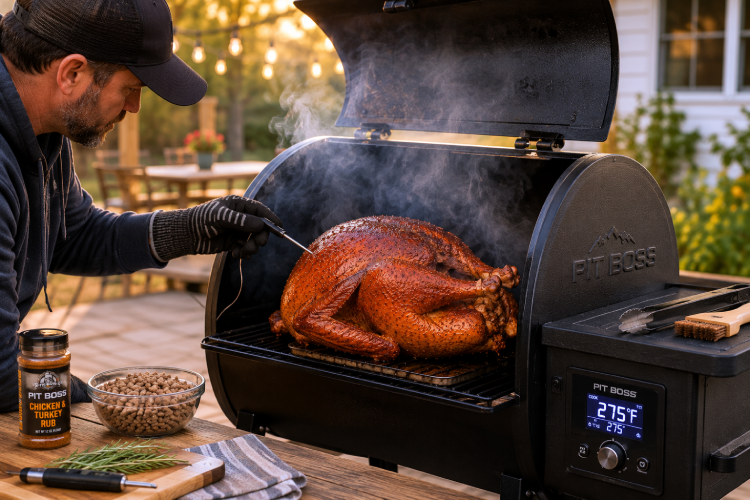
How to Smoke a Turkey on a Pit Boss Pellet Grill — Everything You Need to Know

Let me be honest with you about something before we get into any of this. Smoked turkey gets a bad reputation in a lot of households because someone, at some point, pulled a dried-out bird off a grill and declared the whole idea a mistake. That reputation is completely undeserved and almost always the result of two problems — no brine, and cooking too hot for too long without any attention to internal temperature.

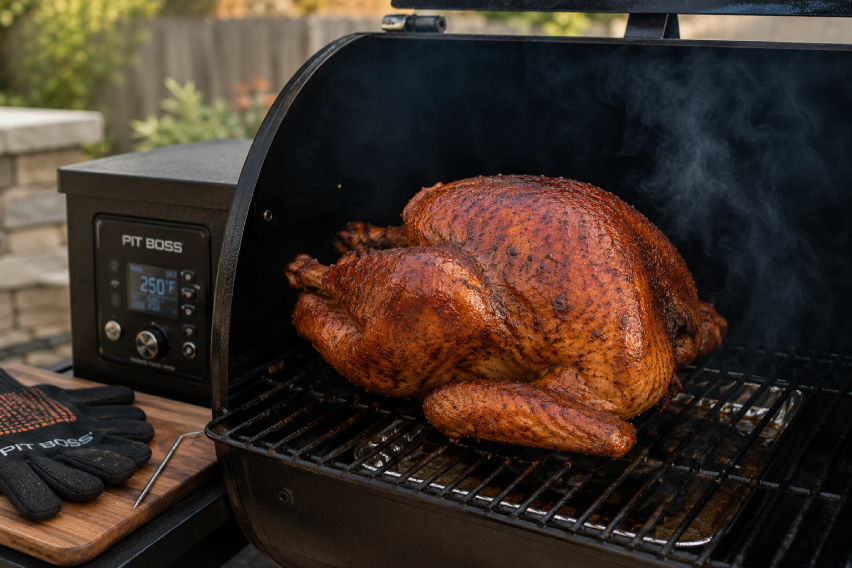
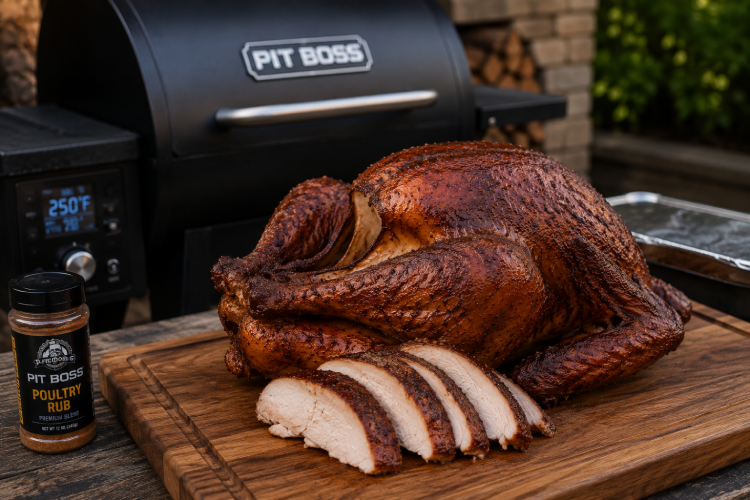
Get those two things right and a smoked turkey from a Pit Boss is genuinely one of the most impressive things you can put on a table. The smoke that gets into the skin and the meat during a low and slow cook does something to a turkey that oven roasting simply can’t replicate. You get this mahogany color on the outside, a faint smokiness in every bite, and — if the brine did its job — meat that’s actually moist rather than the chalky dry texture that’s ruined so many Thanksgiving memories.

So let’s talk about how to actually do this correctly.

Choosing the Right Turkey

Size matters on a pellet grill in a way it doesn’t in an oven, and this is the first decision most people don’t think carefully enough about.

A 12 to 15 pound turkey is the sweet spot for smoking. It fits comfortably on most Pit Boss grill grates with clearance for the lid, it takes 4 to 5 hours at smoking temperature, and it cooks evenly without the dramatic temperature difference between breast and thigh that larger birds develop. A 20-pound bird is manageable but requires more patience and more attention to ensure the thigh comes up to temperature before the breast dries out.

If you’re feeding a big group, smoke two 12-pound turkeys rather than one 22-pounder. Two smaller birds give you more surface area for smoke penetration, cook in less time, and carve into more manageable portions.

Fresh vs frozen: If you’re using frozen, give it a full 24 hours in the refrigerator for every 4 to 5 pounds of bird. A 14-pound turkey needs at least 3 days to fully thaw in the fridge. Partially thawed turkey going onto the grill is a food safety issue and a cooking nightmare — the outside will cook and dry out while the inside is still fighting to come to safe temperature.

The Brine — Don't Skip This

This is non-negotiable. Turkey is lean meat with very little fat marbling to protect it during a long cook. Without a brine, even a carefully cooked smoked turkey can finish dry. With a brine, you’ve given the meat a fighting chance.

Simple wet brine:

  • 1 gallon cold water
  • 1 cup kosher salt (not table salt — it’s too fine and too salty by volume)
  • ½ cup brown sugar
  • 2 tablespoons black peppercorns
  • 4 cloves garlic, smashed
  • Fresh herbs if you have them — thyme and rosemary work well
  • Optional: 1 orange cut in half, squeezed and dropped in

Dissolve the salt and sugar in a cup of hot water first, then add everything to the cold water. Submerge the turkey completely. If the bird floats, weight it down with a plate. Brine in the refrigerator for at least 12 hours and up to 24 hours. Longer than 24 hours and you start to get an unpleasantly salty result.

How to Smoke a Turkey on a Pit Boss Pellet Grill — Everything You Need to Know

After brining, remove the turkey, rinse it thoroughly under cold water, and pat it completely dry with paper towels. This is important — wet skin doesn’t crisp. Dry skin crisps.

Some people prefer a dry brine, which is exactly what it sounds like: rub kosher salt generously all over the bird, including under the skin if you can get your hand in there, and let it sit uncovered in the refrigerator for 24 to 48 hours. The salt draws out moisture, which then reabsorbs back into the meat along with the salt. Same principle, different process. Dry brining also dries the skin out beautifully for crispy results.

Pellet Selection

This is one of those decisions that sounds complicated and really isn’t. Turkey is mild enough that it takes smoke flavor well without being overwhelmed by it, which gives you some flexibility.

Apple wood pellets are the most popular choice for poultry and with good reason. The smoke is sweet, mild, and slightly fruity. It complements the turkey without dominating it. Apple is hard to go wrong with.

Cherry wood pellets give you a slightly deeper color on the skin — that dark mahogany look that makes a smoked turkey look like it belongs on a magazine cover. The smoke flavor is similar to apple but with a little more depth. Cherry and apple mixed is one of the classic poultry combinations.

Pecan pellets are a Texas tradition with poultry. Slightly nuttier smoke, more pronounced than apple but still solidly in the medium category. Works extremely well with turkey.

Hickory or mesquite: Use with caution. Both are heavy smoke woods that can overpower turkey meat during a long cook. If you love the idea of hickory, mix it 50/50 with apple to soften the intensity.

Setting Up Your Pit Boss

Start by filling the hopper completely. A whole turkey takes 4 to 6 hours and you don’t want to be refilling pellets mid-cook.

Temperature: Start at 225°F for the first 2 to 3 hours. This is where the smoke absorption happens — low temperature, maximum time for smoke to penetrate the meat. After 2 to 3 hours, bump it up to 325°F to finish. This higher heat crisps the skin, which stays soft and rubbery if you cook the entire bird at 225°F.

Turn on your Pit Boss and let it fully preheat before the bird goes on — this takes about 15 minutes. Make sure the grates are clean. Clean grates mean better heat distribution and no residual flavors from whatever you cooked last time.

Drip pan: Place a drip pan on the lower rack or directly below the turkey with about a cup of chicken broth in it. This does two things — it catches drips that would otherwise cause flare-ups, and the moisture from the simmering broth helps maintain a slightly humid cooking environment that protects the breast meat from drying out.

Prepping the Bird

Remove the giblets from the cavity — the turkey usually comes with a bag tucked inside the body cavity and sometimes one inside the neck cavity. Check both. Giblets going onto the grill with the turkey won’t ruin anything but they’re wasted space.

Spatchcocking (optional but worth considering): Removing the backbone and flattening the turkey before smoking is the move that solves almost every turkey problem simultaneously. The bird cooks in half the time, the skin across the entire surface gets equal exposure to heat, and the breast and thigh reach finished temperature at nearly the same time rather than the breast drying out while you wait for the thigh.

To spatchcock: place the turkey breast-side down, use heavy-duty kitchen shears to cut along both sides of the backbone and remove it. Flip the bird breast-side up and press firmly on the breastbone until you hear a crack and the bird lies flat. That’s it. Simple, and it transforms the cooking result.

Butter under the skin: Slide your hand between the breast skin and the breast meat and create a pocket. Push softened butter mixed with garlic, thyme, and a pinch of salt directly onto the breast meat. As the turkey cooks, the butter melts into the breast meat and keeps it moist while adding flavor that dry rubs on the outside can’t deliver into the meat itself.

Exterior rub: Mix together:

  • 2 tablespoons olive oil
  • 1 tablespoon kosher salt
  • 1 teaspoon black pepper
  • 1 teaspoon garlic powder
  • 1 teaspoon onion powder
  • 1 teaspoon smoked paprika
  • ½ teaspoon dried thyme
  • ½ teaspoon dried rosemary

Rub this over every exposed surface of the turkey. Work it into every crease and cavity.

The Cook

Whole turkey cook timeline (12–14 lb bird):

Smoke at 225°F for approximately 2 to 3 hours, then increase to 325°F until finished. Total time: 4 to 5 hours.

Spatchcocked turkey cook timeline:

Cook entirely at 325°F. Total time: 2 to 2.5 hours.

These are guidelines, not guarantees. Every turkey is different, every grill runs slightly differently, and ambient temperature affects cook time. The only thing that tells you the turkey is done is a thermometer.

Target temperatures:

  • Breast meat: 165°F — this is the USDA safe temperature. If you want juicier breast meat, pull at 160°F and let carryover cooking finish the job during the rest period.
  • Thigh meat: 175°F — the thigh is dark meat with more collagen, and it actually benefits from a slightly higher temperature to break that collagen down into gelatin. A thigh pulled at 165°F can be slightly chewy.

Insert the thermometer probe into the thickest part of the breast without touching bone for the breast reading, and into the thickest part of the thigh (avoiding the bone) for the thigh reading.

How to Smoke a Turkey on a Pit Boss Pellet Grill — Everything You Need to Know

The stall: You may notice the internal temperature stops rising somewhere around 150°F to 155°F and just sits there for 30 to 45 minutes. Don’t panic. This happens because moisture evaporation from the surface of the meat cools it at the same rate the heat is adding to it. It resolves on its own. Don’t crank the heat trying to push through it.

The Rest

This is the step that most people skip because the turkey looks done and the family is hungry. Don’t skip it.

Pull the turkey from the grill when the thigh hits 175°F. Tent it loosely with foil and let it rest for at least 20 to 30 minutes before carving. During this rest period, the temperature inside the bird continues to rise slightly (carryover cooking) and the juices that have been driven toward the center of the meat by heat redistribute back through the muscle fibers. Cut into a turkey immediately off the grill and those juices run out onto the cutting board. Rest the turkey first and they stay in the meat.

Carving and Serving

Remove the legs by cutting through the joint where the thigh meets the body — it should separate easily if the turkey is fully cooked. Separate the thigh from the drumstick the same way.

For the breast meat, slice parallel to the breastbone rather than across it. This cuts with the grain of the breast meat rather than against it, which gives you longer, cleaner slices.

The smoked turkey will have a pink ring just below the skin — the smoke ring. This is not undercooked meat. It’s a chemical reaction between the smoke compounds and the myoglobin in the muscle. It’s actually the visual evidence that your smoke penetrated the meat, which is exactly what you want.

Quick Reference

  • Bird size: 12 to 15 pounds ideal
  • Brine: Minimum 12 hours, maximum 24
  • Pellets: Apple, cherry, or pecan
  • Temperature: 225°F for 2–3 hours, then 325°F to finish
  • Breast done: 165°F internal
  • Thigh done: 175°F internal
  • Rest time: 20 to 30 minutes minimum

Fabrique Fashion Review – Designer Fashion That Delivers Impressive Value

Fabrique Fashion Review – Designer Fashion That Delivers Impressive Value

Get 15% Off On Your All Orders

Get 15% Off On Your All Orders

Get 15% Off On Your All Orders
FBRQ15
SHOW COUPON
On Going Offer
  • It Works 100% Success It Doesn’t
  • Get 10% Off On Your All Purchases

    Get 10% Off On Your All Purchases

    Get 10% Off On Your All Purchases
    ToAmy10
    SHOW COUPON
    On Going Offer
  • It Works 100% Success It Doesn’t
  • Signup & Get 15% Off On Your First Order

    Signup & Get 15% Off On Your First Order

    Signup & Get 15% Off On Your First Order
    ACTIVATE DEAL
    On Going Offer
  • It Works 100% Success It Doesn’t
  • Get Free Shipping On Order Over $200

    Get Free Shipping On Order Over $200

    Get Free Shipping On Order Over $200
    ACTIVATE DEAL
    On Going Offer
  • It Works 100% Success It Doesn’t
  • Sale! Save Upto 50% Off On Selective Items

    Sale! Save Upto 50% Off On Selective Items

    Sale! Save Upto 50% Off On Selective Items
    ACTIVATE DEAL
    On Going Offer
  • It Works 100% Success It Doesn’t
  • Shop Our New In Collection Starting From $68

    Shop Our New In Collection Starting From $68

    Shop Our New In Collection Starting From $68
    ACTIVATE DEAL
    On Going Offer
  • It Works 100% Success It Doesn’t
  • Checkout Our Bestsellers Collection Starting From $78

    Checkout Our Bestsellers Collection Starting From $78

    Checkout Our Bestsellers Collection Starting From $78
    ACTIVATE DEAL
    On Going Offer
  • It Works 100% Success It Doesn’t
  • Explore Our Jackets & Blazers Collection Starting From $245

    Explore Our Jackets & Blazers Collection Starting From $245

    Explore Our Jackets & Blazers Collection Starting From $245
    ACTIVATE DEAL
    On Going Offer
  • It Works 100% Success It Doesn’t
  • Fabrique Fashion Review - Designer Fashion That Delivers Impressive Value

    Fabrique offers a refreshing alternative for shoppers who appreciate designer-led fashion but do not necessarily want to pay traditional luxury-house prices.

    Instead of presenting one fixed brand aesthetic, Fabrique works as a global designer collective. Its platform brings together more than 350 fashion creatives, allowing customers to discover clothing and accessories shaped by different design backgrounds, inspirations and creative perspectives. Every collection feels slightly different, yet the overall selection remains polished, modern and thoughtfully curated.

    The brand became even more noteworthy in 2026 through its ready-to-wear collaboration with Vera Wang. The Spring/Summer 2026 capsule launched on March 18 and introduced Vera Wang’s recognisable design language through a more accessible contemporary fashion format.

    For shoppers seeking distinctive silhouettes, premium-looking fabrics and named designer involvement without entering the highest luxury price bracket, Fabrique presents a strong value proposition.

    Quick Highlights

    • ✅ Global designer collective featuring more than 350 creatives
    • ✅ Individual products are connected to named designers and their creative vision
    • ✅ Exclusive Vera Wang x Fabrique Spring/Summer 2026 collaboration
    • ✅ Broad range of dresses, denim, shirts, matching sets, tailoring and leather bags
    • ✅ Contemporary designer pricing that remains below many established luxury labels
    • ✅ Strong selection of elevated wardrobe essentials and statement pieces
    • ✅ Leather bags available in suede, calfskin, Nappa and top-grain leather
    • ✅ New collections and designer-led arrivals added regularly
    • ✅ Free shipping promotions available on the official website
    • ✅ Newsletter subscribers can receive 15% off their first purchase
    • ✅ Loyalty rewards can provide coupons worth up to $50
    • ✅ Seasonal promotions can make designer pieces even more accessible

    Fabrique’s official store currently highlights free shipping, a 15% newsletter discount and a loyalty programme offering coupons of up to $50.

    Best for: Style-conscious shoppers who want original designer fashion, premium materials and more exclusivity than mainstream contemporary brands, while spending considerably less than they might at traditional luxury fashion houses.

    About Fabrique

    Fabrique describes itself as a designer-collective brand rather than a conventional fashion label. Instead of relying on one creative director to define every collection, the platform collaborates with hundreds of designers from different regions and fashion backgrounds.

    This approach creates a diverse catalogue that can include romantic occasion dresses, architectural tailoring, experimental denim, relaxed wardrobe essentials, sculptural knitwear and refined leather accessories.

    The designer’s name is often displayed alongside the product, giving shoppers greater insight into the person and creative idea behind the garment. This adds a sense of provenance that is often missing from mass-market fashion.

    Fabrique’s catalogue currently includes:

    • Designer dresses
    • Shirts and blouses
    • Jeans and denim
    • Skirts and trousers
    • Matching sets
    • Blazers and jackets
    • Trench coats
    • Knitwear
    • Coats
    • Shoulder bags
    • Hobo bags
    • Totes
    • Mini bags and leather accessories

    The official site continues to release new pieces from its global creative network and describes its collections as exclusive designs produced in collaboration with more than 350 designers.

    Fabrique Review: Full Breakdown

    The Designer-Collective Concept

    Fabrique’s greatest strength is its ability to offer multiple designer perspectives through one shopping platform.

    Most fashion retailers either sell products from established third-party brands or create everything through one internal design team. Fabrique follows a different model. Independent designers contribute individual collections and products, while the platform provides the shared development, manufacturing and retail infrastructure.

    This means customers are not limited to one repeated seasonal aesthetic. One designer may specialise in soft draping and romantic dresses, while another may focus on tailoring, leather accessories or unconventional denim.

    The result is a collection that feels varied but still intentionally curated.

    For customers, the model provides several benefits:

    • Greater design variety
    • Access to named creative talent
    • More distinctive silhouettes
    • Limited-feeling capsule collections
    • Designer storytelling attached to individual products
    • A broader choice than a traditional single-designer label

    The platform is particularly appealing to shoppers who enjoy discovering new designers but prefer the convenience of purchasing through one central store.

    Vera Wang x Fabrique

    The Vera Wang collaboration is one of the strongest reasons to explore Fabrique in 2026.

    The Spring/Summer 2026 ready-to-wear capsule was designed to present Vera Wang beyond bridal fashion, translating her aesthetic into modern wardrobe pieces. The collection officially launched on March 18, 2026.

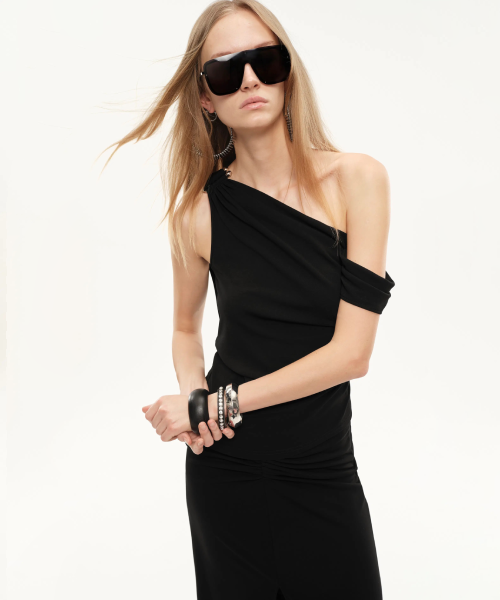
    The collaboration includes contemporary separates and dresses that combine sculptural shapes, asymmetry, layering and Vera Wang’s signature approach to understated drama.

    Current Fabrique listings include Vera Wang collaboration pieces such as:

    • Asymmetric pleated dresses
    • Layered accordion dresses
    • Cotton denim
    • Draped skirts and tops
    • Knit dresses
    • Silk statement pieces

    Examples listed by Fabrique include Vera Wang dresses around $428, with more elaborate silk designs reaching approximately $578 before promotional discounts.

    Compared with the pricing of many established luxury designer collections, this gives customers an opportunity to experience Vera Wang’s design language at a much more approachable price level.

    Best for. Shoppers who admire Vera Wang’s modern, architectural and minimalist aesthetic but want something suitable for everyday, evening or occasion wear rather than bridal fashion.

    Verdict. The collaboration strengthens Fabrique’s credibility as a serious designer platform and offers meaningful value for customers who want a recognisable luxury design perspective at contemporary pricing.

    Quality and Materials

    Fabrique’s selection includes a wide range of fabrics and construction techniques. Current product listings feature materials such as:

    • Silk and silk blends
    • Linen and linen blends
    • Cotton jacquard
    • Cotton-cashmere blends
    • Tencel and lyocell
    • Acetate blends
    • Merino wool
    • Alpaca blends
    • Calfskin leather
    • Nappa leather
    • Suede
    • Top-grain leather

    Many products also include design details such as hand-painted prints, embroidery, smocking, pleating, lacework, draping and asymmetric construction.

    For example, Fabrique’s dress collection currently includes hand-painted silk-linen organza, crinkled silk blends, cotton jacquard, embroidered lace and structured lightweight fabrics.

    These fabric choices and finishing details help distinguish the brand from basic high-street fashion.

    Best Fabrique Products Worth Buying

    The Vera Wang capsule is ideal for customers seeking statement fashion with established designer credibility.

    Top Features

    • Recognisable Vera Wang design direction
    • Modern asymmetrical silhouettes
    • Sculptural layering and draping
    • Dresses, separates and denim options
    • Contemporary pricing compared with traditional luxury collections
    • Exclusive availability through Fabrique

    Best for. Evening dressing, creative events, modern occasion wear and customers building a more directional wardrobe.

    Verdict. This is Fabrique’s most significant collaboration and one of the clearest examples of the value available through its designer-collective model.

    Fabrique’s leather bag collection is another standout category.

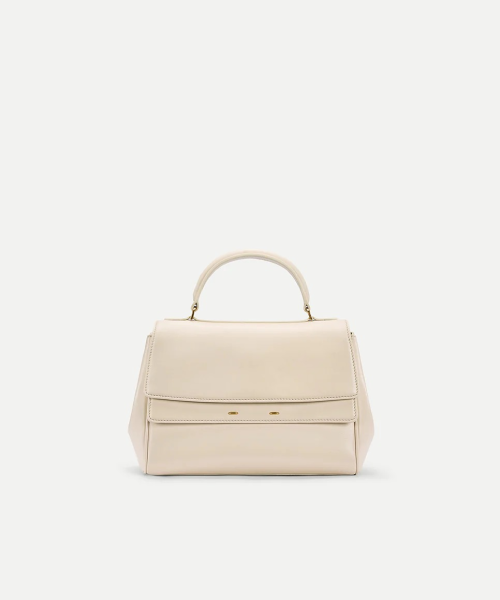
    The range includes shoulder bags, hobo bags, totes, mini bags and charms produced in materials such as Nappa calfskin, nubuck, suede and top-grain leather.

    Current prices include small leather accessories from approximately $88, mini leather bags around $198 and larger Nappa leather bags between roughly $368 and $528 before promotional discounts.

    Top Features

    • Genuine leather constructions
    • Soft Nappa and suede options
    • Distinctive sculptural silhouettes
    • Designs credited to individual creatives
    • Practical shoulder, tote and hobo formats
    • Pricing below many established luxury handbag houses

    Best for. Customers looking for an everyday designer bag that feels more distinctive than a standard department-store accessory.

    Verdict. The bags offer an attractive balance of material quality, original design and accessible luxury positioning.

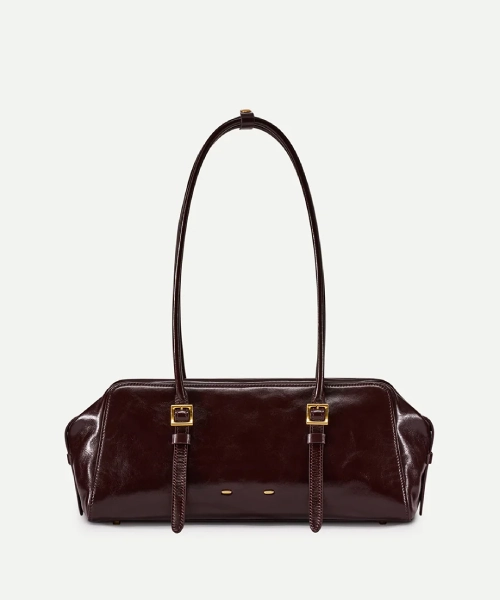
    There are bags you buy for now, and bags you buy for the next ten years. The Monti is firmly the second kind.

    Sophie Jousse spent years at Hermès, Celine, and Fendi before bringing her craft to Fabrique — and that background shows in every detail of this bag. The silhouette is clean and elongated, the hardware refined, and the leather genuinely exceptional. Treated through oil tanning, triple waxing and hand-polishing, it develops its own unique patina over time. Scratches soften. Markings become character. The bag you carry in five years will look better than the one you unboxed on day one.

    Named after Rome’s most creative neighbourhood, the Monti carries that same quiet confidence — sophisticated without trying too hard.

    Top Features:

    • Oil-tanned, triple-waxed European top-grain leather that ages beautifully
    • East-west baguette silhouette — lightweight, structured and everyday-practical
    • 18K gold vacuum-plated “gold bean” studs and column-inspired adjustable handles
    • Back hidden magnetic pocket + inner zip pocket
    • Available in 5 colours: Midnight, Ruby, Burgundy, Dark Brown, Golden Brown

    Verdict: Crafted with a level of material intelligence that’s rare at this price point, the Monti is the kind of bag that outlasts trends, wardrobes, and almost everything else you’ll ever buy.

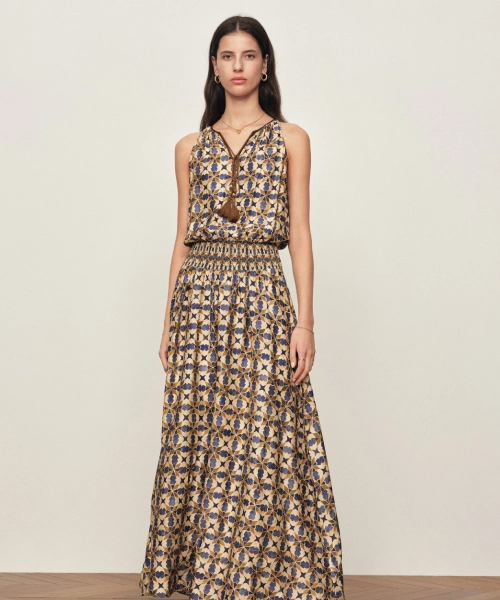
    Some dresses are bought for one occasion. The Jocelyn is the kind you reach for again and again — the holiday dinner, the summer wedding, the evening that starts casual and ends late.

    Designed by Jeanne Labib-Lamour — former creative director at La DoubleJ and BALLY — the Jocelyn draws inspiration from the hand-painted tilework of Southern Italian villas. The result is a print that’s rich and distinctive without being overwhelming, paired with a handcrafted beaded tassel tie and a shirred waist that moves with you rather than restricting you.

    The crinkled silk blend fabric is lightweight, breathable, and naturally wrinkle-resistant — which means it travels beautifully and looks effortless without any effort at all.

    Top Features

      • Crinkled silk blend (56.4% Modal, 29% Viscose, 14.6% Silk) — breathable and wrinkle-resistant
      • Shirred elasticated waist — flattering and adjustable across sizes
      • Handcrafted beaded tassel tie for an artisanal finish
      • Southern Italian tile-inspired print by a former La DoubleJ creative director
      • Full inner lining for comfort and coverage

    Verdict: A summer dress that earns its price through thoughtful design, premium fabric and a print you genuinely won’t find anywhere else.

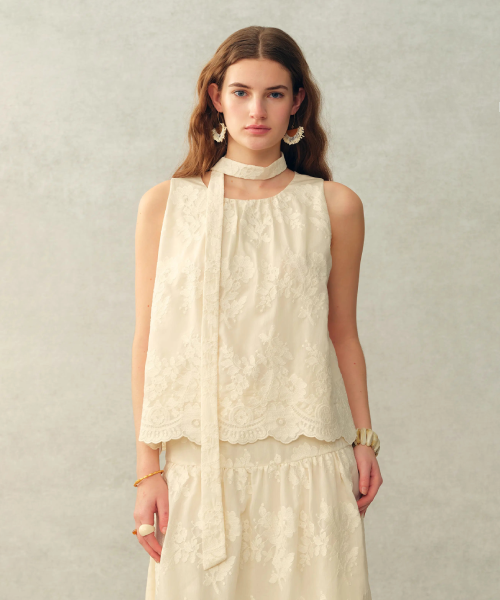
    Fabrique’s matching sets provide a simple way to achieve a complete designer look.

    Coordinated tops, skirts, trousers and knit pieces are designed to work together but can also be separated and styled with existing wardrobe items.

    Top Features

    • Complete coordinated styling
    • Pieces can be worn separately
    • Useful for work, holidays and events
    • Strong cost-per-wear potential
    • Distinct designer identity
    • Easy transition from day to evening

    Best for. Shoppers who want a polished outfit without spending additional time combining separate pieces from different brands.

    Verdict. Because both pieces can be styled independently, matching sets can provide particularly good wardrobe value.

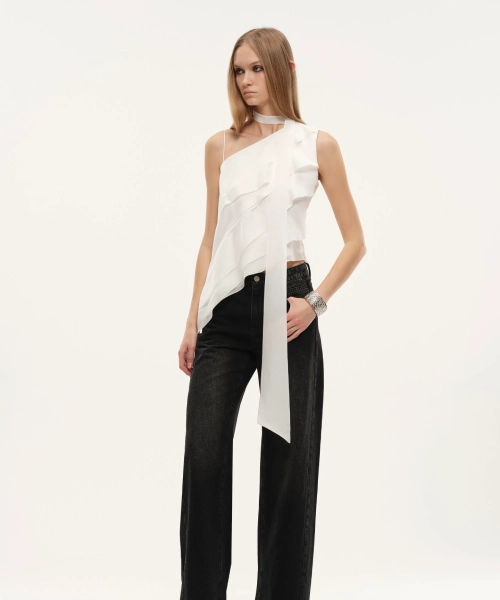
    Vera Wang built her name on the idea that clothing can feel like an occasion in itself. The Veil Ruffle Top takes that philosophy and sets it free from the aisle entirely.

    Crafted from mulberry silk and acetate blended tulle, cut on the bias and layered into cascading ruffles, this top catches light the way evening gowns do — yet somehow never feels overdressed. The asymmetric lines, trailing shoulder ties and adjustable belt give it a sense of movement and intention that’s hard to put into words until you’re actually wearing it.

    The construction is genuine couture technique applied to ready-to-wear — oblique cutting, impermeable lining, hidden zip closure. These are not fast-fashion details. This is a top designed by someone who has spent a lifetime thinking about how clothes move on a body.

    Top Features

    • Mulberry silk and acetate blended tulle (68% Acetate, 23% Silk, 9% Polyester)
    • Bias-cut oblique construction — a genuine haute couture technique
    • Cascading multilevel ruffles with asymmetric diagonal shoulder design
    • Adjustable thin belt for a customisable fit
    • Impermeable lining — sheer layers look intentional, not revealing
    • Exclusive to Vera Wang x Fabrique SS26 collection

    Verdict: Paired with tailored trousers or dark denim, the Veil top elevates everything around it. Genuine Vera Wang vision at a fraction of traditional luxury pricing — one of Fabrique’s most compelling pieces this season.

    Fabrique also offers shirts, jeans, skirts and everyday separates with more design detail than ordinary wardrobe basics.

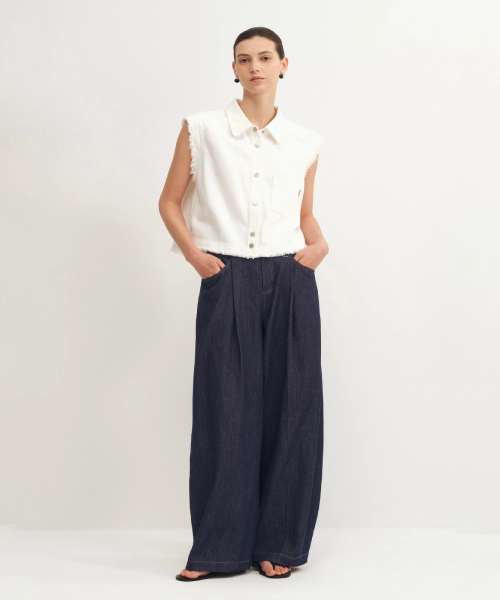
    Popular listings include puff-sleeve shirts, transparent burnout denim, barrel-leg jeans, embroidered tops and draped trousers. Current examples generally fall within approximately $158 to $298 before sale pricing.

    Top Features

    • Fashion-forward denim washes and finishes
    • Contemporary fits
    • Elevated everyday shirts
    • Easy integration into existing wardrobes
    • Lower entry prices than dresses and outerwear
    • Individual designer credits

    Best for. First-time Fabrique customers who want to experience the brand through an everyday piece before investing in a dress, coat or leather bag.

    Is Fabrique Worth It?. Fabrique is worth considering for shoppers who evaluate value through more than the lowest possible purchase price.

    Best for: Buyers looking for fashion-forward denim with a unique designer aesthetic. The Ariel Transparent Burnout Straight Cropped Jeans combine premium craftsmanship a modern straight-leg fit, and subtle burnout detailing to create a statement piece that’s easy to dress up or down.

    Top Features:​

    • Premium straight-leg cropped silhouette that offers a flattering, contemporary fit for everyday styling.
    • Distinctive transparent burnout detailing adds texture and a high-fashion edge without overpowering the design.
    • Crafted from high-quality denim with a comfortable feel and durable construction for long-lasting wear.
    • Versatile cropped length pairs effortlessly with sneakers, heels, ankle boots, and loafers across every season.
    • Designed by Fabrique Fashion, known for combining modern trends with elevated tailoring and premium materials.

    One Honest Drawback: The transparent burnout detailing gives these jeans a bold designer look, which may not suit shoppers who prefer classic, minimalist denim. Their premium construction also places them in a higher price range than standard everyday jeans.

    Verdict: The Ariel Transparent Burnout Straight Cropped Jeans are an excellent choice for anyone seeking standout designer-inspired denim. With their unique burnout finish, premium fabric, and versatile straight cropped fit, they deliver a stylish balance of comfort, quality, and contemporary fashion that justifies the investment.

    Best for: Shoppers looking for an elevated everyday blouse with a modern silhouette. The Claire Drop Shoulder High-Low Puff Sleeve Shirt blends relaxed tailoring with feminine details, making it ideal for both work and weekend wear.

    Top Features:

    • Trendy drop-shoulder design creates a relaxed yet polished look.
    • Elegant high-low hem offers extra coverage and effortless styling.
    • Statement puff sleeves add volume and a sophisticated touch.
    • Crafted from premium-quality fabric for all-day comfort and durability.
    • Designed by Fabrique Fashion with a focus on contemporary fashion and versatile wear.

    One Honest Drawback: The oversized silhouette and puff sleeves create a fashion-forward look that may not appeal to those who prefer more fitted, minimalist shirts.

    Verdict: The Claire Drop Shoulder High-Low Puff Sleeve Shirt is a stylish wardrobe essential that combines comfort, quality, and modern design. Its versatile silhouette makes it easy to pair with jeans, tailored trousers, or skirts, making it a worthwhile investment for everyday and smart-casual outfits.

    The brand offers value through:

    • Named designer involvement
    • Exclusive collections
    • More than 350 creative perspectives
    • Premium and natural fabric options
    • Detailed silhouettes and surface treatments
    • Limited-feeling pieces
    • Lower pricing than established luxury labels
    • Regular sales and first-order incentives

    A typical Fabrique dress may cost more than a mass-market garment, but it is also designed to offer more individuality, stronger materials and a clearer creative identity.

    The more relevant comparison is not inexpensive high-street fashion. Fabrique competes most naturally with contemporary and luxury designers whose dresses can cost several times more.

    Fabrique vs More Expensive Designer Competitors

    Brand

    Indicative Dress Pricing

    Design Model

    Value Position

    Fabrique

    Commonly around $238–$478; selected collaboration pieces approximately $578

    Collective of 350+ global designers

    Strong designer value at contemporary pricing

    A.L.C.

    Selected full-price dresses around €690–€795

    Established contemporary designer label

    Higher-priced contemporary fashion

    Zimmermann

    Examples around €795–€3,650

    Established luxury ready-to-wear and resort label

    Premium luxury pricing

    KHAITE

    Common examples around $1,180–$5,400

    New York luxury designer house

    Significantly higher luxury pricing

    Fabrique pricing is based on current official dress listings. Selected A.L.C. examples have been listed around €690–€795, Zimmermann dresses around €795–€3,650 and current KHAITE examples from approximately $1,180 to above $5,000.

    This comparison shows why Fabrique should be viewed as an accessible designer platform rather than an overpriced fashion retailer.

    While KHAITE and Zimmermann operate firmly within the luxury category, Fabrique provides creative silhouettes, premium materials and designer attribution at a fraction of those prices.

    How to Get the Best Value at Fabrique

    To maximise value when shopping:

    1. Subscribe to the newsletter for the available first-order discount.
    2. Review the Best Sellers section for proven customer favourites.
    3. Explore seasonal sale collections.
    4. Compare the fabric composition of individual products.
    5. Choose versatile pieces that can be styled in multiple ways.
    6. Use matching-set pieces separately to increase cost per wear.
    7. Join the rewards programme for future coupons.
    8. Check new arrivals regularly because the designer selection changes frequently.

    Fabrique currently advertises seasonal reductions of up to 50% on selected products, along with newsletter and loyalty incentives.

    Where to Buy Fabrique

    Fabrique products are available through the brand’s official online store.

    Shopping directly provides access to:

    • The widest available collection
    • Vera Wang collaboration pieces
    • New designer arrivals
    • Best-selling items
    • Seasonal sale pricing
    • Newsletter discounts
    • Loyalty rewards
    • Official product descriptions and fabric information

    Frequently Asked Questions

    Is Fabrique a legitimate fashion brand?

    Yes. Fabrique operates as a designer-collective fashion platform and works with more than 350 global designers. Its official catalogue includes clothing, leather goods, seasonal collections and the 2026 Vera Wang ready-to-wear collaboration.

    Is Fabrique a luxury brand?

    Fabrique can be described as accessible or contemporary designer fashion.

    Its use of named designers, premium fabrics, leather goods and exclusive collaborations gives it many luxury characteristics. However, its pricing remains substantially below luxury labels such as KHAITE and many Zimmermann collections.

    Why are Fabrique clothes valuable?

    The value comes from the combination of original design, individual designer involvement, premium materials and lower prices than established luxury fashion houses.

    Customers are not simply paying for a logo. They are purchasing a product connected to a particular designer and creative concept.

    How much do Fabrique dresses cost?

    Many current dresses are listed between approximately $238 and $478. Selected Vera Wang and premium silk designs may cost around $578 before promotions.

    How much do Fabrique bags cost?

    Current leather accessories begin at approximately $88, while full-size leather bags commonly range from around $198 to $528 before discounts.

    Does Fabrique offer discounts?

    The official website advertises a 15% newsletter signup discount, loyalty coupons worth up to $50 and seasonal promotions on selected products.

    What is the Vera Wang x Fabrique collection?

    It is a Spring/Summer 2026 ready-to-wear collaboration designed to introduce Vera Wang’s aesthetic through modern wardrobe pieces beyond bridal fashion. The collection officially launched on March 18, 2026.

    What should I buy first from Fabrique?

    Good first-purchase options include:

    • A signature blouse
    • Designer denim
    • A versatile dress
    • A matching set
    • A suede or Nappa leather bag
    • A Vera Wang collaboration piece

    First-time customers may find a blouse, denim piece or simple dress particularly easy to incorporate into an existing wardrobe.

    Final Verdict

    Fabrique has created a fashion platform that makes designer creativity more accessible.

    Its greatest advantage is not simply the number of products available. It is the diversity of creative perspectives behind them. With more than 350 designers contributing to the platform, shoppers can explore different silhouettes, cultural influences, materials and styling ideas without moving between dozens of separate boutiques.

    The Vera Wang Spring/Summer 2026 collaboration adds further credibility, while Fabrique’s dresses, matching sets, tailoring and leather bags provide multiple entry points at different budgets.

    Fabrique is not positioned as inexpensive fast fashion, nor should it be evaluated against basic mass-market clothing. Its real value becomes clear when compared with designer labels charging $1,000, $2,000 or even $5,000 for individual garments.

    For shoppers who want distinctive designer fashion, quality materials and a sense of exclusivity without paying traditional luxury-house prices, Fabrique is a compelling and valuable brand to explore in 2026.

    Proper Cloth Review — Are Custom Dress Shirts Actually Worth the Price?

    Proper Cloth Review — Are Custom Dress Shirts Actually Worth the Price?

    ribbon
    Exclusive 12% Off On Your All Orders

    Exclusive 12% Off On Your All Orders

    Save 12% Off On Your All Orders
    MUSINGS10
    SHOW COUPON
    On Going Offer
  • It Works 100% Success It Doesn’t
  • ribbon
    Get 10% Off On Your All Purchases

    Get 10% Off On Your All Purchases

    Get 10% Off On Your All Purchases
    GENTS
    SHOW COUPON
    On Going Offer
  • It Works 100% Success It Doesn’t
  • ribbon
    Today Offer! $20 Off Sitewide

    Today Offer! $20 Off Sitewide

    Today Offer! $20 Off Sitewide
    INTRO-AUG
    SHOW COUPON
    On Going Offer
  • It Works 100% Success It Doesn’t
  • Get Free Shipping On Order Over $300

    Get Free Shipping On Order Over $300

    Get Free Shipping On Order Over $300
    ACTIVATE DEAL
    On Going Offer
  • It Works 100% Success It Doesn’t
  •  

    Proper Cloth Review — Are Custom Dress Shirts Actually Worth the Price?
    Proper Cloth Review 10 min read

    Most men own dress shirts that don't quite fit. The shoulders are right but the chest is tight. The chest is right but the collar gaps. The collar is right and there's a foot of extra fabric billowing around the waist. This is not a personal failing — it's a structural problem with how off-the-rack shirts are made. They're built for a statistical average that matches nobody precisely.

    Proper Cloth exists to fix this. You provide your measurements, they build the shirt to those measurements, and the result fits you rather than the average person your size. The execution is more complicated than the premise suggests, which is why this review exists.

    What Proper Cloth Actually Is

    Proper Cloth is a New York-based made-to-measure shirt company that operates entirely online. They launched in 2008 with a specific focus on making custom shirts accessible — not at the price of a bespoke Savile Row shirt, but at a price point where someone who needs to dress well for work can actually afford to build a wardrobe of shirts that fit properly.

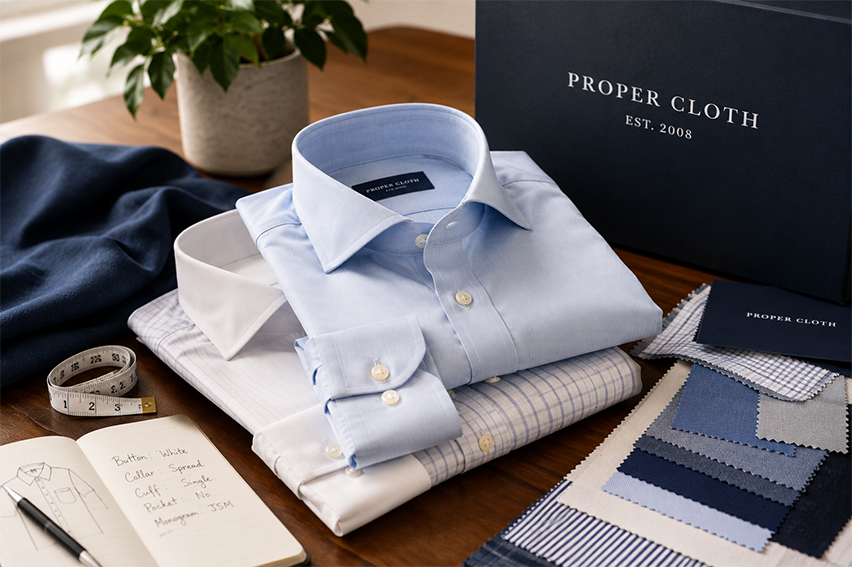
    The process: you either take your own measurements or use their Smart Size quiz, which generates a recommended size based on your height, weight, and build. You then customize the shirt — collar style, cuff style, placket, pocket, fabric — and they build it to your specifications. Price range runs from around $80 for entry-level fabrics to $200+ for premium options.

    The Fit System — How It Actually Works

    Proper Cloth's Smart Size quiz asks about your height, weight, age, build, and how you like shirts to fit. The algorithm generates a starting size that's reasonably accurate for most people on the first order — not perfect, but accurate enough that the adjustments needed are minor. If you have actual measurements you can enter those directly, which produces a more accurate starting point especially for people with proportions that diverge from standard builds.

    The remake policy on first orders is important and underused. If your first shirt doesn't fit right, Proper Cloth will remake it at no charge based on your feedback. Most people who give up on Proper Cloth after one shirt give up before using the tool that makes the system work. After two or three orders with adjustments, most customers have a profile that produces shirts that fit consistently without further tweaking.

    Proper Cloth — Top Picks Worth Ordering
    Made-to-measure shirts built to your measurements — not the statistical average
    Proper Cloth Oxford Shirt
    Best Casual

    Oxford Cloth Button-Down

    OCBD · Multiple colors · Made to measure
    • Wardrobe staple done right
    • Works casual or with blazer
    • Same fit system as dress shirts
    • Best casual Proper Cloth pick
    Start Your Shirt on Proper Cloth
    Proper Cloth Linen Shirt
    Best Summer

    Linen Shirt

    Premium linen · Relaxed fit · Made to measure
    • Heavier quality linen fabric
    • Relaxed fit looks intentional
    • Not thin or poorly constructed
    • Best linen shirt at this price
    Start Your Shirt on Proper Cloth
    Proper Cloth Premium Fabric Shirt
    Best Premium

    Premium Fabric Shirt

    Two-ply · Egyptian cotton · European mills
    • Two-ply or Egyptian cotton
    • Luxury hand feel and drape
    • Comparable to $400 RTW shirts
    • Best fabric quality available
    Start Your Shirt on Proper Cloth

    Proper Cloth Dress Shirts — The Core Product

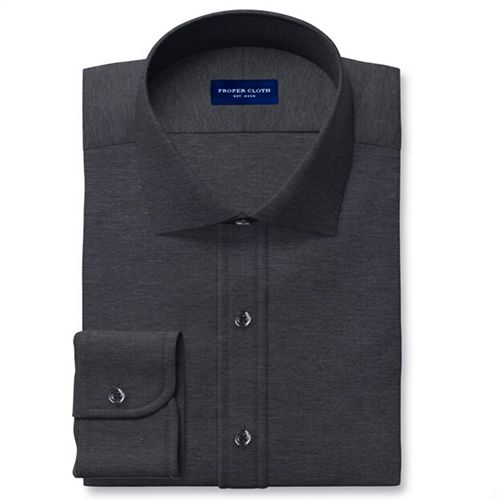
    The dress shirt is where Proper Cloth started and where they're still strongest. The customization options cover everything that actually matters — collar spread and height, cuff style and button count, placket style, back pleat or no pleat, pocket or no pocket, shirt tail length. For most professional environments, the decisions that matter most are collar spread and shirt tail length. Collar spread affects how the shirt looks with different tie knots and without a tie. Shirt tail length determines whether the shirt stays tucked reliably — most off-the-rack shirts have tails too short for taller men, and Proper Cloth lets you specify this.

    First order tip: Start with a mid-range fabric ($120-$150 range). Good enough to evaluate fit properly, not so expensive that a sizing adjustment feels like a loss.

    Proper Cloth Oxford Cloth Button-Down — The Casual Star

    OCBD shirts are wardrobe staples that most men wear constantly, and the off-the-rack versions almost universally have the same fit problems as dress shirts. A well-fitting OCBD from Proper Cloth worn casually or with a blazer is one of those pieces that elevates an outfit without requiring any thought. The same made-to-measure system applies — same fit profile, same measurement process, same remake policy on first orders.


    Proper Cloth Linen Shirt — Better Than Most

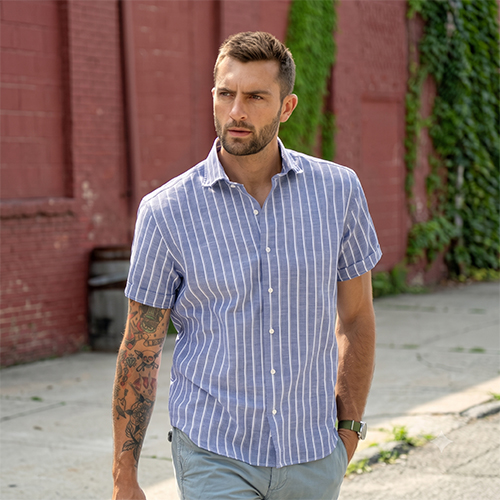
    Linen is notoriously variable in quality and construction. Most mass-market linen shirts are thin, poorly constructed, and finish their first wash looking like they've been worn for a decade. Proper Cloth's linen options use heavier, better-quality fabric and the made-to-measure construction means the relaxed fit of linen looks intentional rather than like the shirt is simply too big.


    The Fabric Selection — Where Proper Cloth Shines

    Proper Cloth's fabric library is one of the most extensive available from any online shirtmaker. Hundreds of options across cotton broadcloth, poplin, Oxford cloth, twill, chambray, linen, and more. Entry-level fabrics at $80 to $100 are solid. Mid-range at $120 to $150 step up noticeably in hand feel and drape. Premium fabrics at $160 and above include two-ply options, Egyptian cotton, and European mill fabrics genuinely comparable to luxury ready-to-wear at three times the price.

    What Proper Cloth Gets Right

    The fit system works once you engage with it properly. The combination of Smart Size quiz, direct measurements, and the remake policy on first orders means most people can get to a consistent fit within two or three orders. The fabric selection is genuinely impressive. Customer service is responsive and the remake policy is honored without friction. The value proposition improves over time — by the fifth shirt, you're ordering quickly from a calibrated profile with consistent fit every time.

    Where They Fall Short

    The first order experience is imperfect by design — getting to a perfect fit requires going through the adjustment process. The website can be overwhelming with hundreds of fabrics and dozens of customization options. Turnaround time is three to four weeks. No physical locations means you can't feel the fabric before ordering.

    Is Proper Cloth Worth the Price

    For anyone who dresses professionally regularly and has struggled with off-the-rack shirt fit — yes, clearly. A $120 Proper Cloth shirt that fits properly looks better than a $200 off-the-rack shirt that doesn't. The honest strategy: commit to two orders minimum before evaluating. Use the remake policy on the first order if the fit isn't right. By the second order you'll know whether the system works for you — and if it does, you'll wonder why you spent years in shirts that didn't fit.

    Proper Cloth Products — Quick Comparison

    ProductPrice RangeBest ForKey Feature
    Custom Dress Shirt$80–$200+Professional wearFull customization
    Oxford Button-Down$90–$150Smart casualWardrobe staple
    Linen Shirt$100–$160Summer & casualQuality linen fabric
    Premium Fabric Shirt$160–$200+Special occasionsTwo-ply Egyptian cotton

    Proper Cloth is for men tired of shirts that almost fit. Commit to two orders, use the remake policy, and you'll never go back to off-the-rack dress shirts.

    Start Your Custom Shirt — Proper Cloth

    McGee & Co Review — Is This Premium Home Decor Brand Actually Worth It?

    By Posted on 0 Comments7min read103 views

    McGee & Co Review — Is This Premium Home Decor Brand Actually Worth It?

    McGee & Co Review — Is This Premium Home Decor Brand Actually Worth It
    McGee & Co Review 10 min read

    Studio McGee built one of the most recognizable interior design aesthetics of the last decade. Clean lines, warm neutrals, natural textures, the kind of spaces that look effortlessly put together without feeling cold or sterile. McGee & Co is where that aesthetic becomes shoppable — the retail brand that Shea and Syd McGee launched so that people who couldn't hire Studio McGee as their interior designer could at least buy the pieces that define the look.

    The question isn't whether the pieces are beautiful. They are. The question is whether the quality justifies the price and whether buying from McGee & Co is actually the right move for someone who loves the aesthetic.

    What McGee & Co Actually Is

    McGee & Co is not a manufacturer. They're a curated retail brand — they source pieces from various manufacturers, apply their design standards and aesthetic filters, and sell them under the McGee & Co label. What you're paying for is curation and trust. The pieces they carry have been selected to work within a specific aesthetic, which means if you buy multiple things from them, they'll likely work together in your space. That's genuinely valuable if you're not a trained designer.

    The brand launched in 2014 alongside the Studio McGee design firm. The Netflix show Dream Home Makeover accelerated awareness significantly and brought a large new audience to both the design studio and the retail brand.

    The McGee & Co Aesthetic — What It Actually Is

    The core look: warm neutrals — whites, creams, taupes, warm greys — layered with natural materials. Linen, jute, rattan, white oak, unlacquered brass. Silhouettes that are clean but not minimal — there's warmth and detail in the pieces, just nothing excessive or fussy. It's an aesthetic that photographs extremely well and also works well in real homes — warm enough to feel livable, structured enough to feel designed, and neutral enough that it doesn't go out of style quickly.

    McGee & Co — Top Picks Worth Buying
    Curated home decor and furniture that actually works together in real spaces
    McGee and Co Thea Chandelier
    Best Lighting

    Thea Chandelier

    Rattan · Brass hardware · Multi-size
    • Woven rattan shade
    • Solid brass hardware
    • Multiple sizes available
    • Anchors any dining room
    Check Price on McGee & Co
    McGee and Co Dawson Bed
    Best Bedroom

    Dawson Bed

    Bouclé or performance fabric
    • Low profile upholstered frame
    • Bouclé headboard option
    • Solid wood construction
    • Makes bedroom look finished
    Check Price on McGee & Co
    McGee and Co Textiles
    Best Value

    Textiles & Throw Pillows

    Linen blend · Wool rugs · Throws
    • Substantial throw blankets
    • High-quality pillow inserts
    • Wool rug options available
    • Best entry point for brand
    Check Price on McGee & Co

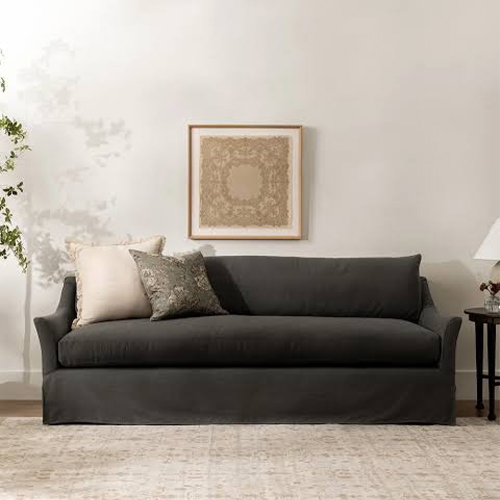
    McGee & Co Siena Sofa — The Statement Piece Worth Knowing

    The Siena Sofa is probably the most-discussed McGee & Co furniture piece and it earns the attention. Deep seat, low profile, clean-lined frame in white oak or walnut finish, cushions in a performance fabric that works for real households rather than just showrooms. The performance fabric is worth noting specifically — it looks like linen, doesn't feel synthetic, and handles everyday use in a way that pure natural fabrics often don't.

    The seat depth is generous. This is a sofa you actually sink into rather than perch on, which sounds obvious but isn't a given at this price point. Lead times run eight to twelve weeks — this is not fast furniture. If you need something quickly, this is not the piece. If you're furnishing thoughtfully and can wait, the Siena is worth it. Price around $3,000 to $4,500 depending on configuration.

    Lead time tip: Order the Siena Sofa before you need it — 8 to 12 weeks is typical. Place the order when you start planning the room, not when you're ready to furnish it.

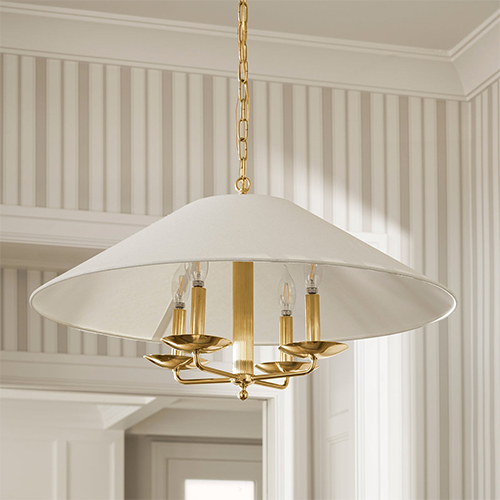
    McGee & Co Thea Chandelier — The Lighting Piece That Changes a Room

    McGee & Co's lighting is some of the strongest work they do and the Thea Chandelier is the centerpiece of that category. Woven rattan shade, brass hardware, available in multiple sizes for different room scales. Lighting is where most people make the biggest design mistake — they treat it as an afterthought and then wonder why their space doesn't look like the design photos they saved. A statement chandelier in the right space does more work than almost any other single piece.

    The rattan is genuinely well-crafted — not the thin brittle rattan in lower-priced versions, but substantial weaving that holds its shape. Price runs $500 to $900 depending on size. For a lighting piece that will anchor a room for years, that's justifiable.


    McGee & Co Dawson Bed — The Bedroom Anchor

    Low profile, clean-lined upholstered headboard in bouclé or performance fabric, solid wood frame. The bouclé option is particularly good — it adds warmth and visual interest without pattern or color, which makes it work in almost any bedroom color scheme. The headboard height is substantial enough to feel like a design choice but not so tall that it overwhelms smaller rooms. Assembly is manageable for two people, slat system included. Price around $1,800 to $2,500 depending on size.


    McGee & Co Textiles — The Underrated Part of the Brand

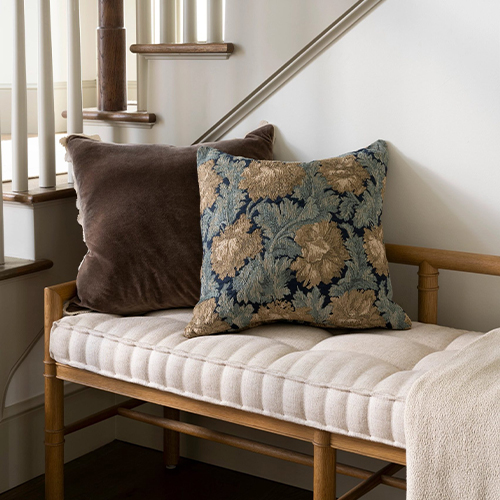
    Most people come to McGee & Co for furniture and lighting. The textiles are quieter but genuinely good and often represent better value. The throw blankets are thick and substantial. The linen-blend options have a texture and weight that reads as genuinely quality. The rugs vary more — wool options are worth spending on, lower-priced options are fine for low-traffic areas. Throw pillows are where McGee & Co shines quietly — fabric quality, insert quality, and size options better than most brands at this price point.


    What McGee & Co Gets Right

    The curation is the main value. Everything on the site works together — buy a sofa, a rug, throw pillows, and a side table from McGee & Co and know that the pieces will cohere. For people who find sourcing home decor stressful, that's worth real money. The aesthetic has longevity — rooted in classic proportions, natural materials, and warm neutrals, none of which will feel dated in five years the way trend-driven design does.

    Where They Fall Short

    Lead times are the biggest friction point. Eight to twelve weeks on furniture is not unusual in the premium category but McGee & Co's popularity means they sometimes push beyond that, and communication during the wait isn't always proactive. Some pieces are aesthetically strong but constructed to a lower standard than the price implies — lighting and smaller decor tend to be stronger quality-to-price than some case goods.

    Is McGee & Co Worth the Price

    For someone whose aesthetic genuinely aligns with what McGee & Co is doing — yes, with caveats around lead times and selective quality. The honest buying strategy: start with lighting and textiles where the price of being wrong is lower. If those pieces work in your space and you love them, scale up to furniture with more confidence. The curation value is real, the best pieces are excellent, and the brand has enough track record that you can research specific pieces before buying.

    McGee & Co Products — Quick Comparison

    ProductPrice RangeLead TimeBest For
    Siena Sofa$3,000–$4,5008–12 weeksLiving room anchor
    Thea Chandelier$500–$9002–4 weeksDining & entry rooms
    Dawson Bed$1,800–$2,5008–12 weeksBedroom centrepiece
    Textiles & Pillows$40–$4001–2 weeksBest entry point

    McGee & Co is for people who want a designer-curated home without hiring a designer. Start with textiles, scale up to furniture when you're sure. The aesthetic is timeless — buy pieces you'll live with for years.

    Shop McGee & Co — Official Site

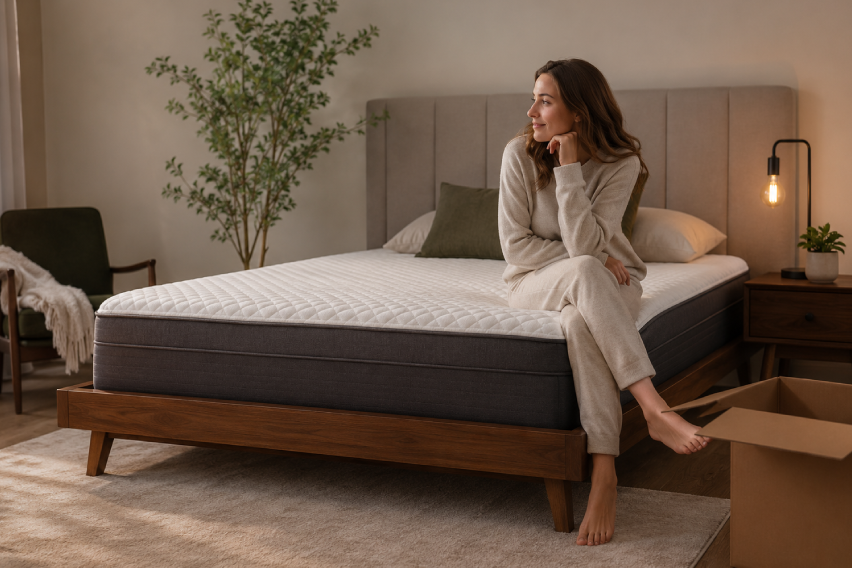
    I Tried the Origin Mattress for 6 Weeks — Here’s My Honest Take (Including Which Model to Actually Buy)

    By Posted on 0 Comments8min read1 views

    I Tried the Origin Mattress for 6 Weeks — Here’s My Honest Take (Including Which Model to Actually Buy)

    Save 20% Off On Your All Orders

    Save 20% Off On Your All Orders

    Save 20% Off On Your All Orders
    GaryW20Off1404
    SHOW COUPON
    On Going Offer
  • It Works 100% Success It Doesn’t
  • Get 5% Off On Your All Purchases

    Get 5% Off On Your All Purchases

    Get 5% Off On Your All Purchases
    SLEEPLINE5%OFF
    SHOW COUPON
    On Going Offer
  • It Works 100% Success It Doesn’t
  • Get Free Shipping On Your All Orders

    Get Free Shipping On Your All Orders

    Get Free Shipping On Your All Orders
    ACTIVATE DEAL
    On Going Offer
  • It Works 100% Success It Doesn’t
  • Sale! Save Upto 34% Off On Selective Items

    Sale! Save Upto 34% Off On Selective Items

    Sale! Save Upto 34% Off On Selective Items
    ACTIVATE DEAL
    On Going Offer
  • It Works 100% Success It Doesn’t
  • Save £418 Off On Origin Lumbar Cloud Mattress

    Save £418 Off On Origin Lumbar Cloud Mattress

    Save £418 Off On Origin Lumbar Cloud Mattress
    ACTIVATE DEAL
    On Going Offer
  • It Works 100% Success It Doesn’t
  • Shop Our Mattresses Collection Starting From £279

    Shop Our Mattresses Collection Starting From £279

    Shop Our Mattresses Collection Starting From £279
    ACTIVATE DEAL
    On Going Offer
  • It Works 100% Success It Doesn’t
  • Checkout Our Origin Coolmax Latex Pillow For £98

    Checkout Our Origin Coolmax Latex Pillow For £98

    Checkout Our Origin Coolmax Latex Pillow For £98
    ACTIVATE DEAL
    On Going Offer
  • It Works 100% Success It Doesn’t
  • Buy Our Origin Contour Mattress Topper For £160

    Buy Our Origin Contour Mattress Topper For £160

    Buy Our Origin Contour Mattress Topper For £160
    ACTIVATE DEAL
    On Going Offer
  • It Works 100% Success It Doesn’t
  • I Tried the Origin Mattress for 6 Weeks — Here's My Honest Take (Including Which Model to Actually Buy)

    Let me start with the thing nobody told me before I bought mine.

    Origin rates the Hybrid mattress at 6.5 out of 10 on firmness. That’s their “medium-firm” positioning — the sweet spot that’s supposed to work for most sleepers. I am a side sleeper. I read that 6.5 and thought: perfect, that’s exactly what I need.

    Three nights in, my hips were aching.

    Not dramatically. Not in a “I need to call someone” way. Just that low, persistent complaint that builds across the day and tells you something isn’t right about how you’ve been sleeping. I switched to my back for a few nights — the aching stopped immediately. I stayed on my back. Aching stayed gone.

    What I’d actually bought was a firm mattress. Closer to an 8 out of 10 if you ask TechRadar’s tester, who spent three weeks on the same model and reached the same conclusion independently. “Much firmer than Origin rates it,” was her exact phrase. She’s right. They’re underselling the firmness, which sounds like a strange complaint to make about a mattress you might actually love — if you’re a back or stomach sleeper.

    I’ll come back to that. First, what Origin actually got right.

    The Thing That Genuinely Surprised Me: How Quiet This Mattress Is

    My partner moves a lot in his sleep. I mean a lot. We’ve tried various mattresses over the years and the nightly earthquake situation has been an ongoing background issue in our relationship — not serious, just persistent and mildly irritating.

    The Origin Hybrid produced the quietest nights we’ve had since we started sleeping in the same bed.

    I didn’t immediately connect this to the mattress. I assumed we were both just tired. But after a week of unusually uninterrupted sleep, I started paying attention. He was moving the same amount. I was just not feeling it the way I normally would.

    NapLab’s independent lab test later confirmed what I’d experienced: the Origin Hybrid produces 30% less motion transfer than the category average across all mattresses they’ve tested. That’s a measured, specific number, not a marketing claim. The wool and memory foam elements in the comfort layer absorb movement before it travels across the surface.

    For couples with mismatched sleep styles, this is genuinely significant. It’s one of the best things about this mattress and one of the least talked-about.

    The Cooling: Real, Effective, Possibly Too Effective

    I’m a cold sleeper. My partner runs hot. We’ve spent years navigating this incompatibility — he pushes the duvet off at 2 a.m., I pull it back, someone is always losing.

    The Origin Hybrid has a bamboo foam layer, a HexaGrid foam structure with an open design that allows air circulation, and a Tencel cover made from wood pulp that regulates surface moisture. These aren’t marketing words for the same thing — they’re three distinct mechanisms that together produce real, measurable cooling.

    TechRadar’s reviewer described her hot-sleeping husband feeling “cool and refreshed throughout the night.” She also described herself — a cold sleeper, like me — as finding it “a little too effective” and feeling “a bit chilly in the night.”

    That’s us exactly. My partner has slept better on this mattress than anything we’ve previously owned. I’ve been wearing thicker socks.

    If you’re a hot sleeper, this is genuinely excellent. If you’re a cold sleeper buying this mattress for yourself, know that the cooling really does work and factor that into your bedding choices.

    The HexaGrid: What It Actually Means in Practice

    Origin’s proprietary HexaGrid is described on their website with enough enthusiasm that I was skeptical before sleeping on it. Developed with orthopaedic specialists, zoned support, pressure distribution, etc. The usual.

    Here’s what it means in practice: the mattress doesn’t feel uniform from head to foot. The center section — roughly where your torso and lower back land — provides more resistance and support. The areas around your shoulders and knees give slightly more. This is the zoned support concept, and it’s a real thing rather than a marketing concept.

    For back sleepers, this matters specifically because your lower back is the area that most needs support and most commonly gets inadequate support on a mattress that’s too soft in the middle. The HexaGrid concentrates support exactly there.

    For people with lower back pain specifically, the Trustpilot UK reviews are full of specific, detailed accounts describing morning improvement. Not vague “I slept better” testimonials — specific descriptions of pain that had been present for years reducing or disappearing within weeks. One buyer describes the LumbarCloud as “the best mattress I ever had, so comfortable. I honestly recommend to anyone who suffers from back pain.”

    I can’t verify individual health claims. But the volume and specificity of back pain improvement accounts across this mattress is unusual enough to be worth noting directly.

    The Edge Support Situation

    Here’s something the origin website definitely doesn’t lead with: the edges of this mattress compress noticeably more than the center.

    I noticed this on the first night when I sat on the edge of the bed to put on my shoes and felt the side compress more than I expected. TechRadar specifically identifies edge support as below average. BestMattressAustralia notes it as a limitation.

    For most sleeping situations this doesn’t matter — you sleep in the middle of the mattress, not on the edge. But if you regularly sleep near the edge (common in couples where one person gets pushed to the perimeter), or if you sit on the edge of the bed as a regular routine, it’s worth knowing before you buy.

    Six Weeks In: What I'd Tell Someone Considering This Mattress

    The Origin Hybrid is a genuinely good mattress. The motion isolation alone made a measurable difference in our household’s sleep quality. The cooling is real and works exactly as described. The construction quality feels appropriate for the price. The 200-night trial (in the UK) is one of the most generous in the category, and the 15-year warranty is meaningfully longer than the 10-year standard most competitors offer.

    But I need to be honest about who it’s for and who it isn’t.

    It’s for you if you’re a back sleeper. This is where the Origin genuinely excels. The firm surface, the zoned HexaGrid support, the lumbar emphasis — all of it is optimized for the position where you need support more than cushioning. Multiple independent testers who sleep primarily on their back describe this as among the best mattresses they’ve used at the price point.

    It’s for you if you’re a stomach sleeper. Same logic. Stomach sleepers need a firm surface to keep their hips level with their shoulders and maintain spinal alignment. The Origin delivers this directly.

    It's for you if you sleep hot. The cooling is real. Ask my partner.

    It might not be for you if you’re a side sleeper. I’m going to be direct here: the firmness means it doesn’t provide adequate cushioning at the shoulder and hip for sustained side sleeping. I know this from my own aching hips in week one. TechRadar’s reviewer confirms it independently. If you’re a dedicated side sleeper, the LumbarCloud is the Origin product designed for you — or look elsewhere in the category.

    It’s for you if you’re on a budget. The near-permanent sale pricing (typically 35–56% off listed RRP with easily-found discount codes) puts this mattress in a tier that’s significantly more accessible than its quality level would suggest if you were paying full price. NapLab rates it the fourth-best mattress they’ve tested within its price tier. That’s a specific, credible framing of what you’re getting for the money.

    The Products: Which Origin to Actually Buy

    The Origin lineup has expanded since launch. Here’s the honest breakdown of which product fits which buyer.

    This is what I bought and what most of this blog is based on. The standard hybrid with the HexaGrid layer, bamboo foam, and pocket springs. Firmly positioned toward back and stomach sleepers at an accessible price.

    Buy this if: You’re a back or stomach sleeper, you run hot at night, you share a bed and motion isolation matters, or you’re on a tighter budget and want the strongest value-per-pound in the Origin lineup.
    Skip this if: You’re a dedicated side sleeper. The firmness will work against you.

    Trial period: 200 nights (UK) | 120 nights (Australia) | 100 nights (US)
    Warranty: 15 years

    The LumbarCloud adds a pillow-top comfort layer over the core hybrid structure, creating a softer initial feel without losing the underlying lumbar support that the HexaGrid provides. It’s the product that addresses the standard Hybrid’s most consistent criticism.

    Dweva’s multi-week testing team — who tested both models simultaneously — found the LumbarCloud “felt gentler on joints” and produced “fewer sleep disruptions when one person moved.” If you’ve read this far and kept thinking “this sounds good but I sleep on my side,” this is the Origin product you’re looking for.

    Buy this if: You’re a side sleeper, a lighter sleeper who wants more cushioning, or you’ve tried firm mattresses before and found them uncomfortable. Also the better choice for couples where sleep positions differ — the pillow-top smooths out what can otherwise feel like a hard landing for the lighter or more pressure-sensitive partner.

    Skip this if: You specifically want a firm surface. The pillow-top softens the initial feel, which is a feature for most buyers and a drawback for the minority who want maximum firmness.

    The Hybrid Plus adds adjustable firmness settings, which allows you to calibrate the feel after purchase rather than committing to a single firmness at the point of sale. This is specifically useful if the gap between Origin’s stated firmness and the independently-tested firmness has made you uncertain about which model to choose.

    Buy this if: You’re genuinely unsure about firmness, or you and your partner have significantly different firmness preferences and want post-purchase adjustment capability.

    Before You Buy: Three Things to Check First

    1. What position do you primarily sleep in?

    This is the only question that really matters for determining which Origin product is right for you. Back or stomach sleeper: standard Hybrid. Side sleeper: LumbarCloud or reconsider the category.

    2. Do you run hot or cold?

    If you’re a hot sleeper, the Origin’s cooling technology is genuinely one of its best features and worth seeking out specifically. If you’re a cold sleeper, the same technology means you may want to upgrade your bedding or sleepwear before the mattress arrives.

    3. Have you checked for a discount code?

    Origin runs near-permanent promotions at 35–56% off listed RRP. The “full price” on the website is rarely what anyone actually pays. Look for a current code before completing your purchase — if there isn’t one active today, there will be one in a few days.

    The Honest Bottom Line

    I came away from six weeks on the Origin Hybrid with a clear, specific view: this is one of the best back-sleeper mattresses available at this price point in the UK market right now. The motion isolation is genuinely excellent, the cooling works, and the 200-night trial is long enough to give you real confidence in your evaluation.

    I wish someone had told me clearly — not in fine print, not buried in a FAQ — that “6.5 firmness” on Origin’s scale means something closer to “firm” on an independent scale. That information would have saved me three nights of hip aching and sent me directly to the LumbarCloud.

    Go in with accurate firmness expectations, matched to your sleep position, and Origin is a genuinely strong purchase at a genuinely competitive price. Go in expecting medium-soft cushioning and you’ll spend your first week confused about what happened.

    The 200-night trial is long enough to figure it out. Just know what you’re expecting before you start the clock.

    Can You Wear Rothy’s in the Kitchen?

    By Posted on 0 Comments10min read0 views

    Can You Wear Rothy’s in the Kitchen?

    Can You Wear Rothy's in the Kitchen?

    I’ll be upfront with you: this is not a question I expected to spend any serious time thinking about.

    Rothy’s are fashion flats. They’re the shoes Meghan Markle wore to a castle. They live in the intersection of “sustainable lifestyle” and “I have my life together enough to spend $149 on a pair of pointed-toe flats made from recycled water bottles.” The kitchen, with its spilled olive oil and flour-dusted floors and the occasional dropped pan, does not immediately feature in that picture.
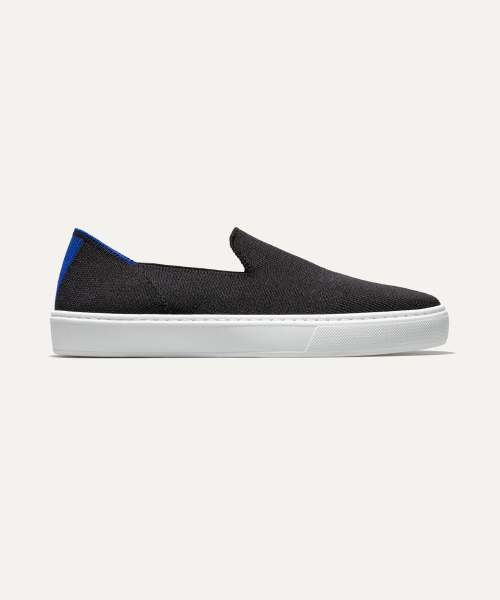
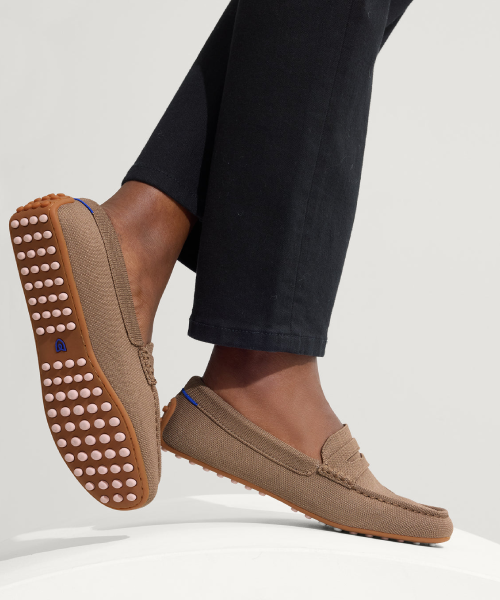
    And yet.

    The more I thought about it — and the more time I actually spent wearing mine around the house, including in the kitchen — the more the answer started shifting from an automatic “no” to a more considered “actually, yes, with some caveats.”

    Here’s the full, honest case.

    What Makes Rothy's Actually Suited to Kitchen Wear

    The single feature that makes Rothy’s genuinely viable in a kitchen context is the one that defines the entire brand: machine washability.

    Think about what happens to your feet in a kitchen over the course of a normal cooking session. A splash of pasta water. A dusting of flour that works its way under the counter. Olive oil on the floor that you don’t notice until your sock slides slightly. The general accumulation of cooking smells — garlic, fish, roasted vegetables — that embeds itself in fabric over time.

    Now think about what happens to most shoes in that environment. They absorb it. They hold it. You wipe the outside, but the inside stays. Fabric shoes get progressively more kitchen-scented regardless of how carefully you cook. Leather shoes absorb cooking fat in ways that are genuinely difficult to reverse. Most shoes simply aren’t designed to be cleaned from the inside out on a regular basis.

    Rothy’s are.

    The recycled plastic knit construction that makes up the entire upper — the same material that gives these shoes their distinctive woven appearance — is fully machine washable. Gentle cycle, cold water, air dry overnight. The shoe comes out clean. Not just cleaner. Actually clean. The odors, the flour, the general kitchen accumulation — gone.

    Multiple long-term Rothy’s owners confirm this holds up not just once but repeatedly, across months and years of regular washing. A PureWow editor who has owned the same pair of Rothy’s sneakers for five years describes them as maintaining their shape and structure through repeated machine wash cycles. The knit doesn’t degrade, the shape doesn’t distort, and the cleaning process is no more involved than any other item in your laundry.

    For kitchen wear specifically, this is a significant practical advantage over almost every alternative at a comparable price point.

    The Spill Question

    Here’s where the honest answer gets more nuanced, and I want to be direct about it rather than just making the case for the purchase.

    Rothy’s are not waterproof. They are not water resistant. The open-weave knit construction that makes them breathable and lightweight also means that liquid — water, cooking oil, broth, anything wet — goes straight through to your foot.

    For kitchen wear, this means two things.

    The first is actually fine: small splashes, flour, light mess. These sit on the surface of the knit, don’t immediately soak through if you address them quickly, and wash out completely in the next machine cycle. The everyday cooking mess that accumulates in most home kitchens — steam, light splashing, general food prep — is exactly the kind of thing the machine washability handles cleanly.

    The second is genuinely not fine: significant liquid spills directly onto the shoe. If you’re draining a full pot of pasta water and some goes sideways, or you knock a glass off the counter, your feet will be wet. Not damp. Wet. The knit absorbs liquid with the same efficiency it absorbs everything else.

    So the honest kitchen verdict is: Rothy’s handle normal cooking conditions well. They handle actual spills the same way any fabric flat would — which is to say, not particularly well. If you cook in a way that regularly involves significant liquid near your feet, keep that in mind.

    The good news: if your feet do get wet, you throw the shoes in the wash. There’s no permanent damage. No staining. Just a cycle through the machine and they’re fine again.

    The Grip and Safety Reality

    This is worth addressing directly because kitchen floor safety is a genuine practical consideration, not just a theoretical one.

    Rothy’s have a flat, smooth rubber sole. They’re not non-slip shoes. They’re not designed for environments where floor traction is a safety priority. On a dry kitchen floor — tile, hardwood, laminate — they perform fine. The sole grip is adequate for normal movement.

    On a wet or oily kitchen floor, they’re no better or worse than any other flat-soled shoe without specific grip technology. Which means: be aware, wipe up spills when they happen, and don’t wear them in a commercial kitchen environment where floor safety standards require proper non-slip footwear.

    For home kitchen use, this is rarely a practical concern as long as you’re maintaining normal kitchen floor hygiene. Most home cooks aren’t navigating oily or wet floors as a regular condition — they’re cleaning up as they go. In that context, Rothy’s grip is adequate.

    The Comfort Question for Long Kitchen Sessions

    Anyone who has spent three hours on their feet preparing a dinner party knows that kitchen comfort is a real, physical consideration. Standing on hard tile for extended periods in the wrong shoes produces fatigue that starts in your feet and works its way up your legs and lower back by the time you’re plating the dessert.

    Here’s where I need to be honest with you about Rothy’s and arch support, because it comes up in every serious review of these shoes and it applies in the kitchen context too.

    Rothy’s provide minimal arch support. The standard footbed is flat and thin. Multiple independent reviewers describe them as inadequate for extended periods of standing, particularly for anyone with flat feet, plantar fasciitis, or any pre-existing foot condition. One multi-year Rothy’s owner specifically describes needing to give away most of her pairs after having children because her support needs changed — “I just wish they had more support.”

    For a thirty-minute dinner prep, this probably doesn’t matter. For a three-hour Thanksgiving cook, it might.

    The practical fix, if you want to wear Rothy’s in the kitchen for extended sessions: add an aftermarket insole. A basic half-insole from any pharmacy — around $8 to $12 — provides enough additional cushioning to extend the comfortable wearing time meaningfully. It fits within the shoe without changing the external appearance and doesn’t affect the machine-washability since the insole is removed before washing.

    Some Rothy’s styles now come with what the brand calls the In Love Insole — a more cushioned footbed than the original. It’s not a structural arch support insert, but it does provide more initial cushioning than the standard footbed. Worth looking for on current styles if extended standing is a concern.

    Which Rothy's Style Actually Works Best in the Kitchen

    Not all Rothy’s are equally suited to kitchen wear, and it’s worth being specific here rather than just saying “any pair will do.”

    The styles that work best in the kitchen are the ones with the simplest construction — the fewest components that can accumulate kitchen mess and the fastest to clean. Elaborate bows, multiple-part closures, and delicate embellishments create more surface area for flour and cooking residue to settle into.

    The styles with more structural complexity — the Mary Jane with the bow tie that must be tied tightly, the clog with the ankle construction — have also shown more durability concerns in independent reviews generally. A Mary Jane strap tearing after a few wears, clogs showing wear at the ankle area. These aren’t defects specifically related to kitchen use, but they suggest that the simpler, more structurally straightforward styles are better long-term bets.

    For the kitchen specifically, the flat slip-on styles are the clear recommendation. Easy on, easy off, no components to catch mess, fully machine-washable from a single piece of knit construction.

    The Smell Issue — and Why It's Actually Less of a Problem Than You'd Think

    Every honest review of Rothy’s eventually mentions the smell concern. The recycled plastic knit doesn’t breathe the way natural materials do. After enough wear in warm conditions — a summer kitchen, an evening of cooking over a hot stove — they can develop an odor.

    In a regular shoe, this is a problem you manage around. You spray them, air them out, hope for the best.

    In Rothy’s, this is a problem you solve directly. Machine wash. Gentle cycle. Cold water. Air dry overnight. The next morning the shoes smell like nothing at all.

    The kitchen is actually one of the better use cases for Rothy’s specifically because it’s an environment where regular washing makes sense anyway. You’re cooking. Your clothes go in the wash. Your apron goes in the wash. Throwing your Rothy’s in on the same cycle is a perfectly natural extension of the post-cooking cleanup routine rather than an additional chore.

    The Honest Bottom Line

    Can you wear Rothy’s in the kitchen? Yes, with clear eyes about what you’re working with.

    They handle everyday home cooking conditions well. They clean up completely and repeatedly through machine washing. They’re comfortable for moderate cooking sessions, more comfortable with an added insole for longer ones. They look significantly better than dedicated kitchen shoes, which means you can go from food prep to having people over without changing your footwear.

    What they won’t do: protect your feet from significant liquid spills, provide non-slip grip on genuinely wet floors, or support your arches through a marathon cooking session without some help.

    The machine-washability is the thing that makes this work. Without it, Rothy’s would be a terrible kitchen shoe. With it, they become a genuinely practical option for home cooks who want something that looks good, performs adequately, and can be fully cleaned after every use.

    The Products: Which Rothy's to Buy for Kitchen Wear

    The brand’s flagship pointed-toe flat and the strongest recommendation for kitchen wear. The construction is a single piece of knit with a flat rubber sole — minimal components, maximum washability, no delicate elements to catch cooking mess. The Point is also the most extensively reviewed style in the entire Rothy’s catalog, with multiple 4–5 year ownership accounts confirming it holds up through repeated machine washing cycles.

    Size up half a step from your usual. The toe box runs narrow and this is consistent across independent reviews — ordering your standard size will leave your toes compressed.

    Best for: Home cooks who want a smart-looking flat that functions well during normal cooking sessions and cleans up completely afterward.

    Care in the kitchen: Machine wash on gentle cycle, cold water, air dry. Do not tumble dry. If an aftermarket insole is added for support, remove it before washing.

    The rounded-toe version of The Point, offering the same single-knit construction and full machine washability in a slightly more relaxed silhouette. Where The Point’s pointed toe can feel slightly more formal, The Flat reads as everyday casual — which many home cooks find more appropriate for kitchen and around-the-house wear.

    The same size-up-half-a-step guidance applies. The Flat runs narrow across the toe box in the same way The Point does.

    Best for: Buyers who find pointed toes uncomfortable for extended wear or who prefer a more casual everyday silhouette for home cooking and kitchen use.

    If you want the most comfortable Rothy’s for extended kitchen sessions, this is the one. The sneaker construction is the most accommodating silhouette in the lineup — it’s the style most often recommended for wider feet, and it provides slightly more structure around the foot than the flat styles. Multiple reviewers describe it as the most comfortable option for longer-duration wear.

    It’s also the style with the strongest durability evidence in the entire catalog. A PureWow editor’s five-year ownership account is specifically about the sneaker — through repeated machine washes, the knit remained intact and the shape was maintained. That’s the kind of confirmed long-term durability that matters when you’re using a shoe in an environment where regular washing is part of the routine.

    Best for: Home cooks who spend longer periods on their feet in the kitchen, buyers with slightly wider feet, and anyone who prioritizes durability and comfort over the more polished appearance of the flat styles.

    A loafer-adjacent slip-on that sits between the flat styles and the sneaker in terms of formality. Easy to get on and off — relevant in kitchen contexts where you might be stepping out to the garden and back — and the same fully machine-washable single-knit construction.

    One documented note from independent reviews: the loafer and driver category has shown slightly more fabric durability variation than the core Point and Sneaker styles. At least one account describes loafer fabric deteriorating after hand-washing with mild detergent. For kitchen use specifically, machine wash rather than hand-wash, and this concern is largely avoided.

    Best for: Home cooks who want a slightly more structured silhouette than a flat but don’t want the athletic look of the sneaker. Good for the transition from kitchen to sitting down with guests without looking like you’re wearing cooking shoes.

    A Note on Insoles

    If you’re planning to use Rothy’s for extended kitchen sessions — think full holiday cooking, lengthy dinner party prep, or any situation where you’re on your feet for two hours or more — add a basic half-insole before you start. Around $8 to $12 at any pharmacy. The arch support in Rothy’s standard footbed is minimal, and the insole makes a meaningful practical difference for longer wear without affecting the shoe’s appearance or machine-washability. Remove the insole before washing, replace it after.

    Quick Reference: Rothy's in the Kitchen


    The Point

    The Flat

    The Sneaker

    The Driver

    Kitchen suitability

    ✅ Strong

    ✅ Strong

    ✅ Strong

    ✅ Good

    Machine-washable

    ✅ Yes

    ✅ Yes

    ✅ Yes

    ✅ Yes

    Best for extended standing

    Average

    Average

    ✅ Best

    Average

    Wide foot suitability

    Narrow

    Narrow

    ✅ Most accommodating

    Moderate

    Ease of on/off

    Slip-on

    Slip-on

    ✅ Slip-on

    ✅ Slip-on

    Durability evidence

    ✅ 4–5 year accounts

    Good

    ✅ 5-year account

    Good

    Starting price

    $149

    $145

    $149

    $149

    Origin Mattress Review — Worth Buying?

    By Posted on 0 Comments11min read0 views

    Origin Mattress Review — Worth Buying?

    Origin Mattress Review 2026 — Worth Buying?

    Origin’s most useful piece of independent evidence in 2026 is a specific, important discrepancy: the brand rates the Hybrid at 6.5 out of 10 on firmness, meaning medium-firm. TechRadar’s hands-on tester rates it closer to 8 out of 10. NapLab’s objective testing places it in the “slightly firm” category. Multiple independent sources agree — this mattress sleeps firmer than Origin’s own marketing suggests, and that single calibration point determines whether Origin is the right mattress for your specific sleep position more than any other factor in this review.

    Quick Highlights

    • ✅ CHOICE Recommended (Australia), ProductReview Award 2026, Product of the Year 2024 — genuine, third-party recognitions across multiple markets
    • ✅ One of the longest trial periods in the category — 200 nights in the UK, 120 nights in Australia, 100 nights in the US — providing real, extended evaluation time well beyond the industry average
    • ✅ 15-year warranty confirmed — meaningfully longer than the 10-year standard most mattress competitors offer
    • ✅ Outstanding motion isolation confirmed by independent testing — NapLab measured 30% less motion transfer than the category average, and TechRadar’s reviewer specifically notes being undisturbed by a partner moving during the night
    • ✅ Temperature regulation genuinely effective — HexaGrid foam and bamboo foam layers confirmed as producing real, noticeable cooling by multiple independent testers, including one who found it slightly too cool
    • ✅ Excellent value-per-dollar confirmed — NapLab rates overall performance below average, but simultaneously rates it the 4th best mattress tested within its price tier, capturing the honest value picture precisely
    • ✅ 2,330 Trustpilot UK reviews with majority positive sentiment — broad, genuine satisfaction base reflecting real commercial scale
    • ❌ Firmness is genuinely higher than Origin’s stated 6.5/10 — independent testers consistently place it closer to 7.5–8/10, which makes it excellent for back and stomach sleepers but potentially uncomfortable for side sleepers
    • ❌ A specific Trustpilot UK account describes a mattress coming apart at the seams, with the company declining to replace it under warranty and classifying the issue as outside covered damage — resolved eventually through the 200-night return policy rather than warranty
    • ❌ Edge support is specifically noted as a weakness across multiple independent tests — TechRadar specifically identifies this as below average, meaning sitting or sleeping near the mattress perimeter produces more compression than central sleeping positions
    • ❌ The cover is not removable or machine-washable — a genuine, practical limitation given how long owners are expected to use the mattress
    • ❌ Near-permanent sale pricing creates pricing confusion — the “RRP” is rarely what buyers pay, with 35–56% discount codes consistently available, making it difficult to evaluate true value against a genuine baseline price
    • ❌ Certain delivery delays and incorrect orders documented in Trustpilot reviews, alongside a minority of customer service experiences described as unhelpful when returns were involved

    Best for: Back sleepers and stomach sleepers specifically, heavy sleepers (90kg+), couples who need good motion isolation, and hot sleepers wanting genuine temperature regulation — who understand going in that this mattress sleeps firmer than Origin’s own stated rating suggests.

    Why Trust This Review

    Cross-referenced from NapLab’s 10-data-point objective lab testing of the Origin Adapt Hybrid, TechRadar’s three-week hands-on test by a sleep writer with extensive comparative mattress experience, BestMattressAustralia’s detailed 2026 structured review with independent firmness assessment, SleepGoodness UK’s detailed five-layer construction analysis, Dweva’s multi-week, multi-tester US review covering both the Adapt and LumbarCloud, and Trustpilot’s UK collection (2,330 reviews). No commercial relationship with Origin Mattress.

    Table of Contents

    • About Origin Mattress
    • Origin Mattress Review: Full Breakdown
    • Best Origin Mattress Products Worth Buying
    • What Customers Actually Think
    • Is Origin Worth It?
    • Origin vs Competitors
    • Where to Buy
    • FAQs
    • Final Verdict

    About Origin Mattress

    Origin is a Singapore-based mattress brand founded in 2018, operating across the UK, US, Australia, and several other markets through a direct-to-consumer model. Despite being relatively new compared to legacy mattress brands, Origin has accumulated genuine industry recognition — including CHOICE Recommendation status in Australia, a 2026 ProductReview Award, and a 2024 Product of the Year national vote. The brand’s stated differentiator is what it calls “world-class German engineering” applied to a value-forward pricing model, with the HexaGrid proprietary foam layer at the center of its technology claims. The current lineup spans the Hybrid (entry-level), Hybrid Plus (with adjustable firmness settings), Hybrid Pro (premium), LumbarCloud (flagship with pillow-top), and the Adapt Hybrid (US market entry).

    Origin Mattress Review: Full Breakdown

    The Firmness Reality — The Single Most Important Thing to Calibrate Before Buying

    This deserves to anchor the entire review because the gap between Origin’s stated firmness and the independently-tested feel directly determines whether this mattress suits you.

    Origin rates the Hybrid at 6.5 out of 10 — their “medium-firm” position. TechRadar’s hands-on tester, after three weeks of sleeping on it, concluded it’s “much firmer and nearer to an 8 out of 10.” BestMattressAustralia’s independent assessment reaches essentially the same finding: “genuinely firm at 7–8/10. You lie on top of it rather than in it.” NapLab’s objective testing categorizes it as “slightly firm.”

    The practical implication is direct and significant: if you’re a side sleeper who checked Origin’s stated medium-firm rating and assumed it would cushion your shoulders and hips adequately, you’re likely to find the actual mattress too firm for comfortable sustained side sleeping. TechRadar’s reviewer specifically states she “didn’t feel that the Origin Hybrid was suited to side sleepers, as it’s a little too firm to provide adequate sinkage at the shoulders and hips.”

    For back sleepers and stomach sleepers — who need a firmer surface to maintain spinal alignment rather than the pressure relief that side sleepers require — this same firmness is a genuine strength. Multiple testers across different markets confirm the Hybrid as “excellent for back sleepers” and “Origin’s sweet spot.”

    The HexaGrid Layer — Genuinely Distinctive, Specifically Explained

    Origin’s proprietary HexaGrid is the most discussed single component across independent reviews, and the description is consistent enough to be credible: a hexagonally-structured foam layer that provides zoned support, concentrating more support in the center third of the mattress where body weight is typically heaviest, while allowing slightly more give at the edges and lighter areas. This was developed “alongside orthopaedic specialists” per TechRadar’s confirmed research.

    The practical effect: the mattress responds differently to different zones of your body rather than providing uniform resistance across the entire surface. Multiple back pain accounts across the Trustpilot UK collection specifically credit this zoned approach with meaningful morning relief — “the best mattress I ever had, is sooo comfortable. I honestly recommend to anyone who suffers from back pain.”

    Temperature Regulation — Genuinely and Specifically Confirmed

    This is one of the categories where independent evidence is both specific and consistent. TechRadar’s reviewer describes her “hot-sleeping husband feeling cool and refreshed throughout the night” — but also notes she personally found it “a little too effective, feeling a bit chilly in the night.” That dual response from the same household is actually useful, credible evidence of genuine cooling performance: a hot sleeper finding it comfortable and a cold sleeper finding it noticeably cool is a meaningful signal that the cooling technology is working as described rather than being a marketing claim.

    The specific materials doing this work: bamboo foam layers (naturally more breathable than standard memory foam), the HexaGrid’s open structure allowing air movement, and a Tencel cover (a wood-pulp-based, highly breathable fabric) that independently regulates surface moisture.

    Motion Isolation — A Specific, Measurable Standout

    NapLab’s objective lab test produced a specific, useful number: 30% less motion transfer than the category average across all mattresses tested. That’s a meaningful, quantified advantage for couples — particularly relevant because hybrid mattresses (which Origin is) typically show more motion transfer than pure foam constructions. The wool and memory foam elements within the comfort layer are specifically identified as the key contributors, with NapLab noting these materials are “having a strong positive impact on motion.” TechRadar’s reviewer independently confirms this through lived experience: undisturbed by a partner moving and a cat jumping on the bed during light sleep.

    Edge Support — A Specific, Documented Weakness

    This deserves honest, direct mention because it appears consistently across independent tests. TechRadar specifically identifies edge support as below average. BestMattressAustralia notes it as a limitation. The practical consequence: the perimeter of the mattress compresses more noticeably when you sit or sleep near the edge than the center does. For buyers who use the full width of their mattress and frequently sleep near the edge, this is worth knowing. For buyers who primarily sleep centrally, it’s less relevant to daily experience.

    The Warranty Claim Account — A Specific, Documented Case

    A specific Trustpilot UK account from a buyer named Martin deserves direct, honest inclusion: a mattress that “came apart at the seams” in multiple areas, documented with photos, with the company declining warranty coverage by citing terms and conditions around damage types — suggesting the seam failure didn’t meet the specific criteria for covered manufacturing defects. The buyer ultimately returned the mattress under the 200-night return policy, describing a cheaper Simba as more comfortable. This is a single documented case rather than a broad pattern, but the company’s response — classifying seam failure across multiple areas as outside warranty coverage — is worth knowing directly.

    NapLab's Overall Performance Score — Context Matters Here

    NapLab’s overall score places the Origin Adapt Hybrid in the bottom 29% of all mattresses tested — a figure that sounds alarming until you read the accompanying context directly: “the price point certainly is [impressive]. Within this pricing tier the Origin Adapt is the 4th best mattress we’ve tested to date.” This is the most precise and honest framing of Origin’s value proposition: not a top performer in absolute terms across the full market regardless of price, but a genuinely strong performer specifically within its affordable price tier. The distinction matters because how you weight it depends on what you’re optimizing for — absolute performance ceiling, or performance per dollar spent.

    Best Origin Mattress Products Worth Buying

    Best for: Back sleepers, stomach sleepers, and heavy sleepers wanting firm hybrid support at a genuinely competitive price point.

    Top Features:

    • Proprietary HexaGrid zoned support layer, developed with orthopaedic specialists, providing more targeted pressure distribution than uniform foam layers
    • Outstanding motion isolation — 30% below category average per objective lab testing, specifically confirmed by independent testing and real-world couple accounts
    • Bamboo foam and Tencel cover for genuine, tested temperature regulation
    • 200-night trial (UK) / 120-night trial (Australia) — among the longest in the category

    One Honest Drawback: Sleeps genuinely firmer than the brand’s stated 6.5/10 rating — independently assessed closer to 7.5–8/10 by multiple separate testers. Side sleepers should factor this in directly before purchasing.

    Verdict: The right choice for back and stomach sleepers wanting solid hybrid support at a below-average price. Side sleepers should look at the LumbarCloud or consider alternatives.

    Best for: Buyers wanting Origin’s core support technology with a pillow-top comfort layer that provides more immediate cushioning — including side sleepers who found the standard Hybrid too firm.

    Top Features:

    • Pillow-top construction adds a softer initial feel without compromising the underlying lumbar support of the core hybrid structure
    • Dweva’s multi-week testing found the LumbarCloud “felt gentler on joints” and produced “fewer sleep disruptions when one person moved” compared to the Adapt
    • Maintains the same temperature regulation and motion isolation advantages of the broader Origin lineup

    One Honest Drawback: At a higher price point than the standard Hybrid, the value-per-dollar advantage that makes the entry Hybrid compelling is reduced — compare against competitors at this tier specifically before deciding.

    Verdict: The right Origin product for side sleepers, lighter sleepers, and buyers wanting more cushioning than the entry Hybrid delivers.

    Best for: Buyers who are uncertain about which firmness will suit them, or couples with genuinely different firmness preferences who want adjustability without purchasing separate mattresses.

    Top Features:

    • Adjustable firmness settings allow post-purchase calibration — a specific, practical advantage given the documented gap between Origin’s stated and independently-felt firmness

    One Honest Drawback: Less extensively reviewed than the core Hybrid or LumbarCloud — less independent long-term evidence available.

    Verdict: Worth considering specifically for buyers whose firmness preference is uncertain or who’ve been surprised by mattress firmness in the past.

    What Customers Actually Think

    Real accounts paraphrased:

    • “I own the LumbarCloud and it is the best mattress I ever had, so comfortable. I honestly recommend to anyone who suffers from back pain.”
    • “Never had such a good night’s sleep until I slept on one of your mattresses. Will certainly recommend to friends and family.”
    • “Mattress came apart at the seams and then was told it would be replaced as a gesture of goodwill, not under warranty. Sent it back under the 200 night policy — wasn’t worth the money. Cheaper Simba is far more comfortable.”
    • “My hot-sleeping husband felt cool and refreshed throughout the night. I actually found it a little too effective — I felt a bit chilly.”
    • “Motion isolation on the Origin Hybrid is outstanding — I’m a light sleeper and wasn’t disturbed by my husband moving about, or the foster cat jumping on the bed.”
    • “Although Origin says the mattress is a medium firm at 6.5 out of 10, I found it much firmer, nearer to an 8 out of 10.”

    Is Origin Worth It?

    For back sleepers, stomach sleepers, and heavy sleepers wanting a firm hybrid with strong motion isolation and genuine cooling at a competitive price: yes, with strong confidence — the independent testing evidence, the trial period length, and the 15-year warranty all support this clearly.

    For side sleepers: approach with real caution given the consistent, independent evidence that the Hybrid sleeps meaningfully firmer than the brand’s stated rating — the LumbarCloud is the more appropriate Origin product for this sleep position if staying within the brand.

    For buyers evaluating against absolute performance ceiling regardless of price: Origin is strong value within its tier, not the top absolute performer across the market. The honest NapLab framing — 4th best in its price tier — is the most accurate way to position it.

    Origin vs Competitors


    Origin Hybrid

    Emma Hybrid

    Simba Hybrid

    Firmness (independent)

    7.5–8/10 (firm)

    Medium

    Medium-firm

    Best sleep position

    Back, stomach

    Side, back

    Back, side

    Trial period (UK)

    ✅ 200 nights

    200 nights

    200 nights

    Warranty

    ✅ 15 years

    10 years

    10 years

    Motion isolation

    ✅ Outstanding (30% below avg)

    Good

    Good

    Temperature regulation

    ✅ Strong

    Comparable

    Comparable

    Price (Queen, UK, sale)

    ✅ ~£399

    ~£499

    ~£549

    Best for

    Value-focused back/stomach sleepers

    Side sleepers, hot sleepers

    Balanced all-rounder

    Where to Buy

    originmattress.co.uk (UK) | originmattress.com (US) | originmattress.com.au (Australia) — direct, with near-permanent discount codes typically reducing prices 35–56% from listed RRP. Free delivery confirmed across most markets. The full trial period begins from delivery date.

    FAQs

    Is Origin Mattress actually medium-firm?

    No — multiple independent testers across different markets consistently place it closer to firm (7.5–8/10) rather than the brand’s stated medium-firm (6.5/10). This is the most important calibration point before purchase.

    Is Origin good for back pain?

    Yes — multiple independent tests and a significant volume of Trustpilot accounts specifically credit the zoned HexaGrid support with meaningful back pain relief, particularly for back and stomach sleepers.

    Is Origin good for side sleepers?

    Not for the standard Hybrid specifically — the firmness is too high for adequate shoulder and hip pressure relief in sustained side sleeping. The LumbarCloud is the better Origin product for side sleepers.

    How long is Origin's trial period?

    200 nights in the UK, 120 nights in Australia, 100 nights in the US — with a minimum of 25 nights required before requesting a return. Among the most generous trial periods in the category.

    Does Origin honor its warranty?

    Generally yes based on the broad evidence base, though one specific, documented case describes seam failure being classified outside warranty coverage based on terms and conditions — the 200-night return policy was ultimately used as the resolution path in that case.

    Final Verdict

    Origin earns its growing market position through a genuinely compelling combination: HexaGrid zoned support backed by orthopaedic input, outstanding independently-measured motion isolation, effective temperature regulation, an exceptionally long trial period, and a 15-year warranty — all at a price point that meaningfully undercuts comparable UK and Australian hybrids.

    The firmness calibration issue is the single most important piece of information in this entire review. This sleeps firm — closer to 8/10 than the brand’s stated 6.5/10 — and that fact entirely determines whether the Hybrid is the right mattress for your sleep position. Back sleepers and stomach sleepers will find it genuinely excellent. Side sleepers should look at the LumbarCloud specifically, or compare against softer alternatives before committing.

    Overall Rating: 8.1 / 10

    Category

    Score

    Back/Stomach Sleeper Support

    9 / 10

    Side Sleeper Suitability

    5.5 / 10

    Temperature Regulation

    8.5 / 10

    Motion Isolation

    9.5 / 10

    Edge Support

    6 / 10

    Trial Period & Warranty

    9 / 10

    Value for Money

    9 / 10

    Overall

    8.1 / 10

    I Wore Rothy’s for a Year — Here’s What Nobody Tells You Before You Buy

    By Posted on 0 Comments6min read0 views

    I Wore Rothy’s for a Year — Here’s What Nobody Tells You Before You Buy

    Save $20 Off On Your All Orders

    Save $20 Off On Your All Orders

    Save $20 Off On Your All Orders
    WELCOME20
    SHOW COUPON
    On Going Offer
  • It Works 100% Success It Doesn’t
  • Get $10 Off On Your All Purchases

    Get $10 Off On Your All Purchases

    Get $10 Off On Your All Purchases
    WELCOME10
    SHOW COUPON
    On Going Offer
  • It Works 100% Success It Doesn’t
  • Signup & Get $20 Off On Your First Order

    Signup & Get $20 Off On Your First Order

    Signup & Get $20 Off On Your First Order
    ACTIVATE DEAL
    On Going Offer
  • It Works 100% Success It Doesn’t
  • Get Free Shipping On Your All Orders

    Get Free Shipping On Your All Orders

    Get Free Shipping On Your All Orders
    ACTIVATE DEAL
    On Going Offer
  • It Works 100% Success It Doesn’t
  • Sale! Save Upto 40% Off On Selective Items

    Sale! Save Upto 40% Off On Selective Items

    Sale! Save Upto 40% Off On Selective Items
    ACTIVATE DEAL
    On Going Offer
  • It Works 100% Success It Doesn’t
  • Save 12% Off On Your All Orders

    Save 12% Off On Your All Orders

    Save 12% Off On Your All Orders
    ACTIVATE DEAL
    On Going Offer
  • It Works 100% Success It Doesn’t
  • Shop Our New In Collection Starting From $55

    Shop Our New In Collection Starting From $55

    Shop Our New In Collection Starting From $55
    ACTIVATE DEAL
    On Going Offer
  • It Works 100% Success It Doesn’t
  • Checkout Our Bestsellers Collection Starting From $59

    Checkout Our Bestsellers Collection Starting From $59

    Checkout Our Bestsellers Collection Starting From $59
    ACTIVATE DEAL
    On Going Offer
  • It Works 100% Success It Doesn’t
  • I Wore Rothy's for a Year — Here's What Nobody Tells You Before You Buy

    Let me be honest with you: I bought my first pair of Rothy’s because Meghan Markle wore them.

    I’m not proud of it. But there it is.

    I’d been seeing them everywhere — on Instagram, in airport terminals, on every woman who looked like she had her life together in a way I aspired to. Shoes made from recycled water bottles that you could throw in the washing machine. Stylish enough for work. Comfortable enough for a full day on your feet. The sustainable choice that didn’t look like a sustainable choice.

    So I spent $149 on a pair of The Points in a deep burgundy and waited for them to arrive.

    What followed was a year of genuine surprises — some great, a few frustrating, and one that made me stop and reconsider the whole thing. Here’s what I wish someone had told me first.

    The First Week: The Sizing Situation Nobody Talks About Enough

    The Points arrived and looked exactly like the photos. Slim, elegant, that signature pointed toe. I slid them on and immediately felt my toes compress into the front of the shoe like they were late for a meeting.

    I’d ordered my usual size. Classic mistake.

    After some research and a quick exchange — Rothy’s return process is genuinely painless — I went up half a size and suddenly understood why people love these shoes so much. The fit clicked into place. Not roomy, but right. Just enough space for your toes to exist as separate entities rather than one consolidated unit.

    I Wore Rothy's for a Year — Here's What Nobody Tells You Before You Buy

    This is the piece of advice every Rothy’s review mentions and yet somehow every new buyer still learns the hard way: size up half a step. Every time. For every style.

    If you have wide feet, size up and cross your fingers, or honestly consider whether the Sneaker style might be a better fit for you — it’s the most accommodating silhouette they make.

    The Rainy Tuesday That Humbled Me

    About three weeks in, I wore my Points on a day that looked dry but wasn’t.

    By the time I made it from the tube station to my office — maybe a seven-minute walk — both feet were completely soaked through. Not damp. Soaked. I spent the next four hours at my desk in what felt like wet swimming socks, slowly air-drying from the inside out.

    Here’s what I learned: Rothy’s are not waterproof. They’re not even water-resistant. That beautiful open-weave knit construction that makes them breathable and flexible and lightweight? It also absorbs water with impressive efficiency.

    These are fair-weather shoes. Not shoes for British weather. Not shoes for “it probably won’t rain” days. Fair. Weather. Only.

    If you live somewhere it rains with any regularity, keep a backup pair of options you don’t mind getting wet. Wear Rothy’s on the days the forecast is genuinely clear.

    Month Two: The Smell Conversation Nobody Wants to Have

    Somewhere around the eight-week mark, after daily wear through a warm stretch of weather, I came home and my partner made a face.

    Not a subtle face.

    The recycled plastic knit that makes Rothy’s so washable also doesn’t breathe the way natural materials do. After enough warm-weather wear, they develop a smell. This is documented by enough independent reviewers that I feel comfortable calling it a feature of the shoe rather than a fault of my personal hygiene.

    The good news: this is exactly what the machine-washable design is for.

    Gentle cycle. Cold water. No dryer — air dry overnight. The next morning, they come out smelling like nothing at all and looking nearly new. I’ve done this more times than I can count and the knit has held up every single time without any visible degradation in the fabric.

    That washability isn’t a marketing gimmick. It’s a genuine, practical, weekly feature of owning these shoes — especially in summer.

    The Arch Support Conversation (Or Rather, the Lack of One)

    By month three I was wearing my Rothy’s four or five days a week. Work, errands, weekend brunches, the occasional longer walk. And my feet started talking back.

    Not dramatically. Just the low-grade tiredness that comes from spending hours in a shoe with minimal arch support on a thin, flexible sole.

    I want to be clear: Rothy’s do not pretend to be orthopedic shoes. They’re fashion flats. But the gap between “comfortable for a few hours” and “comfortable for a full day on your feet” is real, and if you have any pre-existing foot concerns — plantar fasciitis, flat arches, anything that makes you reach for specific insoles in your other shoes — you will feel that gap in Rothy’s.

    The fix, for me, was a half-size insole from a pharmacy. About £8. It made the shoes genuinely wearable for longer days without changing the fit significantly.

    If you need serious arch support, no insole is going to turn Rothy’s into the right shoe for you. But for moderate daily wear with a simple insole addition, they work well enough that I kept reaching for them.

    The Washing Machine Test (Over and Over and Over)

    By month six, I had washed my Points at least a dozen times.

    Let me tell you what they look like now: almost exactly like they did the day they arrived. The knit hasn’t frayed. The color hasn’t faded significantly. The shape has been retained through every wash and air-dry cycle. The sole shows some wear at the toe from regular use, but the shoe itself looks like it has years left in it.

    This is not universally true for every Rothy’s style — I’ve read accounts of clogs unravelling at the ankle area after 18 months, and loafers deteriorating after hand-washing. My honest take is that the core styles — The Point and The Sneaker in particular — have the strongest long-term durability evidence, and the more structurally complex styles carry more documented risk.

    But for The Points specifically: yes, they wash as well as advertised, and they keep washing well for years, not just months.

    The Part That Bothered Me

    About eight months in, a friend bought a pair of Mary Jane style Rothy’s — the ones with the bow at the front. Within a couple of wears, the fabric on the straps tore. Not from rough use. Just from the tension created by tying the bow tightly enough to keep it from falling open.

    She contacted Rothy’s, explained what had happened, and described it as what it appeared to be: a design issue with how tightly the bow needed to be secured to stay in place.

    Their response: $30 off a new pair.

    On a $145+ shoe. For a defect she hadn’t caused.

    I Wore Rothy's for a Year — Here's What Nobody Tells You Before You Buy

    I’ve seen similar responses documented elsewhere — clogs unravelling after 18 months offered a link to the recycling programme. Fabric deteriorating after hand-washing with mild detergent dismissed as a washing issue. The pattern is consistent enough to be worth saying clearly: Rothy’s warranty responses tend toward store credit and replacement discounts rather than repair, refund, or replacement. That’s a real thing to factor into how you think about this purchase.

    A Year In: Would I Buy Them Again?

    Yes. And I have — twice.

    Here’s the honest version of what Rothy’s are: they’re genuinely stylish, genuinely washable, genuinely lightweight travel shoes that hold up better than most things at their price point for the specific use case they’re designed for. Fair-weather city wear, desk-to-dinner versatility, travel packing where space matters.

    They are not: waterproof, arch-supportive, suitable for all-day standing on hard floors without an insole, or backed by the kind of warranty that gives you real confidence when something goes wrong.

    The sweet spot is buying The Points or The Sneakers in a style you love, sizing up half a step without exception, adding a basic insole if you’re going to wear them for long days, and washing them regularly before the smell situation becomes anyone’s problem.

    Do that and you’ll understand why there are people still wearing their original pair five years later.

    Don’t do that and you might spend a very damp Tuesday wondering what you were thinking.

    Before You Buy: The Checklist

    Do buy Rothy's if:

    • You want a genuinely stylish, machine-washable everyday flat
    • You’re a fair-weather city dresser or frequent traveller
    • You’re comfortable sizing up half a step and doing it every time
    • You have normal-width feet or slightly narrow feet
    • Sustainability and recycled materials matter to you as a purchase factor

    Don't buy Rothy's if:

    • You live somewhere it rains regularly and want to actually wear your shoes
    • You need meaningful arch support or have plantar fasciitis
    • You have wide feet (the Sneaker is the exception — try that first)
    • You expect a generous, hassle-free warranty response if something goes wrong
    • You’re buying as a long-term investment piece expecting 10+ years from a single pair