
How to Smoke a Turkey on a Pit Boss Pellet Grill — The Complete Guide
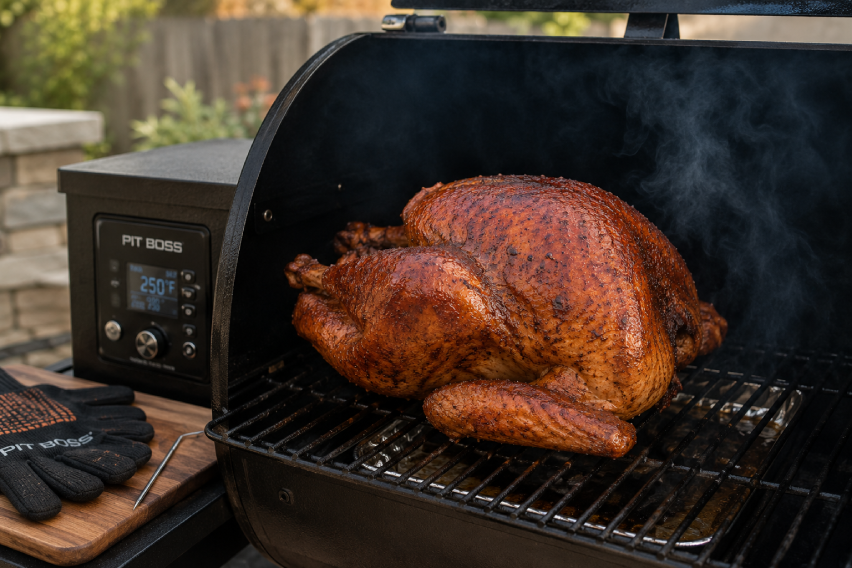
Let me be honest with you about something before we get into any of this. Smoked turkey gets a bad reputation in a lot of households because someone, at some point, pulled a dried-out bird off a grill and declared the whole idea a mistake. That reputation is completely undeserved and almost always the result of two problems — no brine, and cooking too hot for too long without any attention to internal temperature.
Get those two things right and a smoked turkey from a Pit Boss is genuinely one of the most impressive things you can put on a table. The smoke that gets into the skin and the meat during a low and slow cook does something to a turkey that oven roasting simply can’t replicate. You get this mahogany color on the outside, a faint smokiness in every bite, and — if the brine did its job — meat that’s actually moist rather than the chalky dry texture that’s ruined so many Thanksgiving memories.
So let’s talk about how to actually do this correctly.
Choosing the Right Turkey
Size matters on a pellet grill in a way it doesn’t in an oven, and this is the first decision most people don’t think carefully enough about.
A 12 to 15 pound turkey is the sweet spot for smoking. It fits comfortably on most Pit Boss grill grates with clearance for the lid, it takes 4 to 5 hours at smoking temperature, and it cooks evenly without the dramatic temperature difference between breast and thigh that larger birds develop. A 20-pound bird is manageable but requires more patience and more attention to ensure the thigh comes up to temperature before the breast dries out.
If you’re feeding a big group, smoke two 12-pound turkeys rather than one 22-pounder. Two smaller birds give you more surface area for smoke penetration, cook in less time, and carve into more manageable portions.
Fresh vs frozen: If you’re using frozen, give it a full 24 hours in the refrigerator for every 4 to 5 pounds of bird. A 14-pound turkey needs at least 3 days to fully thaw in the fridge. Partially thawed turkey going onto the grill is a food safety issue and a cooking nightmare — the outside will cook and dry out while the inside is still fighting to come to safe temperature.
The Brine — Don't Skip This
This is non-negotiable. Turkey is lean meat with very little fat marbling to protect it during a long cook. Without a brine, even a carefully cooked smoked turkey can finish dry. With a brine, you’ve given the meat a fighting chance.
Simple wet brine:
- 1 gallon cold water
- 1 cup kosher salt (not table salt — it’s too fine and too salty by volume)
- ½ cup brown sugar
- 2 tablespoons black peppercorns
- 4 cloves garlic, smashed
- Fresh herbs if you have them — thyme and rosemary work well
- Optional: 1 orange cut in half, squeezed and dropped in
Dissolve the salt and sugar in a cup of hot water first, then add everything to the cold water. Submerge the turkey completely. If the bird floats, weight it down with a plate. Brine in the refrigerator for at least 12 hours and up to 24 hours. Longer than 24 hours and you start to get an unpleasantly salty result.
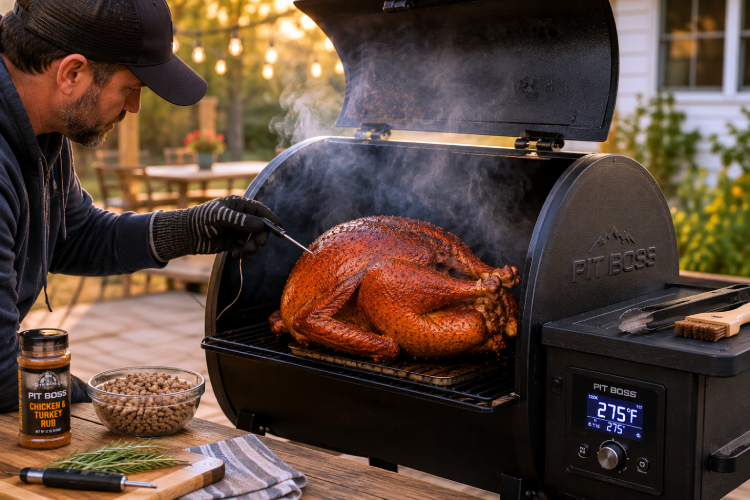
After brining, remove the turkey, rinse it thoroughly under cold water, and pat it completely dry with paper towels. This is important — wet skin doesn’t crisp. Dry skin crisps.
Some people prefer a dry brine, which is exactly what it sounds like: rub kosher salt generously all over the bird, including under the skin if you can get your hand in there, and let it sit uncovered in the refrigerator for 24 to 48 hours. The salt draws out moisture, which then reabsorbs back into the meat along with the salt. Same principle, different process. Dry brining also dries the skin out beautifully for crispy results.
Pellet Selection
This is one of those decisions that sounds complicated and really isn’t. Turkey is mild enough that it takes smoke flavor well without being overwhelmed by it, which gives you some flexibility.
Apple wood pellets are the most popular choice for poultry and with good reason. The smoke is sweet, mild, and slightly fruity. It complements the turkey without dominating it. Apple is hard to go wrong with.
Cherry wood pellets give you a slightly deeper color on the skin — that dark mahogany look that makes a smoked turkey look like it belongs on a magazine cover. The smoke flavor is similar to apple but with a little more depth. Cherry and apple mixed is one of the classic poultry combinations.
Pecan pellets are a Texas tradition with poultry. Slightly nuttier smoke, more pronounced than apple but still solidly in the medium category. Works extremely well with turkey.
Hickory or mesquite: Use with caution. Both are heavy smoke woods that can overpower turkey meat during a long cook. If you love the idea of hickory, mix it 50/50 with apple to soften the intensity.
Setting Up Your Pit Boss
Start by filling the hopper completely. A whole turkey takes 4 to 6 hours and you don’t want to be refilling pellets mid-cook.
Temperature: Start at 225°F for the first 2 to 3 hours. This is where the smoke absorption happens — low temperature, maximum time for smoke to penetrate the meat. After 2 to 3 hours, bump it up to 325°F to finish. This higher heat crisps the skin, which stays soft and rubbery if you cook the entire bird at 225°F.
Turn on your Pit Boss and let it fully preheat before the bird goes on — this takes about 15 minutes. Make sure the grates are clean. Clean grates mean better heat distribution and no residual flavors from whatever you cooked last time.
Drip pan: Place a drip pan on the lower rack or directly below the turkey with about a cup of chicken broth in it. This does two things — it catches drips that would otherwise cause flare-ups, and the moisture from the simmering broth helps maintain a slightly humid cooking environment that protects the breast meat from drying out.
Prepping the Bird
Remove the giblets from the cavity — the turkey usually comes with a bag tucked inside the body cavity and sometimes one inside the neck cavity. Check both. Giblets going onto the grill with the turkey won’t ruin anything but they’re wasted space.
Spatchcocking (optional but worth considering): Removing the backbone and flattening the turkey before smoking is the move that solves almost every turkey problem simultaneously. The bird cooks in half the time, the skin across the entire surface gets equal exposure to heat, and the breast and thigh reach finished temperature at nearly the same time rather than the breast drying out while you wait for the thigh.
To spatchcock: place the turkey breast-side down, use heavy-duty kitchen shears to cut along both sides of the backbone and remove it. Flip the bird breast-side up and press firmly on the breastbone until you hear a crack and the bird lies flat. That’s it. Simple, and it transforms the cooking result.
Butter under the skin: Slide your hand between the breast skin and the breast meat and create a pocket. Push softened butter mixed with garlic, thyme, and a pinch of salt directly onto the breast meat. As the turkey cooks, the butter melts into the breast meat and keeps it moist while adding flavor that dry rubs on the outside can’t deliver into the meat itself.
Exterior rub: Mix together:
- 2 tablespoons olive oil
- 1 tablespoon kosher salt
- 1 teaspoon black pepper
- 1 teaspoon garlic powder
- 1 teaspoon onion powder
- 1 teaspoon smoked paprika
- ½ teaspoon dried thyme
- ½ teaspoon dried rosemary
Rub this over every exposed surface of the turkey. Work it into every crease and cavity.
The Cook
Whole turkey cook timeline (12–14 lb bird):
Smoke at 225°F for approximately 2 to 3 hours, then increase to 325°F until finished. Total time: 4 to 5 hours.
Spatchcocked turkey cook timeline:
Cook entirely at 325°F. Total time: 2 to 2.5 hours.
These are guidelines, not guarantees. Every turkey is different, every grill runs slightly differently, and ambient temperature affects cook time. The only thing that tells you the turkey is done is a thermometer.
Target temperatures:
- Breast meat: 165°F — this is the USDA safe temperature. If you want juicier breast meat, pull at 160°F and let carryover cooking finish the job during the rest period.
- Thigh meat: 175°F — the thigh is dark meat with more collagen, and it actually benefits from a slightly higher temperature to break that collagen down into gelatin. A thigh pulled at 165°F can be slightly chewy.
Insert the thermometer probe into the thickest part of the breast without touching bone for the breast reading, and into the thickest part of the thigh (avoiding the bone) for the thigh reading.
The stall: You may notice the internal temperature stops rising somewhere around 150°F to 155°F and just sits there for 30 to 45 minutes. Don’t panic. This happens because moisture evaporation from the surface of the meat cools it at the same rate the heat is adding to it. It resolves on its own. Don’t crank the heat trying to push through it.
The Rest
This is the step that most people skip because the turkey looks done and the family is hungry. Don’t skip it.
Pull the turkey from the grill when the thigh hits 175°F. Tent it loosely with foil and let it rest for at least 20 to 30 minutes before carving. During this rest period, the temperature inside the bird continues to rise slightly (carryover cooking) and the juices that have been driven toward the center of the meat by heat redistribute back through the muscle fibers. Cut into a turkey immediately off the grill and those juices run out onto the cutting board. Rest the turkey first and they stay in the meat.
Carving and Serving
Remove the legs by cutting through the joint where the thigh meets the body — it should separate easily if the turkey is fully cooked. Separate the thigh from the drumstick the same way.
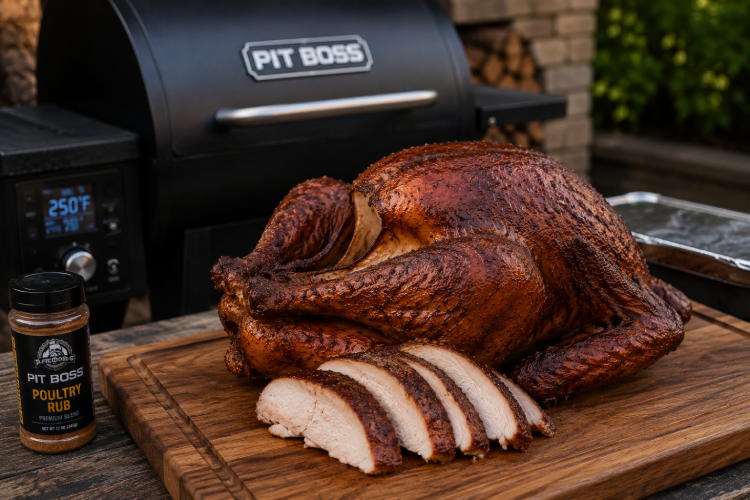
For the breast meat, slice parallel to the breastbone rather than across it. This cuts with the grain of the breast meat rather than against it, which gives you longer, cleaner slices.
The smoked turkey will have a pink ring just below the skin — the smoke ring. This is not undercooked meat. It’s a chemical reaction between the smoke compounds and the myoglobin in the muscle. It’s actually the visual evidence that your smoke penetrated the meat, which is exactly what you want.
Quick Reference
- Bird size: 12 to 15 pounds ideal
- Brine: Minimum 12 hours, maximum 24
- Pellets: Apple, cherry, or pecan
- Temperature: 225°F for 2–3 hours, then 325°F to finish
- Breast done: 165°F internal
- Thigh done: 175°F internal
- Rest time: 20 to 30 minutes minimum