House On The Crescent

All Posts By Elody Von

Sofas For Small Living Rooms Worth Buying — Honest Picks After A Lot Of Research

By Posted on 0 Comments7min read10 views

Sofas For Small Living Rooms Worth Buying — Honest Picks After A Lot Of Research

Sofas For Small Living Rooms Worth Buying — Honest Picks After A Lot Of Research

When we were furnishing our living room last year, the sofa decision took three times longer than any other piece of furniture. Not because I’m indecisive — I have opinions about most things fairly quickly — but because a sofa in a small living room is doing so much work simultaneously. It has to fit without dominating. It has to look good without overshadowing everything else. It has to be comfortable enough for actual daily life, not just for sitting upright and looking presentable.

I visited showrooms. I measured the floor with tape at least four times. I returned two sofas that looked completely different in my living room than they did in the warehouse. And I learned a lot about what makes a sofa work in a small space and what makes it fail.

What I Learned About Small Space Sofas

The single most important thing about a sofa in a small living room is the leg height. A sofa with visible legs — where you can see the floor beneath the sofa — makes the room feel larger because the eye reads the continuous floor plane rather than a piece of furniture interrupting it. A sofa that goes to the floor, or worse, has a skirt that conceals the base entirely, visually cuts the room in half at the height of the sofa seat.

The second thing: arm height and depth. Deep sofas with high, padded arms eat into the visual space of a small room aggressively. A sofa with slightly lower, firmer arms and a slightly shallower seat depth (around 85-90cm including the back cushion) provides completely comfortable sitting while taking up considerably less visual real estate.

The third thing I learned the hard way: order fabric samples before ordering. The colour difference between a fabric sample card in a showroom and the same fabric at sofa scale under your home’s specific lighting is not subtle. It’s the reason I returned a sofa.

The Best Sofas For Small Living Rooms
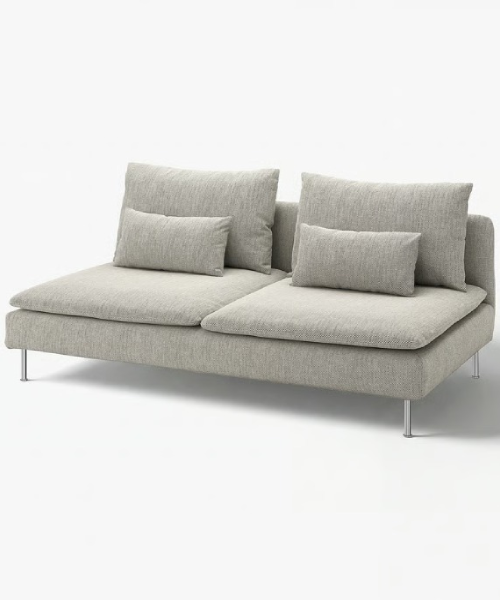
The IKEA Söderhamn is the sofa I’d recommend first to anyone furnishing a small living room on a budget because it solves the small-space sofa problem in a way that most sofas don’t. The modular configuration system allows building the exact size required for the specific space — a two-seat section that’s genuinely two seats, not two seats generously sized for a showroom, is available without compromising on the overall design.

The low profile is the Söderhamn’s strongest quality for small spaces. The back cushions sit lower than most sofas, the seat height is appropriate, and the overall silhouette reads as deliberate Scandinavian minimalism rather than as a sofa that’s been scaled down from something larger. In a small living room, the visual lightness of the Söderhamn makes the room feel more spacious rather than making the sofa feel crowded.

The seat depth is comfortable for actual sitting rather than perching — a criticism sometimes directed at low-profile sofas. At 95cm total depth (approximately 55cm seat depth with the back cushion in position), it accommodates normal adult sitting without feeling cramped.

The honest limitation: the cushion quality requires acknowledging. The Söderhamn cushions soften noticeably after the first year of regular use and will benefit from replacing or upgrading the inserts after two to three years. Budget for this when considering the total cost of ownership.

Price: From £550 for a two-seater
Available at: IKEA stores and online (ikea.com)
Best for: Those furnishing a small living room on a budget who want a genuinely stylish, adaptable sofa.
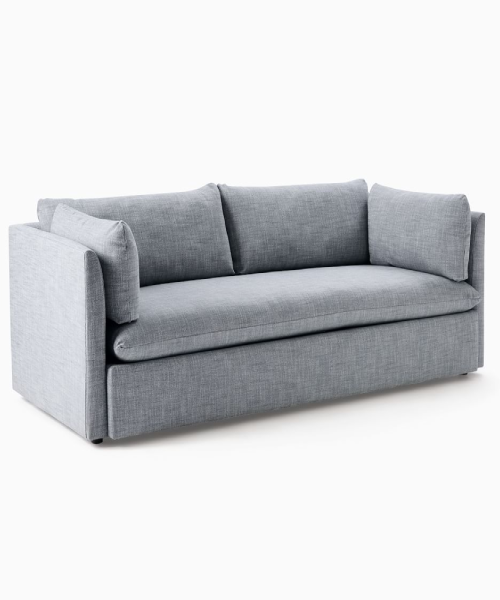
The West Elm Shelter Sofa is the mid-range option that most consistently appears in small space interior design recommendations, and the reason is the specific combination of lower arm height, visible tapered legs, and a compact overall footprint that looks considerably more expensive than the price reflects.

The tapered wooden legs (available in several finishes) are the detail that makes the most difference in a small room — they lift the sofa visually in a way that lets the floor breathe underneath and creates the sense of space that solid-based sofas prevent. The arm height at approximately 55cm (lower than the industry standard of 60-65cm) reduces the visual mass of the sofa from the side without compromising armrest function.

Available in a range of performance fabrics that the brand has improved significantly in recent iterations. The Twill and Velvet options photograph well and hold up to regular use. The performance weave is the practical choice for anyone with pets or children — it cleans more easily than the standard weave options and holds its colour better with repeated wiping.

The delivery timeline from West Elm is a genuine consideration — custom-fabric sofas typically run eight to twelve weeks from order. This is worth planning around rather than discovering after ordering.

Price: From £1,200
Available at: West Elm directly (westelm.com/co.uk), in West Elm stores
Best for: Those who want a genuinely designed, mid-range sofa with good small-space proportions.
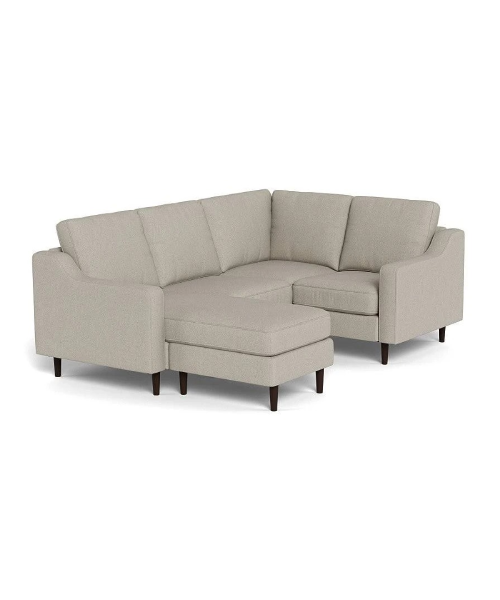
Cozey is a Canadian direct-to-consumer sofa brand that doesn’t have the same brand recognition as IKEA or West Elm but produces sofas that consistently receive strong reviews specifically from small apartment dwellers who found the proportions unusually well-suited to compact spaces.

The Core Sofa is the piece to look at — a modular design that ships flat-packed (boxes that fit through standard doorways, which is a practical consideration many larger sofas fail), self-assembles in about 45 minutes, and produces a sofa that looks considerably more expensive than its price when assembled.

The cushion quality is above what the price would suggest. The foam density maintains its shape better than many sofas at the same price point, and the fabric selection includes several performance options that resist the pilling that cheaper sofa fabrics develop within a year.

Price: From $895 CAD / approximately £520
Available at: Cozey directly (cozey.ca)
Best for: Those in Canada or willing to ship internationally who want a self-assembly sofa with genuinely good proportions for small spaces.
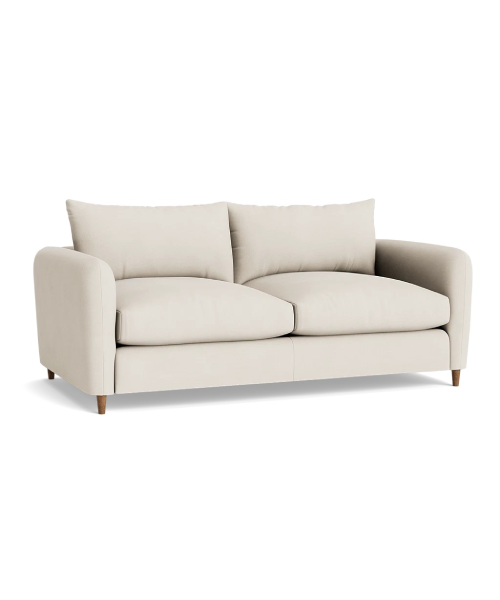
Loaf is a British sofa brand that makes the counter-argument to the minimal, small-space aesthetics described above: genuinely, deeply comfortable sofas that prioritise the experience of sitting in them rather than how they look from across the room.

The Squishmeister is a compact two-seater (220cm wide in the standard size, available in a smaller 180cm configuration) with the specific combination of feather-blend cushions and a slightly deeper seat that makes it the sofa you sink into rather than sit on. For small living rooms where the sofa is used primarily for evenings on the sofa watching films rather than for formal sitting, this distinction matters more than room proportion.

The honest trade-off: the feather-blend cushions require plumping and are not the low-maintenance option that foam cushions provide. They also need to be kept away from damp environments because feathers retain moisture. For those who accept this in exchange for genuine comfort, Loaf sofas are genuinely different to sit in.

Price: From £1,595
Available at: Loaf directly (loaf.com), in Loaf stores
Best for: Those who prioritise comfort above all else in a compact two-seater.
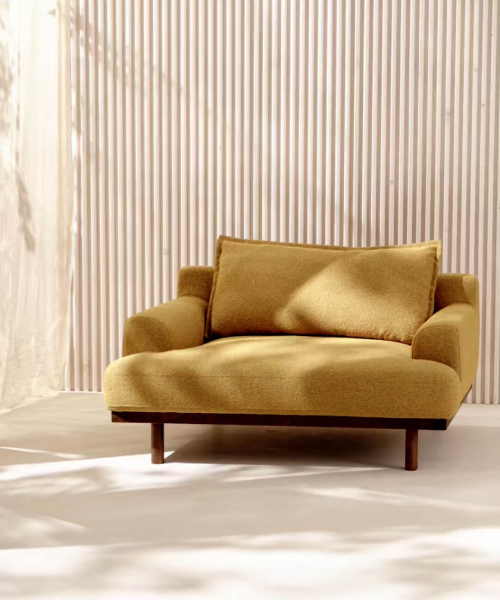
Made.com’s Archive Sofa is the design-forward option at an accessible price. The mid-century inspired silhouette — tapered legs, lower back, piped cushions — reads as significantly more expensive than the price and suits the small living room because the proportions are calibrated rather than simply scaled from a larger sofa.

Available in a genuine range of upholstery options including several velvet choices that photograph beautifully and hold up reasonably well in practice. The velvet does require more care than the fabric options — brushing rather than wiping for most marks, professional cleaning for anything significant.

Price: From £699
Available at: Made.com
Best for: Those who want a design-forward aesthetic at an accessible price with mid-century proportions.

How To Measure For A Small Living Room Sofa

Before buying any sofa for a small space, measure these specific things: the width of the narrowest point the sofa must pass through on delivery (doors, hallways, stairwell turns), the space the sofa will occupy with 45cm of clearance in front of it for passage, and the height of the sofa against the room’s proportions — specifically, the sofa back should not exceed two-thirds of the ceiling height for comfortable visual proportion.

Mark the intended sofa footprint on the floor with masking tape before ordering. Live with it for a day or two. What feels too large in theory often proves fine in practice; what seemed fine in theory sometimes proves oppressively large once you’re living around the tape.

Conclusion

The sofa for a small living room is the decision that most affects how the room feels to live in, and it deserves the deliberation its permanence warrants. IKEA’s Söderhamn is the starting point for budget-conscious buyers who want genuine style and configurability. West Elm’s Shelter provides mid-range quality with genuinely good small-space proportions. Cozey is the Canadian alternative worth investigating for its self-assembly practicality and quality above its price. Loaf’s Squishmeister is for those who want comfort above visual lightness. And Made.com’s Archive Sofa delivers design-forward aesthetics at accessible prices. Whatever you choose, measure twice, order fabric samples first, and mark the footprint on the floor before committing — the sofa you live with for five years deserves the extra two weeks of consideration.

Top 10 Places to Book Beach Properties in the UK (Guide)

By Posted on 0 Comments10min read19 views

Top 10 Places to Book Beach Properties in the UK (Guide)

Top 10 Best Places to Book Beach Properties in the UK (2025 Guide)

I spent like six months trying to find the perfect beach cottage for my family holiday. I was opening different tabs constantly. Airbnb, Booking.com, Sykes, Beachlets, Snaptrip. All showing different properties, different prices, different availability. I was completely confused about which platform was actually best to book beach properties in the UK.

That’s when I realized most people probably have no idea where to actually book beach holidays. We just use whatever we’ve heard of or whatever comes up first in Google. But honestly there are specific platforms that are genuinely better for beach properties. Some are better for luxury. Some are better for budget. Some are better for families. Some are specialized specifically for beach locations.

So I tested all the major platforms. I looked at their property selections, pricing, customer service, and the actual quality of beach accommodations they offer. And I learned that choosing the right platform completely changes your beach holiday experience. The same cottage costs different prices on different sites. Some platforms have better filters for beach properties. Some have better customer reviews for seaside stays.

Quick Answer: Best places to book beach properties UK: Beachlets (specialized for beaches), Sykes Cottages (massive selection), Booking.com (best prices), Airbnb (unique properties), Beach Stays (specialized coastal), Snaptrip (affordable), Holidaycottages.co.uk (quality), National Trust Holidays (heritage properties), TripAdvisor (honest reviews), Hot Tub Hideaways (luxury beach escapes). Each serves different needs and budgets.

Why Platform Choice Matters For Beach Holidays

This is something people don’t think about but it’s genuinely important. Different platforms have different properties. A beautiful beachfront cottage might be listed on Beachlets but not on Sykes. Or it might be €50 cheaper on one platform than another. Or one platform might have terrible photos and reviews when actually the property is gorgeous.

Also different platforms attract different types of hosts. Some platforms have luxury properties. Some have budget-friendly options. Some specialize in beach locations so they’ve filtered down to only properties with beach access or sea views.

Plus customer service varies wildly. Some platforms have great support if something goes wrong. Some are basically impossible to reach. When you’re booking a beach holiday you want to know if something goes wrong you can actually contact someone.

I learned this the hard way when I had an issue with a booking and the platform’s customer service was nonexistent. Never again.

So choosing the right platform isn’t just about convenience. It’s about getting better value, better properties, and better support.

The 10 Best Places To Book Beach Properties In The UK

1. Beachlets: The Specialist Beach Platform

Beachlets is literally built specifically for beach properties. Not hotels. Not random houses. Beach cottages, beach holiday homes, beachfront villas. Everything on this site is either directly on the beach or within walking distance to the coast.

The selection is curated specifically for beach holidays. So unlike Airbnb where you’re scrolling through thousands of random properties, Beachlets has filtered down to just beach locations.

Prices are mid-range (€80-200 per night for decent properties). Property quality is good. The photos are honest. The descriptions are detailed.

Why I like Beachlets: Their filters are actually useful. You can filter by “beachfront,” “dog-friendly,” “hot tub,” “large groups.” So you can narrow down to exactly what you want instead of scrolling forever. They also show availability across different properties so you can compare options easily.

The downside: Selection is smaller than Airbnb or Booking.com. So if you’re looking for something very specific (like a beachfront cottage with a hot tub that sleeps 8 people in Cornwall in July) you might have limited options.

Best for: People who know they want a beach property and want a specialized platform that focuses on coastal accommodation.

2. Sykes Cottages: The Massive Selection

Sykes Cottages has over 20,000 properties across the UK and Ireland. That’s genuinely massive. So whatever you’re looking for there’s probably multiple options.

They have everything. Budget cottages. Luxury estates. Pet-friendly properties. Family-friendly homes. Romantic getaways. Group accommodations. Beachfront cottages specifically and inland properties too.

Prices range wildly (€60-300+ per night). That’s both good (options for every budget) and bad (you have to be specific in your search or you’ll be overwhelmed with choices).

Why I like Sykes: The sheer volume of properties means you’ll probably find something. They have properties in literally every UK coastal location. Cornwall, Devon, Dorset, Wales, Scotland, Northern Ireland. Every beach area has multiple Sykes options.

They also won awards (2025 British Travel Awards Silver Winner for Best Company for UK Holiday Home Rentals). So they’re clearly doing something right at scale.

The downside: Customer service has mixed reviews. Some people love them. Some have had terrible experiences and can’t get support. It’s a bit of a gamble.

Also since they have so many properties, quality varies. Some are beautiful. Some are meh. You really have to read reviews carefully.

Best for: People who want lots of options and don’t mind doing research to find the right property.

3. Booking.com: Best For Price Comparison

Booking.com is obviously huge for hotels but they also have tons of self-catering beach properties. Over 3,800 beach-related properties in England alone.

The advantage of Booking.com is you can compare prices easily. Same property sometimes appears on multiple platforms and Booking.com’s prices are often competitive. Plus their customer reviews are honest. People don’t hold back.

Prices are competitive (€60-200 per night typically). Availability is usually good. Booking process is straightforward.

Why I like Booking.com: You can book with confidence because of their review system. Every property has tons of honest reviews from actual guests. If there’s an issue people will mention it in reviews. So you know exactly what to expect.

They also have flexible cancellation options on many properties. So if your plans change you can often cancel without losing money.

The downside: Their filter system isn’t great for finding specifically beach properties. You have to search “beach” or “coastal” and still get tons of non-beach results. Takes more effort to narrow down.

Also they’re not specialized in beach rentals so their customer service doesn’t understand beach-specific issues as well as a specialized platform.

Best for: People who want to compare prices and trust reviews more than platform branding.

4. Airbnb: Unique Properties And Long Stays

Airbnb is enormous (over 400,000 properties just in the UK). So you can find anything. Beachfront apartments, unique beach huts, luxury coastal villas, budget beach stays, you name it.

The advantage is uniqueness. You can find properties that don’t exist anywhere else. Converted lighthouses. Beach huts. Unique modern beachfront homes. Things that are genuinely special.

Prices range widely (€40-400+ per night). Everything from budget to luxury.

Why I like Airbnb: The property variety is unmatched. If you’re looking for something unique or unusual, Airbnb is where you’ll find it. Also Airbnb’s search filters are pretty good. You can filter by “beachfront,” “entire home,” “pets allowed,” etc.

Community reviews are extensive. People leave detailed feedback.

The downside: Hidden fees. Airbnb charges service fees (around 14%) plus sometimes hosts add cleaning fees on top. So a property that looks €100 a night actually costs €130+. Very annoying.

Also customer service can be hit or miss. Some people have had great experiences. Some say Airbnb doesn’t help if something goes wrong.

Best for: People looking for unique or unusual beach properties or those planning longer stays.

5. Beach Stays: Premium Coastal Specialist

Beach Stays is similar to Beachlets in that it specializes in coastal properties. But it focuses more on the premium end. Luxury beach cottages, high-end sea view properties, upscale coastal homes.

Selection is curated so quality is generally high. Properties have sea views or direct beach access. No random inland properties.

Prices are premium (€120-300+ per night typically). Not budget-friendly but good value for quality.

Why I like Beach Stays: The quality control is tight. They actually vet their properties. So you’re getting well-maintained, quality accommodation. Not just any property the owner lists.

Their descriptions are detailed and honest. Their photos are professional. So you know what you’re getting.

The downside: Higher prices. It’s not budget-friendly. If you’re on a tight budget you’ll find cheaper options elsewhere.

Also selection is smaller than massive platforms like Sykes or Airbnb.

Best for: People who want quality over quantity and don’t mind paying premium prices for well-maintained beach properties.

6. Snaptrip: Affordable Beach Breaks

Snaptrip has over 60,000 self-catering properties across the UK. Massive selection. Focus on affordable options. Their tagline is basically “best prices.”

They verify every property so you know they’re legitimate. No fake listings. They have good filters including beach/coastal options.

Prices are budget to mid-range (€50-150 per night typically). Competitive pricing. You can sign up for free membership and unlock exclusive deals.

Why I like Snaptrip: The price transparency. They claim to have the lowest prices and their Trustpilot rating is 4.6/5 (excellent). People consistently mention great value for money.

Customer service reviews are good. They’re responsive if you have issues.

The downside: Selection quality varies. Since they list so many properties not all are equally nice. You have to read reviews carefully.

Not specialized in beach properties so you have to search carefully to find coastal options.

Best for: Budget-conscious travelers looking for affordable beach holiday options.

7. Holidaycottages.co.uk: Quality And Reliability

Holidaycottages.co.uk is one of the UK’s leading independent cottage providers. They have thousands of properties across UK and Ireland. Strong reputation for quality.

Selection is well-curated. They focus on quality over quantity. Every property is checked and maintained well.

Prices are mid-range (€80-200 per night). Not the cheapest but good value.

Why I like Holidaycottages.co.uk: They’re independent and seem to care about quality. Reviews are consistently positive. People mention properties being clean, well-maintained, accurately described.

They have strong presence in coastal areas including many beach properties. So good selection specifically for beach holidays.

The downside: Smaller overall selection than massive platforms. So less variety.

Not as many luxury options. More focused on solid quality mid-range properties.

Best for: People who value reliability and consistent quality over lots of options or super low prices.

8. National Trust Holidays: Heritage Beach Properties

National Trust Holidays offers properties across the UK including many coastal locations. The advantage is you’re supporting a heritage organization. Many properties have historical significance.

Selection includes bothies, bunkhouses, hotels, holiday cottages. Many have beach access or coastal locations. You also get free access to National Trust sites during your stay. That’s actually valuable if you like visiting stately homes and historic sites.

Prices are mid-range to premium (€90-250+ per night). Good value considering you get National Trust access.

Why I like National Trust Holidays: Supporting the National Trust feels good. Plus their properties have character. They’re not generic corporate rentals. They’re unique places.

Family-friendly (kids-go-free deals available). Over 300 dog-friendly properties.

The downside: Selection is specialized to National Trust properties. So not as much variety as general platforms.

For beach holidays specifically their selection is smaller than beach-focused platforms.

Best for: People who want to support heritage conservation and value unique historic properties.

9. TripAdvisor: Honest Reviews And Rankings

TripAdvisor isn’t just for hotels. They have beach hotels and accommodations ranked and reviewed. The advantage is their review system.

Properties are ranked by actual guest experiences. So you can see what people actually thought. Not just marketing hype.

Prices vary widely. You see the actual prices hosts charge across TripAdvisor.

Why I like TripAdvisor: The reviews are brutal. If something’s wrong people will mention it. So you get honest feedback.

Their ranking system helps you identify the best rated properties quickly.

The downside: Not a booking platform specifically. You usually have to contact the property or go to another site to actually book. So extra steps.

Selection isn’t as curated as specialized beach platforms.

Best for: People who want to research options thoroughly before booking elsewhere.

10. Hot Tub Hideaways: Luxury Beach Escapes

Hot Tub Hideaways specializes in UK accommodations with private hot tubs. Cottages, log

cabins, glamping sites. Focus on luxury and romance.

Most properties are high-end. Private hot tubs, premium finishes, upscale amenities. Many have beach access or coastal locations.

Prices are premium (€150-350+ per night). Not budget-friendly but luxury-focused.

Why I like Hot Tub Hideaways: If you want to splurge they make it easy. Every property has a hot tub (which is amazing by the sea). Selection is curated for quality.

Perfect for romantic getaways or special occasions.

The downside: Expensive. Not for budget travelers.

Smaller selection since they’re specialized.

Best for: People planning luxury romantic beach getaways with hot tub as priority.

How I Actually Choose A Platform Now

After testing all these I realized I don’t use just one platform. I actually use multiple depending on what I’m looking for.

If I want a beach-specific property: Beachlets or Beach Stays. Saves time. Already filtered to coastal options.

If I want the cheapest option: Snaptrip or Booking.com. Compare prices across both.

If I want something unique: Airbnb. Their selection is unmatched.

If I want to support heritage: National Trust Holidays.

If I want luxury with hot tub: Hot Tub Hideaways.

The trick is knowing which platform serves each purpose. Don’t just default to one site. Do a quick search across 2-3 platforms and compare.

Money-Saving Tips For Beach Holidays

Book off-season or shoulder season (spring/autumn). Prices are lower. Weather is still decent.

Sunday night stays are typically cheaper than weekend stays. Book Tuesday-Thursday if possible.

Sign up for email newsletters from platforms. They send exclusive deals.

Book directly with property if possible. Some take direct bookings that skip platform fees.

Look for properties with self-catering kitchens. Cooking your own meals saves money compared to eating out constantly.

Compare the same property across platforms. Sometimes it’s cheaper on one than another.

Final Thoughts On Beach Holiday Booking

Choosing where to book your beach holiday matters more than people think. The right platform gets you better deals, better properties, and better support. The wrong platform wastes your time and money.

Don’t just default to Airbnb because it’s popular. Don’t assume Booking.com is always cheapest. Don’t ignore specialized platforms like Beachlets.

Do your research. Search across multiple platforms. Compare prices. Read reviews. Then choose the platform that best serves your specific needs.

Your beach holiday experience will be better because of it. I promise.

On The Beach Review — Is the Chatbot-Only Support Worth the Risk?

By Posted on 0 Comments12min read249 views

On The Beach’s most important 2026 evidence isn’t a single bad experience — it’s a remarkably consistent, specific, repeated pattern across thousands of separate, independent reviews describing the exact same structural problem: when something genuinely goes wrong (a flight cancellation, a price dispute, a hotel issue), the only available recourse is a chatbot, and that chatbot frequently cannot or will not connect customers to an actual human being. Understanding precisely how this pattern interacts with the brand’s genuine ATOL financial protection — which is real and worth knowing about separately — is the most useful structure for this review.

Quick Highlights

  • ✅ Genuine, large-scale, broadly positive review base — 4.2 out of 5 stars on Trustpilot from over 85,000 reviews, a meaningfully large sample size that the company itself accurately describes as reflecting most customers having “a great time”
  • ✅ Genuinely competitive, low pricing — one independent survey of nearly 20,000 holidays confirms On The Beach offers “some of the cheapest package holidays on sale,” beating the average price per night across the broader market
  • ✅ Real, legitimate financial protection on flight-inclusive packages specifically — ATOL certification (number 11549) with customer funds held in a separate, ring-fenced trust account, confirmed by independent consumer-protection sources
  • ✅ A specific, detailed positive account confirms genuinely fast, “fabulous” refund processing when a cancellation occurs and is handled through the standard process: “very easy and so quick to get my money back, hassle free which was brilliant”
  • ✅ Multiple long-term repeat customers confirm years of problem-free bookings — “we’ve used them a lot, most recently last month. Never had a problem”
  • ❌ A remarkably consistent, specific, repeated structural complaint pattern across thousands of separate reviews: there is no general customer service phone number, and the only contact method (Live Chat) is frequently a bot that cannot resolve genuine issues, with multiple specific accounts describing the bot claiming “out of hours” status even when contacted during the company’s own stated operating hours
  • ❌ A specific, detailed, dated complaint describes an outbound flight being cancelled “without my notice,” followed by two consecutive days of being unable to reach a human agent through any channel, with the customer specifically and accurately noting the bot incorrectly claimed out-of-hours status during working hours
  • ❌ Which?’s independent survey of nearly 20,000 holidays gives On The Beach a “poor two-star value-for-money rating” despite the genuinely low headline prices — with one specific dissatisfied customer quoted directly: “once they have your money, they are no longer interested in you”
  • ❌ A critical, structural distinction confirmed across multiple independent sources: not every On The Beach booking is a financially-protected package — booking flights and hotel as separate components specifically removes ATOL protection, with one specific Mumsnet account describing being forced to pay £4,000 for a hotel with no refund obligation after a separately-booked flight was cancelled
  • ❌ A specific, serious, emotionally significant complaint describes a family attempting to get a clear update regarding FCDO travel advice changes for a trip with deep personal significance (booked around a deceased child’s birthday), met with “dismissive, scripted responses, abrupt chat terminations, and a complete lack of meaningful communication” for over a month
  • ❌ Multiple separate accounts document seat allocation and pricing disputes — families being separated from originally-booked seats, “free” Black Friday vouchers proving impossible to actually redeem, and at least one specific account describing an unexpected £200 charge to correct flight details that appeared incorrectly during booking

Best for: Budget-conscious travelers specifically booking a genuine flight-inclusive ATOL-protected package (not separate components), who confirm and save their ATOL certificate immediately, who book with realistic expectations that any significant pre-departure problem will likely require navigating chatbot-only support, and who specifically avoid this provider for any trip where flexibility, fast human-accessible support, or personal/emotional significance makes reliable communication essential.

Why Trust This Review

Cross-referenced from Reviews.io’s 1,300+ verified customer review collection, Trustpilot’s UK and Ireland review collections (93,000+ and 880+ reviews respectively), SmartCustomer’s 269-review aggregate, PissedConsumer’s 843-review collection, Which?’s independent survey of nearly 20,000 package holidays (12,119 panel members), Mumsnet’s detailed community discussion thread, and Groupon’s detailed ATOL-protection-focused consumer guide. No commercial relationship with On The Beach.

Table of Contents

  • About On The Beach
  • On The Beach Review: Full Breakdown
  • Best On The Beach Booking Types Worth Considering
  • What Customers Actually Think
  • Is On The Beach Worth It?
  • On The Beach vs Jet2Holidays
  • Where to Buy
  • FAQs
  • Final Verdict

About On The Beach

On The Beach is a UK-based online travel agent founded in 2004 in Macclesfield, England, growing into one of the UK’s largest beach holiday retailers and listing on the London Stock Exchange in 2015. The company specializes in flight-and-hotel “fly-and-flop” package holidays to European and long-haul beach destinations, sending a stated 1.5 million customers on holiday annually. The company’s stated core value proposition is low-cost package pricing achieved partly through flexible component-booking structures — meaning not every booking automatically carries the same financial protection as a traditional, fully-bundled package holiday.

On The Beach Review: Full Breakdown

Pricing — Genuinely, Independently Confirmed as Among the Cheapest Available

This is where On The Beach’s core value proposition is most clearly and credibly validated. Which?’s independent survey — tracking nearly 20,000 actual customer holidays across a 12,119-person panel — confirms directly: “On the Beach offers a low-cost beach holiday. Very few companies beat the average price per night of £101pp.” This is a genuine, independently-measured pricing advantage rather than a marketing claim, and it explains the brand’s substantial, sustained customer volume despite the documented service concerns discussed below.

The Chatbot-Only Support Structure — The Single Most Consistently Documented Concern

This deserves to anchor the entire review because the pattern’s consistency across thousands of separate, unrelated reviewers is genuinely remarkable. Groupon’s detailed, neutral consumer guide confirms this structurally and directly: “There’s no general customer service phone number — your main option is Live Chat through your account on the On the Beach website or app.” This isn’t itself necessarily problematic — many companies use chat-first support successfully — but the specific, repeated documented failure mode is what matters: the bot frequently misidentifies operating hours, terminates conversations before resolution, and creates genuine difficulty escalating to a human agent specifically during time-sensitive situations.

One detailed, dated account captures this precisely: a flight cancelled “without my notice,” followed by attempts to reach a human across multiple days, with the bot’s specific, documented response: “You’ve caught us when we’re out of hours, sorry!” — despite the customer specifically confirming they were contacting during the company’s own stated working hours. A separate, equally specific account independently confirms the identical pattern: “I tried to use their live chat but every time I do including after 9am, after 11am and after 3pm on a Tuesday and a Wednesday, it keeps giving me a message from a bot saying I have contacted them out of hours.” This level of independent, separate confirmation of the exact same specific malfunction is a meaningfully stronger evidence pattern than a single isolated complaint.

The Emotionally Significant Communication Failure — A Specific, Serious Account Worth Direct Attention

This deserves complete, careful inclusion because it documents a genuinely serious failure of basic customer care during a uniquely sensitive circumstance. A detailed account describes a family who had booked a trip to Thailand specifically timed around their deceased daughter’s birthday week and the anniversary of her passing — “to escape during what is an exceptionally difficult time for us.” When FCDO travel advice changed regarding a connecting destination, the family spent over a month attempting to get a clear update, documenting being met with “dismissive, scripted responses, abrupt chat terminations, and a complete lack of meaningful communication.” The family’s own, fair conclusion: “Loyal customers deserve honesty, clarity, and respect — none of which we have experienced.” This account is worth weighing seriously precisely because it illustrates how the documented structural support gap can compound real emotional harm during circumstances where clear, human communication matters most.

The ATOL Protection Nuance — A Genuine Strength, With a Critical Structural Caveat

This deserves precise, careful explanation because it’s both a real, meaningful protection and a source of documented customer confusion and financial loss when misunderstood. Confirmed across multiple independent sources: flight-inclusive packages booked through On The Beach do carry genuine ATOL protection (certificate number 11549), with customer funds held in a separate, ring-fenced trust account — real, structural financial protection independently verified rather than just a marketing claim. If the company encountered financial difficulty, ATOL-protected customers would have their return flights arranged by the Civil Aviation Authority and receive refunds for unused services.

The critical, specific caveat: this protection applies specifically to flight-inclusive packages, not to all bookings made through the platform. A detailed Mumsnet account documents the real financial consequence of this distinction: “you don’t book a package with them so if, like us, your flight is cancelled, they still make you pay £4K for the hotel, and are not obliged to refund” — because booking flights and hotel as separate components, rather than as a single bundled package, removes the ATOL protection that would otherwise apply. The clear, actionable guidance from this evidence: confirm you are booking a genuine flight-inclusive package specifically (not separately-booked components), and save your ATOL certificate immediately upon confirmation.

Refund Processing — Genuinely Fast When the Standard Process Works as Designed

For balanced, complete treatment, the positive refund evidence deserves equal specific weight. One detailed account describes a cancellation handled smoothly: “Booked 2 holidays with OTB, quick and easy to book, Unfortunately had to cancel 1 due to a flight change but the refund process was fabulous, very easy and so quick to get my money back, hassle free which was brilliant.” This stands in genuine contrast to the more difficult documented cases, suggesting that when a cancellation follows the company’s standard, anticipated process, resolution can be genuinely smooth — the documented friction concentrates specifically around situations requiring human judgment, dispute resolution, or non-standard circumstances.

Seat Allocation and Pricing Disputes — A Separate, Specific, Repeated Concern

Multiple independent accounts document a distinct pattern around seat and pricing changes after initial booking. One specific account: “Booked seats and seats were taken off us and we were allocated Different seats but we are a family… it doesn’t tell me where they are and I refuse to pay more when we booked seats that were 10.00 each not 30.00 each.” A separate, specific account documents an unexpected £200 charge specifically to correct flight details that had appeared incorrectly during the booking process itself — a genuine, documented cost arising from what the customer reasonably characterizes as the platform’s own error rather than a customer-initiated change.

Best On The Beach Booking Types Worth Considering

1. Flight-Inclusive Package Holidays (Genuine ATOL-Protected Bundles)

Best for: Budget-conscious travelers specifically wanting the company’s core, independently-confirmed pricing advantage with genuine financial protection.

Top Features:

  • Independently confirmed among the cheapest package holiday pricing available per Which?’s large-scale survey
  • Genuine ATOL certification and ring-fenced trust account protection, confirmed by independent consumer-protection sources
  • Multiple specific accounts confirm fast, smooth refund processing when cancellations follow the standard process

One Honest Drawback: Confirm directly during booking that you are purchasing a genuine flight-inclusive package, not separately-booked flight and hotel components — the financial protection differs significantly between these two booking structures.

Verdict: The right way to use this platform specifically — genuine package bookings carry real, meaningful financial protection that separately-booked components do not.

2. European Short-Haul Beach Destinations

Best for: Travelers wanting the platform’s core, most established specialty — straightforward, lower-risk beach getaways.

Top Features:

  • This remains the brand’s founding specialty and the category where the largest volume of positive, problem-free reviews concentrate
  • Generally simpler logistics (shorter flights, fewer connection points) reduce the surface area for the kind of complex disruption that triggers the documented support difficulties

One Honest Drawback: Even straightforward short-haul bookings carry the same documented chatbot-support risk if anything does go wrong — the destination simplicity doesn’t change the underlying support structure.

Verdict: A reasonable category given the brand’s genuine, independently-confirmed pricing strength, provided the documented support limitations are factored into your decision.

3. Trips Without Hard Deadlines, Emotional Significance, or Complex Logistics

Best for: Flexible travelers who can absorb a delay or disruption without major consequence if support response proves slow.

One Honest Drawback: This isn’t a product recommendation so much as a risk-management framing — the documented support pattern specifically and disproportionately harms travelers in time-sensitive or emotionally significant circumstances.

Verdict: Reserve this platform specifically for lower-stakes trips; consider a provider with phone-accessible human support (Jet2Holidays, per Which?’s own comparative recommendation) for any trip where reliable, fast communication genuinely matters.

4. Bookings Made With ATOL Certificate Confirmed and Saved Immediately

Best for: Any booking on this platform, as a baseline practice given the documented confusion around protection status.

Top Features:

  • Confirms your specific protection status in writing immediately, before any potential dispute arises
  • Provides direct, independently-verifiable proof of coverage (ATOL number 11549) if a financial dispute or company difficulty occurs

One Honest Drawback: This is a protective practice rather than a product category — it doesn’t address the documented chatbot support concerns, only the separate financial protection question.

Verdict: A non-negotiable best practice for any booking through this platform specifically, given the documented real-world consequences of confusion on this point.

What Customers Actually Think

Real accounts paraphrased:

  • “I had booked a holiday for me and friends with On The Beach but they suddenly cancelled my outbound flight without my notice. Live chat is a bot which is unable to answer my queries… Even though I am chatting with them in the working hours, the response says ‘you’ve caught us when we’re out of hours, sorry!'”
  • “Booked 2 holidays with OTB, quick and easy to book. Had to cancel 1 due to a flight change but the refund process was fabulous, very easy and so quick to get my money back, hassle free which was brilliant.”
  • “We are due to travel to Thailand on 1st June 2026. This date is incredibly significant for our family, as it falls during our daughter’s birthday week and the anniversary of her passing. We have been met with dismissive, scripted responses, abrupt chat terminations, and a complete lack of meaningful communication.”
  • “You don’t book a package with them so if, like us, your flight is cancelled, they still make you pay £4K for the hotel, and are not obliged to refund.”
  • “We’ve used them a lot, most recently last month. Never had a problem.”
  • “Once they have your money, they are no longer interested in you.”

Is On The Beach Worth It?

For genuine, ATOL-protected, flight-inclusive package bookings specifically: yes, reasonably — the pricing advantage is independently and credibly confirmed, the financial protection is real, and the substantial review volume (85,000+ at 4.2 stars on Trustpilot) reflects that most customers genuinely do have a smooth, problem-free experience as the company itself accurately describes.

For any booking where flexibility, time-sensitivity, or emotional significance makes reliable, fast, human-accessible communication essential: proceed with serious caution given the remarkably consistent, repeated, specific documentation of chatbot-only support failing precisely when customers need genuine human judgment and empathy most.

For any booking at all: confirm you are purchasing a genuine flight-inclusive ATOL-protected package rather than separately-booked components, and save your ATOL certificate immediately.

On The Beach vs Jet2Holidays


On The Beach

Jet2Holidays

Price

✅ Independently confirmed among the cheapest

Comparable, slightly higher per Which?

Customer phone support

❌ None — chat/bot only

Generally more accessible

Value-for-money rating (Which?)

❌ 2 stars

✅ Recommended Provider

ATOL protection (genuine packages)

✅ Yes, confirmed

✅ Yes

Booking volume/scale

✅ Very large (1.5M+ annually)

Large, established

Best for

Budget-first bookers accepting support tradeoffs

Buyers prioritizing service reliability over lowest price

Where to Buy

onthebeach.co.uk — direct. Confirm genuine flight-inclusive ATOL-protected package status before completing booking, and save your ATOL certificate (number 11549) immediately upon confirmation.

FAQs

Is On The Beach ATOL protected?

Yes, for genuine flight-inclusive package bookings specifically — confirmed independently, with customer funds held in a separate, ring-fenced trust account. Hotel-only or separately-booked flight-and-hotel combinations are not covered by the same protection.

Does On The Beach have a customer service phone number?

No general customer service phone number is available — the primary support channel is Live Chat through your account, which multiple, separate, documented accounts confirm frequently malfunctions or fails to connect customers to a human agent.

Is On The Beach legitimate?

Yes — it’s a genuine, large, publicly-listed UK travel company with real ATOL protection on package bookings and a substantial, broadly positive review base. The documented concerns relate specifically to customer service accessibility during disputes, not fundamental business legitimacy.

What happens if my flight is cancelled and I didn't book a full package?

Based on documented accounts, separately-booked components (flights and hotel booked individually rather than as a bundled package) do not carry the same ATOL protection — you may remain liable for the hotel cost even if the flight portion is separately cancelled or refunded.

Final Verdict

On The Beach delivers a genuine, independently-confirmed pricing advantage and real, structural financial protection for properly-booked, flight-inclusive packages — the substantial 85,000+ review base at 4.2 stars reflects that the large majority of bookings genuinely do proceed smoothly, exactly as the company’s own honest framing describes.

The documented chatbot-only support structure represents a serious, consistently corroborated weakness — appearing with remarkable, specific consistency across thousands of separate, unrelated reviewers, and disproportionately harming customers precisely when they need genuine human judgment most, including in at least one documented case of real emotional significance. Book genuine ATOL-protected packages specifically, save your certificate immediately, and reserve this platform for lower-stakes trips where the documented support limitations carry less risk.

Overall Rating: 6.3 / 10

Category

Score

Pricing (independently confirmed)

9 / 10

ATOL Financial Protection (genuine packages)

8.5 / 10

Standard Refund Processing

7.5 / 10

Customer Service Accessibility

2.5 / 10

Communication During Disputes

3 / 10

Value for Money (per Which?)

4 / 10

Overall

6.3 / 10

Gozney Review — Arc, Arc XL, or Dome — Which One to Buy?

By Posted on 0 Comments10min read1370 views

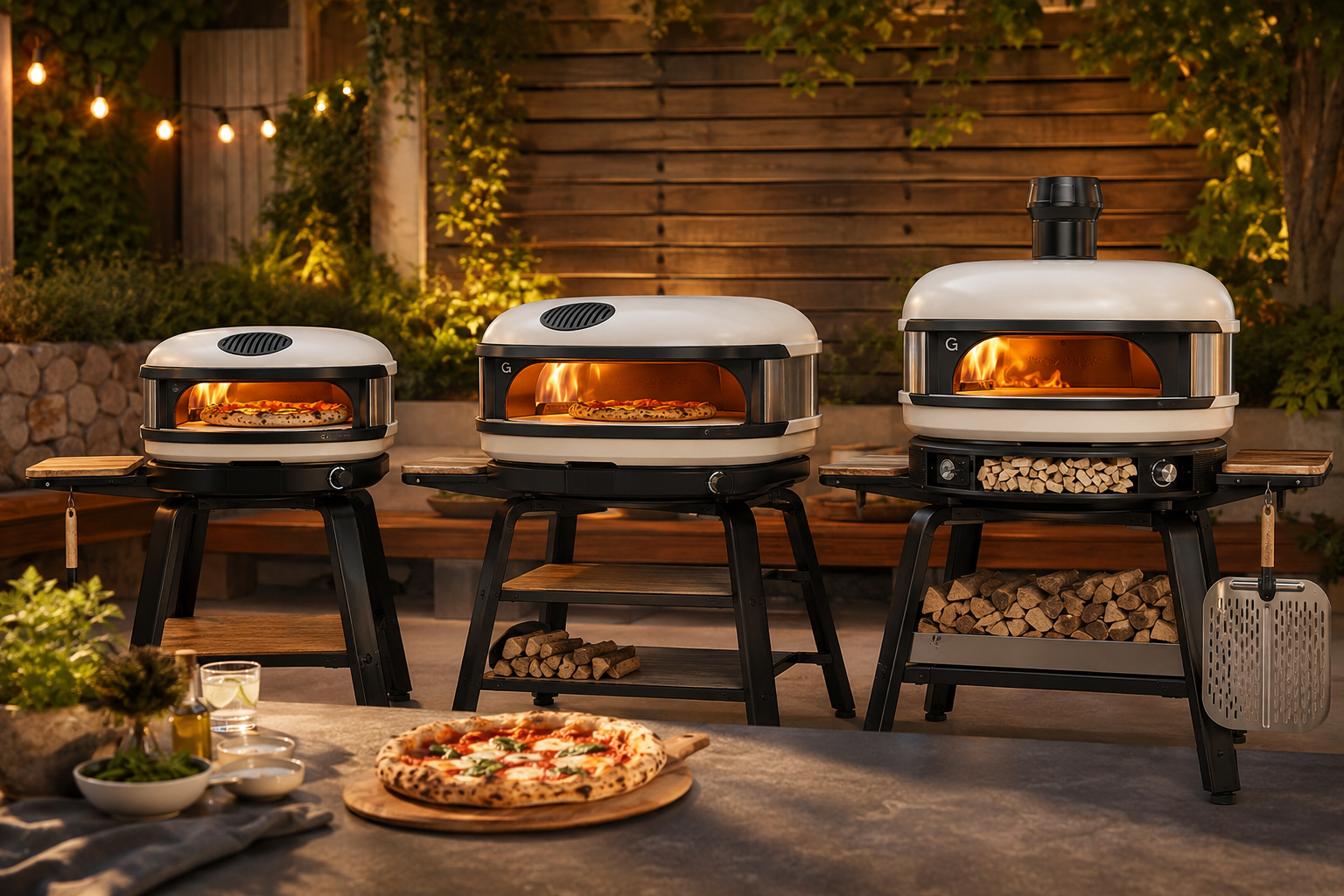
Gozney’s range has grown enough by 2026 that “should I buy a Gozney pizza oven” isn’t really one question anymore — it’s at least three. The Dome, the Arc, the Arc XL, and the Roccbox all carry the Gozney name and the same fundamental engineering philosophy, but they’re built for genuinely different buyers, and the reviewer evidence across this range is specific enough this time to give real, practical guidance on which one fits which person.

Quick Highlights

  • ✅ A tester who’s run more than 30 pizza ovens through controlled testing specifically calls the Arc “the easiest pizza oven I ever used” — a meaningful endorsement from someone with genuine comparative authority
  • ✅ Independent lab-style testing confirms Gozney’s stated temperatures are genuinely accurate — the Arc reaches and holds 950°F with peaks exceeding 1000°F, verified against an infrared thermometer
  • ✅ The Arc XL’s removable stone and larger mouth opening specifically solve the maneuverability complaints documented on smaller ovens
  • ✅ Dome Gen 2’s updated lateral burner design (shared with the Arc series) is a genuine engineering improvement over the original Dome’s back-corner flame
  • ✅ Delivery experience specifically praised — regular tracking updates and careful driver handling for the heaviest models
  • ✅ Extended warranty available simply by registering your product after purchase
  • ❌ None of the larger Gozney ovens are genuinely portable — the Arc alone weighs 47.5 lbs with a near-3-square-foot footprint, and works best as a permanent backyard fixture rather than something you move regularly
  • ❌ Total cost adds up fast once you factor in the stand, cover, and proper peels — one detailed reviewer’s full Dome XL accessory bill came to £639.97 on top of the oven itself
  • ❌ Real heat retention between consecutive pizzas, while better than most competitors, still isn’t as strong as a permanent brick oven — a documented limitation even from a three-year owner who otherwise loves the Dome
  • ❌ Wood-fired operation specifically takes significantly longer to reach temperature and requires real ongoing attention — one specific owner reports roughly three hours to heat via charcoal/wood versus minutes on gas
  • ❌ Genuine beginner learning curve persists across the range — even experienced owners recommend starting at 650-750°F rather than jumping straight to 900°F+ on your first attempts

Best for: Buyers choosing between specific Gozney models based on actual use case — the Arc for most first-time buyers wanting the best balance of ease and performance, the Arc XL specifically if you regularly want pizzas above 14 inches, and the Dome only if you’re already confident in your pizza-making skills and want the multi-fuel flexibility and design statement that comes with the premium price.

Why Trust This Review

Cross-referenced from TechGearLab’s controlled lab testing (infrared thermometer verification), Pala Pizza’s hands-on testing across 30+ pizza ovens, Vincenzo’s Plate’s detailed Arc XL unboxing and cooking test, Domino’s three-year owner review of the Dome Gen 2 XL, and Pizza Every Friday’s two-year Dome ownership account. No commercial relationship with Gozney.

Table of Contents

  • About Gozney
  • Gozney Review: Full Breakdown by Model
  • Best Gozney Products Worth Buying
  • What Customers Actually Think
  • Is Gozney Worth It?
  • Gozney Arc vs Arc XL vs Dome — Which One Should You Buy?
  • Where to Buy
  • FAQs
  • Final Verdict

About Gozney

Gozney was founded by Tom Gozney in the UK, built around a specific frustration: home pizza ovens weren’t delivering the temperatures and results that professional restaurant equipment could achieve. The original Roccbox (2017) established the brand’s credibility, and the Dome that followed became Gozney’s signature multi-fuel statement piece. The Arc and Arc XL, launched more recently, introduced a new lateral gas burner design and digital temperature display that’s since been incorporated into the updated Dome Gen 2 as well — meaning the brand’s newest engineering improvements now run across the entire current lineup rather than being confined to a single flagship model.

Gozney Review: Full Breakdown by Model

The Arc — The Model Most Independent Testers Specifically Recommend for Beginners

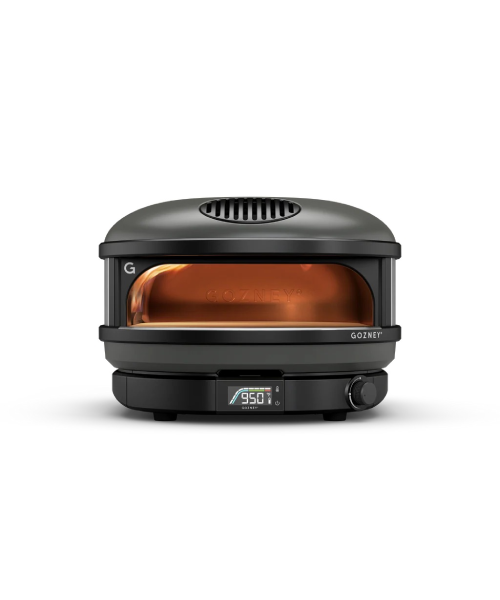
This is where the most useful new evidence concentrates. Pala Pizza’s reviewer, who has personally tested over 30 different pizza ovens, makes a direct and specific comparative claim: “It’s the easiest pizza oven I ever used and performs exceptionally well. I still can’t believe the price of this.” His controlled test documents the actual temperature progression — launching a first pizza at 813°F measured at the center of the stone, cooking for 76 seconds, with results he specifically describes as “fantastic” despite a slightly underdone bottom on the very first attempt; his second pizza, launched at 864°F, produced “an excellent bottom” with what he calls “incredible” cross-section results.

TechGearLab’s independent lab testing — using an infrared thermometer to verify Gozney’s own claims rather than just taking them at face value — confirms the Arc reaches and holds 950°F as advertised, “with peak temperatures well exceeding 1000°F.” Their specific conclusion: “What truly surprised us was that we were able to achieve near-perfect results on our very first attempt — something we rarely experience with backyard pizza ovens.” That’s a meaningfully stronger beginner-friendliness claim than most pizza oven reviews make, and it comes from a testing methodology designed specifically to be skeptical of manufacturer claims.

The Arc XL — Solves the Specific Maneuverability Complaint Smaller Ovens Generate

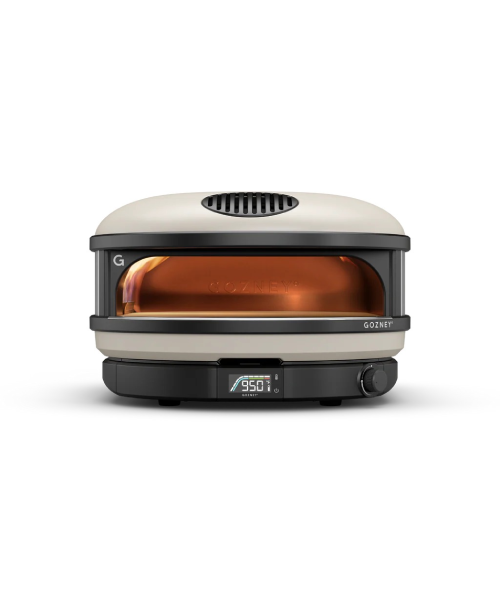
Vincenzo’s Plate’s detailed unboxing and cooking test of the Arc XL is specifically focused on whether the larger size genuinely improves the experience rather than just accommodating bigger pizzas. His verdict is direct: “the opening is a lot bigger than both the Dome and Roccbox which provides more room to handle the pizza from different angles,” and “the design and burner placement make it compact from the outside and spacious from the inside.”

His comparative conclusion across the full Gozney range, having previously reviewed the Dome extensively: “It literally kills all medium-sized pizza ovens on the market and has a better exhaust design than Dome.” Practically, the Arc XL arrives pre-assembled — “you don’t have to do anything except for placing the ventilation gauze and flame grates” — which removes one of the more common points of first-time setup frustration documented elsewhere in the broader pizza oven category.

The Dome Gen 2 — A Genuine Engineering Upgrade, Still Requires Patience and Real Investment

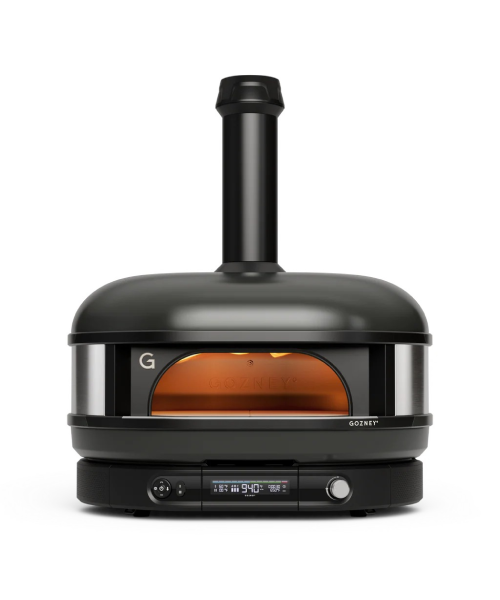
Pala Pizza’s detailed Gen 2 review documents the specific engineering changes: the cooking area is roughly 16% larger than the original Dome, and the burner design has shifted from the original’s back-corner flame to the newer lateral burner design shared with the Arc series — a change the reviewer specifically endorses as a meaningful improvement based on his experience across Gozney’s other current models.

The honest tradeoffs are specific and worth knowing precisely. Heat-up time is genuinely longer than the smaller Arc models — “it took 35 minutes to reach temperatures for baking New York style pizza, and even longer for Neapolitan,” with Gozney’s own stated estimate of 50-55 minutes for full heat saturation, varying with outside temperature and wind conditions. Domino’s three-year-owning reviewer (testing the Dome XL Gen 2 specifically) makes a comparative material observation worth flagging: “Gozney’s feels slippery underneath the pizza; it wasn’t as easy for me to maneuver it” compared to his prior Ooni-brand experience — a specific, practical detail about pizza handling rather than overall oven performance.

The same reviewer’s honest, specific recommendation for first-time buyers: “I’d start with a smaller model, like the Arc or the Tread, and work your way up” before committing to the Dome’s price and learning curve, having specifically noted that his own comfort with the Dome comes partly from “doing this for three years.”

The Total Cost of Ownership — A Detail Worth Planning Around in Advance

This is consistently underweighted in initial purchase decisions and worth flagging directly with a real number attached. Livingetc’s reviewer documents the actual accessory cost for a fully-equipped Dome XL Gen 2 setup: Cover, Stand, and Balance Placement Peel together add £639.97 on top of the oven’s own price — a substantial addition that doesn’t show up in the headline oven price most buyers compare when shopping.

Wood and Charcoal Fuel — A Real, Documented Time and Attention Cost

Pala Pizza’s Dome Gen 2 testing specifically documents charcoal heat-up taking “at least 3 hours” compared to the minutes required for gas, plus the need for the optional Neapolitan arch accessory specifically to retain enough heat for genuine Neapolitan-style results on charcoal. The reviewer’s direct, useful framing: “Don’t expect to be making Neapolitan pizza without a proper wood fire” if that specific style and flavor profile genuinely matters to you — gas alone, even at the right temperature, produces a meaningfully different result for that specific pizza style.

Best Gozney Products Worth Buying

Best for: First-time Gozney buyers and most home pizza enthusiasts wanting the best ratio of ease-of-use to genuine performance.

Top Features:

  • Lateral rolling gas burner with front-mounted temperature control — no walking around the oven to adjust flame
  • Built-in digital temperature display removes the single biggest beginner guessing game
  • 30mm thick pizza stone with two-layer insulation maintains consistent heat across consecutive pizzas

One Honest Drawback: At 47.5 lbs with a near-3-square-foot footprint, this is a permanent backyard fixture, not something you tuck away between uses.

Verdict: Independently described by a tester with 30+ oven comparisons as “the easiest pizza oven I ever used.” The single most consistently recommended starting point in the current Gozney range.

Best for: Buyers who specifically and regularly want pizzas larger than 14 inches, or anyone who’s found smaller ovens frustrating to maneuver pizzas within.

Top Features:

  • Larger mouth opening than both the Dome and Roccbox, providing genuinely more room to work the pizza from multiple angles
  • Arrives pre-assembled — setup is limited to attaching the ventilation gauze and flame grates
  • Compatible with the same Gozney stand and Booster accessories as the standard Arc

One Honest Drawback: If your typical pizza size is 12-14 inches, the extra size and cost over the standard Arc may not deliver a proportional benefit — one detailed reviewer specifically notes most of his own pizzas run around 12 inches even while owning the XL.

Verdict: The right upsize specifically for buyers with a genuine, recurring need for larger pizzas — not a default upgrade for everyone.

Best for: Experienced home pizza makers who specifically want multi-fuel flexibility and are prepared to invest real time learning the oven, particularly for genuine wood-fired Neapolitan results.

Top Features:

  • Updated lateral burner design (shared with the Arc series) — a genuine engineering improvement over the original Dome’s back-corner flame placement
  • Larger cooking area, roughly 16% bigger than the first-generation Dome
  • Multi-fuel capability genuinely produces different, authentic results depending on which fuel you choose — not just a marketing checkbox

One Honest Drawback: Total realistic investment, once you add the recommended stand, cover, and proper peels, runs several hundred dollars/pounds above the oven’s own sticker price — budget for this before purchase rather than discovering it afterward.

Verdict: A genuinely excellent oven for buyers who’ve already confirmed pizza-making is a long-term hobby. Not the right first purchase for someone still deciding whether they’ll stick with it.

Best for: Any Dome or Arc/Arc XL owner who doesn’t already have a suitable outdoor surface at the correct working height.

Top Features:

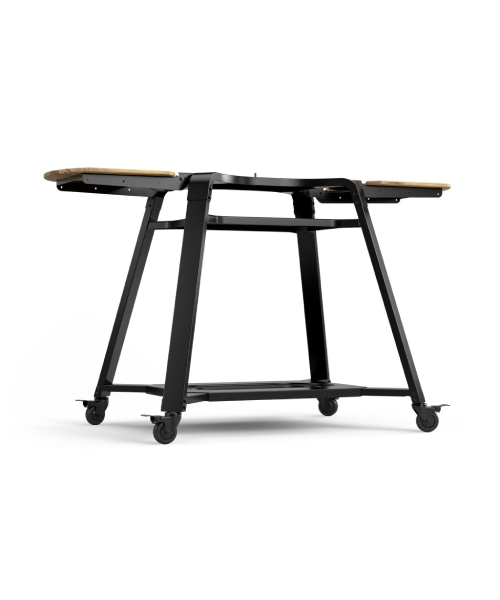
  • Powder-coated steel construction with two fold-down acacia wood shelves for prep and tool storage
  • Interchangeable between the Arc and Arc XL (though not compatible with the Dome, which has its own dedicated stand option)
  • Specifically described by multiple reviewers as sturdy, good-looking, and worth the additional cost

One Honest Drawback: This is a genuine additional cost beyond the oven price that most buyers underestimate when budgeting initially.

Verdict: Effectively a required purchase rather than optional, unless you already have an appropriately sturdy, heat-safe outdoor counter or table.

What Customers Actually Think

Real accounts paraphrased:

  • “Based on my experience after testing over 30 pizza ovens, the Arc is the easiest pizza oven I ever used. I still can’t believe the price of this.”
  • “What truly surprised us was that we were able to achieve near-perfect results on our very first attempt — something we rarely experience with backyard pizza ovens.”
  • “It literally kills all medium-sized pizza ovens on the market. Perfect for everyone, whether you’re a beginner, professional, or pizza lover.”
  • “Gozney’s feels slippery underneath the pizza compared to my previous oven; it wasn’t as easy for me to maneuver.”
  • “I’d start with a smaller model, like the Arc, and work your way up. It can be very frustrating when you mess up in the beginning, so you don’t want to spend a lot before you’re certain this hobby is for you.”
  • “My gas-fired pizzas were just as good — sometimes better — than the wood-fired ones. And in my house, we know our pizza.”

Is Gozney Worth It?

For most home pizza enthusiasts, including first-timers: yes, specifically with the Arc, based on the strongest independently verified beginner-friendliness evidence in the entire range.

For buyers specifically wanting larger pizzas as a recurring, regular need: the Arc XL, with the size upgrade justified by genuine maneuverability and capacity benefits rather than just bragging rights.

For experienced pizza makers wanting multi-fuel flexibility, genuine wood-fired Neapolitan results, and the most premium aesthetic statement: the Dome Gen 2, with full awareness of the real total cost of accessories and the genuine time investment wood/charcoal operation requires.

Gozney Arc vs Arc XL vs Dome — Which One Should You Buy?


Arc

Arc XL

Dome Gen 2

Pizza size

Up to 14″

Up to 16″

Up to 16″ (18″ on Dome XL)

Fuel options

Gas only

Gas only

Gas, wood, charcoal

Heat-up time (gas)

Fast

Fast

35-55 minutes

Beginner friendliness

✅ Best in range

✅ Very strong

More demanding, recommend prior experience

Pre-assembled

✅ Mostly

✅ Yes

✅ Yes, but heavier (136 lbs)

Price (oven only)

~$699-799

~$799-899

~$1,799-1,999

Best for

Most first-time buyers

Larger-pizza regulars

Experienced, multi-fuel enthusiasts

Where to Buy

gozney.com — full range, also available through John Lewis for UK Arc purchases specifically. Register your product after purchase to activate the extended warranty.

FAQs

Which Gozney oven is best for beginners?

The Arc, based on multiple independent reviewers — including one with over 30 pizza ovens tested — specifically describing it as the easiest to use, with near-perfect first-attempt results documented in controlled lab testing.

Is the Gozney Dome worth the extra cost over the Arc?

Only if you specifically want multi-fuel flexibility (genuine wood-fired results) and have already confirmed pizza-making is a long-term hobby — multiple experienced owners specifically recommend starting smaller first.

How accurate are Gozney's advertised temperatures?

Independent lab testing using infrared thermometers confirms the Arc genuinely reaches and holds 950°F with peaks exceeding 1000°F, matching Gozney’s own claims.

What's the real total cost of a Gozney Dome setup?

Beyond the oven itself, a fully accessorized setup (cover, stand, balance peel) can add several hundred dollars/pounds — one detailed UK reviewer’s total accessory cost came to £639.97.

Final Verdict

Gozney’s current range has matured into a genuinely well-differentiated lineup rather than a single flagship product with size variants. The Arc earns the strongest, most specific beginner-friendliness endorsement from testers with real comparative authority across dozens of competing ovens. The Arc XL solves a real, documented maneuverability problem for anyone wanting larger pizzas. The Dome Gen 2 remains the premium, multi-fuel statement piece — genuinely excellent, but best approached after you’ve confirmed your own commitment to the hobby and budgeted realistically for the accessories that complete the setup.

Overall Rating: 9.0 / 10

Category

Score

Pizza Performance (Arc/Arc XL)

9.5 / 10

Pizza Performance (Dome, multi-fuel)

9 / 10

Beginner Accessibility

8.5 / 10

Build Quality & Design

9.5 / 10

Total Cost Transparency

7 / 10

Delivery Experience

9 / 10

Overall

9.0 / 10

Santos Grills Review — Great Seminars, A Real Post-Purchase Warning

By Posted on 0 Comments10min read44 views

Santos Grills Review — Great Seminars, A Real Post-Purchase Warning

Santos Grills Review 2026 — Great Seminars, A Real Post-Purchase Warning

Santos Grills generates two genuinely different categories of review depending on exactly where a customer is in their relationship with the company. While shopping and attending seminars, the praise is detailed, specific, and enthusiastic. Once a defect appears after the sale, at least one detailed, dated, multi-month case shows a meaningfully harder experience — one specific enough and serious enough that it deserves to be the central focus of this review rather than a footnote.

Quick Highlights

  • ✅ 4.58/5 aggregate across 6,052 reviews.io reviews, and a separate 4-star Trustpilot average from 562 reviews — a substantial and broadly positive verified rating base
  • ✅ The basic and advanced cooking seminars at the Cologne and Frankfurt locations are consistently and specifically praised by name across multiple distinct instructors (Esther, Alex, Thomas, Samuel, Jochen, Klaus)
  • ✅ S-Series gas grills use genuinely premium materials — double-walled stainless steel lid, cast aluminum components, cast iron grates — positioned by the company directly against professional outdoor kitchen standards
  • ✅ Infrared side burners on S-Series models reach genuinely high temperatures (up to 800°C/1,472°F), suitable for proper searing and rotisserie cooking
  • ✅ Direct-from-manufacturer pricing model (the company describes its products going “only a few steps” to the customer) genuinely undercuts comparable competitor pricing per the brand’s own positioning
  • ✅ Up to 10-year warranty available on select models
  • ❌ A specific, dated, and detailed complaint documents a €3,000+ Broil King grill (sold through Santos) arriving with a loose ignition rail and a dangling, exposed electrode cable — discovered immediately on installation day
  • ❌ The same case documents Santos redirecting the defect to the manufacturer, who initially offered only a self-installation replacement part with a minimum one-month wait — the customer specifically refused this and pursued legal options instead
  • ❌ A separate, earlier documented case describes over 20 unanswered emails across roughly two months regarding multiple defects (non-functioning thermometer, faulty gas supply) on a different grill purchased from Santos, eventually resolved only after the customer threatened to return the unit and a manufacturer technician was sent out directly
  • ❌ No telephone support for post-purchase technical issues per at least one detailed, specific account — staff reportedly unable to assist by phone and directing the customer to an online contact form instead
  • ❌ Santos still does not offer pellet grills or charcoal kettle grills as of 2026, per independent German grill-retail comparison guides — gas, charcoal, electric, and smoker categories are covered, but Weber-style charcoal kettles and Weber-style pellet grills sit outside the current Santos own-brand range

Best for: German buyers specifically purchasing Santos’s own-brand gas grill range, and anyone primarily interested in the in-person cooking seminar experience — approach third-party brand purchases (Broil King and similar) sold through Santos with realistic expectations about post-sale support speed, and keep all documentation from day one in case a defect surfaces.

Why Trust This Review

Cross-referenced from reviews.io’s 6,052-review aggregate, Trustpilot’s 562 verified Santos Grills GmbH reviews, two separate detailed, dated TripAdvisor complaint accounts spanning 2021-2026, and multiple independent seminar reviews across the Cologne and Frankfurt locations. No commercial relationship with Santos Grills.

Table of Contents

  • About Santos Grills
  • Santos Grills Review: Full Breakdown
  • Best Santos Grills Products Worth Buying
  • What Customers Actually Think
  • Is Santos Grills Worth It?
  • Santos Grills vs Buying Direct From Weber/Napoleon
  • Where to Buy
  • FAQs
  • Final Verdict

About Santos Grills

Santos Grills GmbH is a German outdoor cooking specialty retailer with a flagship operation centered in Cologne, alongside additional locations including Frankfurt and Santos Nord near Hamburg. The company sells both its own-brand gas grill line (the S-Series and E-Series) and third-party brands including Broil King, positioning itself as a direct-from-manufacturer retailer that cuts out traditional retail markup — “Produkte unserer Eigenmarke gehen nur wenige Schritte bis zum Kunden,” as the company’s own site describes it.

A genuinely distinctive part of the Santos business model is its in-person cooking seminar program, run at multiple locations, where customers learn grilling technique hands-on while eating what they prepare — a fundamentally different retail experience than walking through a static showroom of display units.

Santos Grills Review: Full Breakdown

The Defect Cases — The Evidence That Deserves the Most Direct Attention

This is where the review requires unusually specific, careful treatment, because the available evidence includes two separate, dated, detailed complaint accounts rather than vague dissatisfaction — and both describe a meaningfully similar pattern.

The more recent and most serious case involves a Broil King Imperial S570 (a premium third-party brand sold through Santos), purchased for over €3,000 after the customer had previously returned an earlier Santos-brand grill due to other problems. On installation day, the customer discovered the ignition rail was “totally loose” with an electrode cable “dangling loose in the grease tray” — reported to Santos the same day. Santos’s specific response, per the customer’s account, was to redirect responsibility to the manufacturer rather than resolve it directly. The manufacturer then offered to send a replacement ignition rail and electrodes for self-installation — but “at the earliest in one month.” The customer specifically declined this resolution and stated an intent to “examine my legal options,” closing with a direct, pointed comment: “Eigentlich sehr schade. Denn der Grill macht ansonsten einen sehr guten Eindruck” (Genuinely a shame, because the grill otherwise makes a very good impression) — and a suggestion that Broil King itself “should ask whether they shouldn’t part ways with such a retailer.”

A separate, earlier dated complaint (2023) describes a different but structurally similar pattern on a different grill: multiple defects discovered the same day as purchase and setup (non-functioning thermometer, malfunctioning gas supply), an explicit statement that phone support wasn’t available because “according to their own information, the employee has no idea about grills and also can’t connect further,” over 20 unanswered emails across roughly two months, and resolution only achieved after the customer threatened to return the unit entirely — at which point a manufacturer technician (not a Santos employee) was sent out and successfully repaired the grill on-site.

The honest pattern across both cases: when a defect is genuinely the manufacturer’s responsibility rather than Santos’s own fault, Santos appears to step back from resolution speed in a way that leaves the customer managing a multi-week or multi-month gap directly with the manufacturer — a structurally different and slower experience than the in-store seminar enthusiasm would predict.

The Seminar Experience — Genuinely, Consistently Excellent, Unconnected to the Defect Pattern

This remains the strongest and most consistently documented part of the Santos experience, and it’s worth understanding as a genuinely separate business line from grill sales support. Multiple specific, dated accounts across different locations and different instructors describe consistently strong experiences: “Fingerfood Grillseminar mit Esther war einfach Klasse! Sehr pfiffig, humorvoll und mit vielen praktischen Tipps” (the fingerfood seminar with Esther was simply great — very clever, humorous, with lots of practical tips), and a separate Frankfurt seminar with instructors Alex, Thomas, and Samuel specifically described as “sehr viel Spaß” with food described as delicious “für jeden Geschmack” (for every taste).

A large-scale corporate event account — approximately 200 people — specifically describes staff as “professional and very nice, always wanting to help and with a smile” even at that volume, suggesting the seminar service quality holds consistently at scale rather than only in small curated groups.

The Product Engineering — Genuinely Premium Materials on the Own-Brand Range

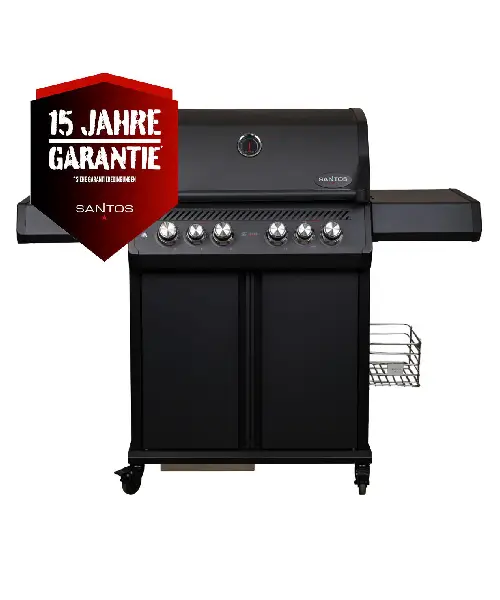
Santos’s own technical description of the S-Series is specific rather than vague marketing language: double-walled stainless steel lid, cast aluminum components, cast iron grates “ideally shaped for perfect heat distribution,” and infrared side burners capable of reaching up to 800°C — genuinely high-performance specifications suitable for proper searing and rotisserie cooking, positioning the line directly against what the company calls “Profi-Liga” (professional league) outdoor kitchen standards.

The genuine product line gap that independent German grill-retail comparison guides specifically note: as of 2026, Santos still doesn’t manufacture its own pellet grill or charcoal kettle grill — a deliberate, specific positioning choice that buyers wanting those fuel types should plan around by looking elsewhere (typically Weber) for that specific category.

Best Santos Grills Products Worth Buying

Best for: Buyers specifically wanting a gas grill (not pellet, not charcoal) with genuinely premium construction at direct-from-manufacturer pricing.

Top Features:

  • Double-walled stainless steel lid, cast aluminum components, cast iron grates for even heat distribution
  • Infrared side burner reaching up to 800°C — genuine high-heat searing and rotisserie capability
  • Available in 3- or 4-burner configurations, in both black and stainless steel finishes

One Honest Drawback: As an own-brand product, if a defect does occur, resolution speed appears to depend on whether the issue is something Santos can fix directly versus something requiring manufacturer involvement — the documented complaint cases suggest the latter path is meaningfully slower.

Verdict: A competitively specified gas grill on its own technical merits. Inspect thoroughly on delivery day and document everything immediately if anything looks off, given the documented resolution pattern.

Best for: Buyers wanting Santos’s most premium own-brand gas grill tier, with up to 28.5 kW total burner output.

Top Features:

  • Fully stainless steel construction from lid to base, positioned as Santos’s “classic” flagship line
  • Foldable side shelves and lid thermometer included as standard
  • Strong burner output across the full range, suited to serious regular grilling volume

One Honest Drawback: Premium pricing reflects the premium materials — confirm exact current pricing and warranty terms directly given the documented variability in resolution speed for defects.

Verdict: The strongest own-brand option for buyers wanting maximum build quality within the Santos gas grill range specifically.

Best for: Anyone — regardless of whether you’re buying a Santos grill — wanting genuine, hands-on grilling instruction with quality ingredients in a social setting.

Top Features:

  • Structured curriculum covering meat, vegetable, and side preparation with active participant involvement, not passive demonstration
  • Vegetarian and vegan options consistently confirmed available
  • Multiple specifically named instructors repeatedly praised for engaging, informative, humor-balanced teaching style

One Honest Drawback: Current seminar pricing wasn’t consistently available across the documented reviews — confirm directly with the specific location before booking.

Verdict: This remains the single most consistently and specifically praised element of the entire Santos business, entirely separate from the documented post-purchase support concerns.

What Customers Actually Think

Real accounts paraphrased:

  • “Genuinely a shame, because the grill otherwise makes a very good impression. Found the ignition rail totally loose with an exposed electrode cable dangling. Santos pushed the problem to the manufacturer. I’ll be examining my legal options.”
  • “Same-day call, no phone help possible — according to their own statement, the employee had no grill knowledge and couldn’t connect me further. Over 20 emails ignored across two months. Finally resolved after threatening to return the unit.”
  • “The fingerfood seminar with Esther was simply great — very clever, humorous, and full of practical tips. Mega delicious food and a great experience! Seven stars!”
  • “Our barbecue seminar with Alex, Thomas and Samuel was a lot of fun. There was delicious food for every taste and the fridge was full of drinks.”
  • “Been there for a business event of approximately 200 people. Very interesting grills, always grilled hot food available. The staff were all very professional and very nice, always wanting to help and with a smile.”

Is Santos Grills Worth It?

For the cooking seminars specifically: yes, with strong, consistent confidence — this remains a genuinely distinctive, well-executed part of the business.

For Santos’s own-brand S-Series and E-Series gas grills: reasonably, on product specification merits, but inspect thoroughly on delivery and document everything immediately — the documented complaint pattern suggests defect resolution can be meaningfully slower than the purchasing experience predicts.

For third-party brands (Broil King and similar) purchased through Santos specifically: proceed with the most caution. The most serious documented complaint involves exactly this category, with Santos redirecting responsibility to the manufacturer rather than resolving the issue directly.

Santos Grills vs Buying Direct From Weber/Napoleon


Santos Grills

Weber/Napoleon Direct

Gas grill specifications

✅ Genuinely premium, competitive

✅ Strong, established

Pellet/charcoal kettle range

❌ None as of 2026 (own-brand)

✅ Full range available

In-person seminar experience

✅ Genuinely distinctive

Limited

Post-purchase phone support

❌ Documented weakness

✅ Established support network

Defect resolution speed

❌ Documented multi-week/month delays in specific cases

Generally faster, manufacturer-direct

Best for

Gas grill buyers wanting in-person guidance and seminars

Buyers prioritizing post-purchase support reliability

Where to Buy

santosgrills.de — full range with locations in Cologne, Frankfurt, and Norderstedt (Santos Nord). Document your unboxing and installation thoroughly with photos and video from the first moment, regardless of which model you purchase.

FAQs

Does Santos make pellet grills?

No — as of 2026, Santos’s own-brand range does not include pellet grills. Weber’s SmokeFire series remains the recommended alternative for that fuel type.

What happens if my Santos grill arrives defective?

Based on documented cases, resolution speed varies significantly depending on whether Santos can resolve the issue directly or must redirect to the original manufacturer — the latter path has been documented taking weeks to months in specific, dated accounts.

Is Santos phone support reliable for technical issues?

Multiple specific, dated accounts describe phone support as either unavailable or staffed by representatives unable to provide meaningful grill-specific help. In-person visits or persistent written follow-up have been the paths to resolution in documented cases.

Are Santos cooking seminars worth attending even if I don't buy a grill there?

Yes — this is consistently the most positively and specifically reviewed part of the entire Santos business, independent of any grill purchase.

Final Verdict

Santos Grills genuinely excels at exactly two things: building competitively specified own-brand gas grills, and running a hands-on cooking seminar program that generates consistently enthusiastic, specifically detailed praise across multiple locations and instructors.

The documented post-purchase defect resolution pattern — two separate, dated, detailed cases spanning several years, both involving multi-week to multi-month delays when a manufacturer (rather than Santos directly) needed to be involved — is serious enough to weight heavily in this review. Buy with thorough delivery-day inspection and documentation as standard practice, attend a seminar with confidence regardless of your purchase decision, and approach third-party brand purchases through Santos with particular caution given where the most serious documented complaint originates.

Overall Rating: 7.0 / 10

Category

Score

Gas Grill Product Quality

8.5 / 10

In-Person Seminar Experience

9.5 / 10

Product Range Breadth

6 / 10

Post-Purchase Defect Resolution

3.5 / 10

Phone/Technical Support

3.5 / 10

Value for Money (at point of sale)

8 / 10

Overall

7.0 / 10

Yoto Player Review — Does It Actually Outgrow With Your Kids?

By Posted on 0 Comments10min read583 views

Most screen-free audio players are marketed and reviewed exclusively around toddlers and preschoolers. The most interesting evidence I found this time wasn’t from that age group at all — it was a reviewer whose 13-year-old son tested a Yoto Mini expecting to find it “too young,” and instead used his own money five days later to buy a second one so he wouldn’t have to share with his younger sister.

That single detail tells you more about whether Yoto actually has staying power than almost any glowing toddler review could.

Quick Highlights

  • ✅ A direct multi-year comparison reviewer with 7 years of Toniebox use, 5 years of Yoto use, and a newer Voxblock all in active rotation specifically rates Yoto’s app and content range as the strongest of the three
  • ✅ Genuinely surprises parents of tweens and teens — multiple independent accounts document 10-13 year olds engaging seriously, not just younger children
  • ✅ 600+ hours of offline audio storage per device — genuinely useful for road trips and areas without reliable Wi-Fi
  • ✅ Doubles as a functional night light with 7 selectable colors — a specific, repeatedly praised secondary feature
  • ✅ Yoto Club membership ($-/year) includes free shipping and 10% off everything, even during sales, with no lock-in commitment
  • ✅ 41,900+ Trustpilot reviews, consistently positive on core product satisfaction
  • ❌ Individual cards are genuinely expensive — $10-39 depending on content length, and building a real library adds up
  • ❌ Still requires Wi-Fi for initial setup and first-time card content download, despite “screen-free” marketing — worth knowing if you’re buying specifically for fully offline use
  • ❌ Documented shipping delays on expedited orders, including a specific case of “more than two weeks” wait despite paying for 3-5 day delivery
  • ❌ One specific documented case shows a hardware issue (audio jack failure) requiring the unit to be sent back for replacement
  • ❌ Discount code application is reported as unnecessarily clunky by at least one reviewer

Best for: Families wanting genuine, multi-year audio entertainment that scales from toddler stories through tween podcasts and music — not just a temporary toddler distraction device.

Why Trust This Review

Cross-referenced from Busy Busy Learning’s direct 5-7 year multi-brand comparison (Toniebox, Yoto, Voxblock), Family Holiday Destinations’ tween/teen-focused field test during an 11-day camping trip, Trustpilot’s 41,900+ verified reviews, and PureWow and Two Mama Bears’ independent product breakdowns. No commercial relationship with Yoto.

Table of Contents

  • About Yoto
  • Yoto Review: Full Breakdown
  • Best Yoto Products Worth Buying
  • What Customers Actually Think
  • Is Yoto Worth It?
  • Yoto vs Toniebox — A Direct Multi-Year Comparison
  • Where to Buy
  • FAQs
  • Final Verdict

About Yoto

Yoto is a UK-founded screen-free audio platform, designed around a simple mechanic: children insert physical cards into the top of the player to trigger audio content — stories, music, podcasts, and educational material — without any screen, app navigation, or video involvement on the child’s side. The device range covers the full-size Yoto Player (stereo output, designed for bedroom/home use) and the more compact, headphone-focused Yoto Mini, designed specifically for travel and portability.

The card catalog has grown to over 800 titles, spanning age ranges from toddler through early teens, with content including licensed movie soundtracks (Encanto, Wicked, K-Pop Demon Hunters are specifically documented examples), original audiobooks, podcasts, and a daily-updating Yoto Daily content stream that’s accessible for free without requiring a specific card.

Yoto Review: Full Breakdown

The Most Valuable Evidence — A Direct, Multi-Year, Multi-Brand Comparison

This is genuinely the strongest single piece of evidence available, because it comes from a reviewer who isn’t comparing Yoto against a single competitor from a brief test period, but against two other screen-free audio brands across years of actual household use: “I have a wealth of experience with using audio players in our home including Tonieboxes for around 7 years, Yoto Players for around 5 years and most recently the addition of Voxblock.” That’s a reviewer with genuine comparative authority rather than a single-brand enthusiast.

Her honest framing of the central tradeoff: “if you’re deciding between them, the choice usually comes down to portability versus sound depth” — and her core conclusion on long-term value is appropriately conditional rather than universally enthusiastic: “in homes where it gathers dust, it becomes an expensive speaker. Used well, it’s a tool that can genuinely support independence, imagination, and literacy.” That’s a more honest, more useful framing than most single-use-case reviews offer, because it correctly identifies that the product’s value is entirely dependent on whether your specific child is naturally inclined toward audio content — not a guarantee that applies to every household equally.

The Tween and Teen Surprise — Evidence the Product Genuinely Scales With Age

This is the most interesting new evidence in this review cycle. A detailed field test specifically conducted with children aged 10 and 13 — well outside Yoto’s typical marketing demographic — documents the reviewer “quietly assuming it might be a little young” before being proven decisively wrong. The specific evidence: within five days of receiving a review unit, the 13-year-old son “ended up using his own money to buy a second one — purely so he didn’t have to share it with his younger sister.” That’s a meaningfully different signal than a parent’s positive review; it’s a teenager voting with his own money.

The same reviewer specifically notes the content library’s breadth surprised her: “there is also a decent range for tweens and younger teens,” including movie soundtrack cards and audiobook content that engaged a child with a Specific Learning Disorder who had previously shown no interest in audiobooks through any other format — a meaningful outcome for a family specifically trying to encourage reading-adjacent engagement through an alternative medium.

The "Screen-Free" Claim — One Honest Technical Clarification

This deserves direct, specific clarification because the marketing language can create a slightly inaccurate impression. PureWow’s detailed review notes precisely: “despite the ‘screen-free’ language, the Yoto needs Wi-Fi for the initial setup and to download the audio content from Yoto cards for the first time. After the content is downloaded, the cards can be played offline without a Wi-Fi connection. Streaming content like Yoto Radio and podcasts requires Wi-Fi.”

This isn’t a flaw exactly — it’s a reasonable technical requirement for a connected device — but it’s worth understanding precisely before you buy specifically for fully offline use (camping, international travel without reliable Wi-Fi). The practical workaround that multiple reviewers confirm: download your card library at home before traveling, and the device functions completely offline from that point forward, with up to 600 hours of audio storage capacity per device.

The Card Cost — A Real, Ongoing Expense Worth Budgeting For

Multiple independent reviewers flag this directly and specifically rather than glossing over it. One detailed account states plainly: “the cards are expensive, usually anywhere from $10 to $39 based on the scope of content,” with the honest acknowledgment that “buying a Yoto means buying more stories” on an ongoing basis. The mitigating factor that shows up consistently: young children frequently re-listen to the same content repeatedly rather than needing constant new purchases — “we’re actually still cycling through her original cards from the Mini” months later, per one specific account — and the free Make Your Own card functionality lets parents record content at no ongoing cost.

Shipping and Customer Service — Generally Strong, With Documented Exceptions

The Trustpilot pattern across 41,900+ reviews shows a brand that generally resolves issues when contacted, though not always on the first attempt. One specific account describes paying for expedited 3-5 day delivery and waiting “more than two weeks,” with the company’s response acknowledging the gap directly and committing to process improvements rather than deflecting. A separate documented case describes an audio jack hardware failure resolved through a straightforward return-and-replace process after troubleshooting steps were exhausted.

Best Yoto Products Worth Buying

Best for: The primary home device — bedroom and bedtime use, where the stereo speaker output and night light function matter most.

Top Features:

  • Stereo sound output, functions as a night light with 7 color options, includes a room thermometer and OK-to-wake settings
  • Comes with one free Make Your Own card for custom recordings out of the box
  • Supports both wired and Bluetooth headphone connections on the current generation

One Honest Drawback: Less portable than the Mini — designed as a home-base device rather than a travel companion.

Verdict: The right primary purchase for most families, with the night light feature specifically solving a real secondary problem for children developing fear of the dark, per multiple independent accounts.

Best for: Travel, road trips, camping, and any context where portability matters more than stereo sound depth — and genuinely effective for tweens and young teens, not just younger children.

Top Features:

  • Compact, durable build specifically praised as feeling “sturdy” and travel-ready by multiple independent reviewers
  • Designed primarily for headphone use, making it ideal for shared car rides or quiet spaces
  • Survived an 11-day camping trip including a 7-hour drive each way in one specific documented field test, with no durability issues reported

One Honest Drawback: The headphone-focused design means it’s less suited as a room-filling speaker compared to the full-size Player.

Verdict: One of the most consistently and surprisingly praised products in this entire review series — specifically because of how well it engaged older children who weren’t the intended primary audience.

Best for: Building out content variety once you’ve confirmed your child engages with the format.

Top Features:

  • Over 800 titles spanning toddler through early-teen content, including licensed movie soundtracks
  • Yoto Daily provides genuinely free, daily-updating content without requiring card purchases
  • Cards download once and then play offline indefinitely — no recurring streaming cost per use

One Honest Drawback: Per-card pricing is genuinely premium, and a real card library represents an ongoing investment beyond the initial device purchase.

Verdict: Budget deliberately rather than buying impulsively — start with a handful of titles your specific child is likely to enjoy, then expand based on actual engagement patterns.

Best for: Cost-conscious families wanting to add personal, custom content without the per-card commercial pricing.

Top Features:

  • Record personal stories, family messages, or custom playlists directly onto a reusable, wipeable card
  • One specific account describes using this functionality for “positive affirmations” cards recorded by family members, used specifically during moments of big emotions
  • Genuinely extends the device’s value beyond the commercial card catalog

One Honest Drawback: Requires some parental setup time through the app to record and load content.

Verdict: One of the most distinctive and cost-effective features in the entire Yoto ecosystem — worth using actively rather than relying purely on purchased cards.

What Customers Actually Think

Real accounts paraphrased:

  • “I have a wealth of experience with audio players including Tonieboxes for around 7 years, Yoto Players for around 5 years, and a newer Voxblock. Used well, Yoto is a tool that can genuinely support independence, imagination, and literacy.”
  • “My 13-year-old son ended up using his own money to buy a second Yoto Mini, purely so he didn’t have to share it with his younger sister. That alone probably tells you everything you need to know.”
  • “My kid loves her Yoto! It’s great to have an entertainment option that leaves a lot of room for imagination, and she is enjoying the independence of being able to choose exactly what she listens to.”
  • “Order didn’t arrive. Followed up twice and got an AI reply after the second attempt. Zero resolution. Update: the Yoto humans are super helpful and sorted it out properly once I reached them directly.”
  • “My only complaint is how hard it is to apply discounts to an order. The discount links in the emails don’t always work smoothly.”
  • “As a parent of a preschooler, I think the Yoto Player is 100 percent worth the price. It’s one of the best gifts she’s ever gotten.”

Is Yoto Worth It?

For families whose children are naturally drawn to audio content, and who’ll genuinely integrate it into daily routine rather than buying as a one-time novelty: yes, with strong confidence, based on the depth of multi-year evidence and the genuinely surprising tween/teen engagement data.

For families uncertain whether their specific child will engage with audio storytelling over screens: the multi-year comparison reviewer’s honest framing is the right one to apply — “frequency of use is the real deciding factor… if it’s rarely used, it will feel expensive.” Consider starting with the lower-cost Mini and a small card selection before committing to the full ecosystem.

For anyone planning fully offline use (camping, international travel): download your card content at home first — the device requires Wi-Fi for initial setup and first-time content download despite the “screen-free” marketing positioning.

Yoto vs Toniebox — A Direct Multi-Year Comparison


Yoto

Toniebox

Years of comparative use (one reviewer)

5 years

7 years

Content library breadth

✅ 800+ cards, broader age range

Smaller, more toddler-focused

App quality

✅ Specifically rated stronger

Comparatively less refined

Tween/teen engagement

✅ Documented, genuinely surprising

Less suited per the same reviewer

Portability

Mini version specifically excels

Single compact figurine-based design

Night light feature

✅ Yes, 7 colors

No

Best for

Broader age range, growing with the child

Very young children, simplest interaction

Where to Buy

yotoplay.com — full range, also available through Amazon, Target, and Maisonette. Yoto Club membership provides free shipping and ongoing 10% discount with no lock-in commitment.

FAQs

Does the Yoto Player really work without Wi-Fi?

Once content is downloaded onto a card while connected to Wi-Fi, it plays fully offline. Initial setup and first-time card downloads, plus streaming features like Yoto Radio and podcasts, require an internet connection.

Is Yoto good for older kids, not just toddlers?

Yes, based on specific independent field testing — a 13-year-old in one documented account engaged seriously enough to buy a second unit with his own money, and the card library includes content (movie soundtracks, podcasts) suited to tweens and young teens.

How much storage does the Yoto Player have?

Up to 600 hours of audio content can be stored for fully offline playback per device.

Are Yoto cards expensive?

Yes, relative to many alternatives — typically $10-39 per card depending on content length. Budget for this as an ongoing cost beyond the initial device purchase, and use the free Make Your Own card feature to supplement the commercial library at no extra cost.

Final Verdict

Yoto’s strongest evidence this review cycle wasn’t from a toddler’s parent — it was from a 13-year-old who voted with his own allowance money. Combined with a genuinely rare direct multi-year, multi-brand comparison reviewer rating Yoto’s app and content range above two established competitors, the evidence supports a product that scales meaningfully with a child’s age rather than being a temporary, quickly-outgrown novelty.

Overall Rating: 8.9 / 10

Category

Score

Content Library Breadth

9 / 10

Age-Range Scalability

9.5 / 10

Build Quality & Durability

9 / 10

App Experience

8.5 / 10

Card Cost/Value

7 / 10

Customer Service

8 / 10

Overall

8.9 / 10

AFA Stores Review — Is It Legit? Real Risks to Know Before Buying

By Posted on 0 Comments10min read123 views

AFA Stores Review — Is It Legit? Real Risks to Know Before Buying

AFA Stores Review

AFA Stores’ review landscape this cycle produces a genuinely consistent and useful pattern: the buying experience and product variety are repeatedly praised, while a specific structural issue — what happens when an item arrives in the wrong color, damaged, or simply doesn’t match the description — surfaces across multiple independent platforms with remarkably similar economics each time. Understanding that specific pattern before you order is more useful than any general “is it legit” reassurance.

Quick Highlights

  • ✅ Genuinely large catalog — 50,000+ products from 100+ established furniture brands, confirmed by multiple independent reviewers
  • ✅ eKomi partnership produces a 4.5/5 rating from 2,331 customer reviews, and ComplaintsBoard’s separate aggregate sits at 4.0/5 from 45 reviews — both reflecting majority satisfaction
  • ✅ Price match guarantee genuinely offered, and multiple buyers specifically confirm pricing competitive with or better than local stores
  • ✅ Secure, long-established domain with over a decade of operating history (founded 2012) — standard legitimacy indicators are solid
  • ✅ Multiple specific accounts describe fast delivery, careful packaging, and furniture matching website photos accurately
  • ❌ A specific, detailed PissedConsumer account documents ordering dressers in “acorn” color and receiving a noticeably different “chestnut” finish, with the company allegedly claiming it had simply renamed the same color — followed by a quoted $808 return shipping cost plus a $192 restocking fee for what the customer characterizes as a de facto no-returns policy
  • ❌ A separate documented case describes a lamp being delivered instead of an ordered piece of furniture, sitting on the customer’s porch for three days, followed by the company attempting to redeliver the same wrong item twice after the order was cancelled — with a customer service manager described as “condescending” and indifferent during the resolution attempt
  • ❌ A detailed ComplaintsBoard account describes a Malaysia-manufactured bedroom set arriving with damage on nearly every piece across three separate replacement shipments, ultimately requiring a partial refund rather than functional replacement
  • ❌ Return policy, while stated as a 30-day window, frequently involves freight return shipping costs and restocking fees that several independent reviewers specifically describe as functioning as a practical barrier to actually using the stated return right
  • ❌ At least one specific, detailed account describes a credit card dispute being the only effective resolution path after the company refused to provide return shipping instructions while a customer’s dispute was pending

Best for: Buyers ordering smaller, lower-value items (lamps, side tables, accent pieces) where the freight-return economics aren’t punishing if something goes wrong, and anyone making a larger purchase who reads the specific color/finish description carefully, confirms construction materials directly with customer service before ordering, and pays via a credit card with strong dispute support as a backup resolution path.

Why Trust This Review

Cross-referenced from PissedConsumer’s detailed, dated complaint accounts, ComplaintsBoard’s 45-review aggregate with both detailed positive and negative accounts, Trustpilot’s 1,125+ verified reviews, eKomi’s 2,331-review independent partnership rating, and House on the Crescent’s independent category-by-category breakdown. No commercial relationship with AFA Stores.

Table of Contents

  • About AFA Stores
  • AFA Stores Review: Full Breakdown
  • Best AFA Stores Categories Worth Buying
  • What Customers Actually Think
  • Is AFA Stores Worth It?
  • AFA Stores vs Wayfair
  • Where to Buy
  • FAQs
  • Final Verdict

About AFA Stores

AFA Stores is an online furniture and home décor retailer founded in 2012, operating as a marketplace-style business selling products from over 100 established furniture brands rather than manufacturing its own goods. The catalog spans over 50,000 products across bedroom, living room, dining, home office, and outdoor categories. The company has partnered with eKomi, an independent third-party feedback platform, specifically to provide externally-verified customer review collection rather than relying purely on self-hosted testimonials.

As a retailer rather than a manufacturer, AFA Stores’ fundamental quality profile depends heavily on which specific brand and product line a buyer chooses within the catalog — a structural characteristic shared with comparable marketplace retailers like Wayfair, and one that independent reviewers consistently flag as the most important factor in managing expectations.

AFA Stores Review: Full Breakdown

The Color-Substitution Dispute — A Specific, Detailed Case Worth Understanding in Full

This is the most economically significant documented complaint pattern this cycle, and it deserves precise treatment because the dollar figures are unusually specific. A detailed PissedConsumer account describes ordering two dressers in “acorn” color to match an existing bed set, waiting five weeks, and receiving dressers in a noticeably different, more red-toned “chestnut” finish. When the customer contacted the company, she reports being told that “acorn” had simply been renamed to “chestnut” — a claim she specifically disputes as false based on her own research.

The resolution offered, per her account: $808 to ship the dressers back, plus a $192 restocking fee — a combined cost she accurately describes functioning as “basically a no returns policy” given that it likely exceeds or substantially erodes whatever the dressers themselves cost. She specifically notes this was her first-ever credit card chargeback dispute despite years of consumer purchasing experience, framing the decision as a direct response to feeling there was no other functional path to resolution.

The Wrong-Item Delivery Case — A Separate, Specific Pattern Worth Knowing

A different documented account describes ordering an expensive furniture piece, waiting weeks, and receiving a lamp instead of the ordered item — which then sat on the customer’s porch for three days before being retrieved. After cancelling the order out of frustration, the customer describes AFA attempting redelivery of the same cancelled, incorrect item not once but twice, with the final attempt resulting in the (correct, heavy) furniture piece being left on the doorstep by the delivery driver despite weighing “a couple hundred pounds” and the customer being unable to move it. Her specific characterization of the customer service manager she eventually reached: “condescending, had little affect, and basically just didn’t care.”

The Malaysia-Manufactured Bedroom Set Case — A Detailed, Specific Quality Account

A separate ComplaintsBoard account provides unusually granular detail about a specific bedroom set purchase: described on the listing as constructed from “solid American hickory wood,” but received as what the customer specifically identifies as “glued wood particles” with veneer over plywood construction, manufactured in Malaysia. Every piece in the set arrived with some form of damage across the initial shipment and two subsequent replacement attempts — cracked drawers, a cracked nightstand backboard, and surface marks requiring furniture markers to conceal. The customer ultimately kept two damaged-but-functional pieces and requested a refund specifically for the two pieces that arrived “severely damaged” on all three delivery attempts.

This level of specific, repeated, multi-attempt damage on a single order is a meaningfully more serious quality signal than an isolated single-item defect, and it’s worth knowing about for buyers considering larger furniture sets specifically.

The Genuine Counter-Evidence — Equally Specific, Equally Real

It’s important to weight the positive evidence with the same specificity given to the complaints above, because both are genuinely present in the available data. eKomi’s independently-administered 4.5/5 rating from 2,331 reviews and ComplaintsBoard’s separate 4.0/5 aggregate from 45 reviews both reflect majority satisfaction — these aren’t self-selected or company-hosted ratings, which adds credibility.

Specific positive accounts are detailed and varied: “My wife and I don’t usually agree quickly on furniture, but this time it was surprisingly easy… the drawers slide smoothly, and it actually helped declutter our room a lot.” A separate buyer describes a side table arriving “carefully packaged, everything arrived in perfect condition,” with a finish that “matches the photos on the website, which doesn’t always happen with online furniture.” Another describes a sectional sofa and ottoman “delivered promptly and set up in my living room with ease,” specifically praising both comfort and customer service follow-up after delivery.

Understanding the Return Policy Before You Need It

House on the Crescent’s independent breakdown provides the clearest, most actionable summary available: AFA Stores’ stated return policy includes a 30-day window, “but return shipping and restocking fees can apply” — and “even if the store accepts returns, freight returns can be expensive and inconvenient.” This single sentence captures the structural reality behind both the color-substitution case and several other documented disputes: the stated policy and the practical cost of using it are two genuinely different things for large, freight-shipped furniture specifically.

Best AFA Stores Categories Worth Buying

Best for: Buyers wanting to test the AFA Stores experience with manageable financial risk, where the documented freight-return-cost problem is largely irrelevant.

Why this category: Multiple specific, detailed positive accounts cluster here — a side table described as having “a nice finish, feels stable,” a coffee table purchase described as “smoother than I thought it would be” with careful packaging — and the lower per-item shipping weight means a wrong-color or damaged item is a manageable parcel-carrier return rather than an expensive freight dispute.

One Honest Drawback: Less impactful for buyers specifically furnishing an entire room who want everything from one retailer.

Verdict: The lowest-risk entry point to evaluate AFA Stores before committing to larger purchases.

Best for: Buyers using AFA Stores’ price match guarantee specifically, having already identified the exact product and price at a competing retailer.

Why this category: House on the Crescent’s review specifically frames this as AFA Stores’ clearest competitive advantage: “if you compare exact SKUs across retailers, that can be a real advantage” given the stated price match policy.

One Honest Drawback: Requires the upfront research effort of finding the identical product elsewhere first — not a spontaneous browsing advantage.

Verdict: The smartest way to use AFA Stores’ pricing strength while minimizing the risk of ordering something whose construction quality or color accuracy you can’t verify independently first.

Best for: Buyers wanting functional, mid-investment furniture pieces with manageable assembly.

Why this category: Multiple specific positive accounts describe desks and dining tables specifically: “I ordered a desk for my home office… assembly was a breeze, and the quality exceeded my expectations,” and a separate dining table purchase described as “elegant without feeling too formal” with a wipeable surface that’s held up to regular family use.

One Honest Drawback: Larger desk and table pieces still carry the documented freight-shipping and return-cost risk if something arrives incorrect or damaged — inspect immediately on delivery before signing off.

Verdict: A reasonable category with specific positive evidence, provided you inspect thoroughly at delivery rather than discovering issues days later.

What Customers Actually Think

Real accounts paraphrased:

  • “We ordered two dressers in acorn color. Five weeks later we received chestnut — a noticeably different, more red-toned finish. They claimed they’d simply renamed the color, which is false. Then they quoted $808 to ship it back plus a $192 restocking fee. This is basically a no-returns policy.”
  • “My wife and I don’t usually agree quickly on furniture, but this time it was surprisingly easy. The drawers slide smoothly, and it actually helped declutter our room a lot.”
  • “They delivered a lamp instead of the furniture I ordered. It sat on my porch for three days. After I cancelled, they tried delivering the cancelled wrong item twice more. The customer service manager was condescending and didn’t seem to care.”
  • “It has a nice finish, feels stable, and adds just the right touch to the room. Everything arrived in perfect condition. It made the whole experience feel thoughtful and worth it.”
  • “This bedroom set looks good in the photos and the description makes it sound like quality solid wood furniture, but every single piece arrived damaged across three separate shipments. Buyer beware.”
  • “The website’s layout is clean, intuitive, and easy to navigate. The customer service team was friendly and knowledgeable, providing helpful recommendations. The furniture exceeded my expectations.”

Is AFA Stores Worth It?

For smaller accessories and items where you’ve confirmed the exact SKU matches a competing retailer’s listing: yes — the price match positioning and the volume of specific positive evidence in these categories support a reasonably confident purchase.

For larger, expensive furniture sets — particularly anything in a specific custom color or finish: proceed with real caution. The documented color-substitution dispute, the wrong-item delivery case, and the multi-shipment damage pattern on a bedroom set all involve exactly this category of purchase, and the freight return economics make correcting a mistake genuinely expensive.

For anyone ordering anything substantial: pay with a credit card offering strong dispute protection as a backup resolution path, photograph and inspect immediately on delivery before signing any acceptance paperwork, and get color/finish confirmations in writing before ordering if matching an existing piece is critical.

AFA Stores vs Wayfair


AFA Stores

Wayfair

Catalog size

50,000+ products, 100+ brands

✅ Larger, 18M+ products

Price match guarantee

✅ Explicitly offered

Less formalized

Independent review verification

✅ eKomi partnership

Standard platform reviews

Documented color/finish accuracy issues

❌ Specific, detailed case documented

Comparable marketplace risk

Freight return cost transparency

❌ Documented as a practical barrier

Similar structural risk

Best for

Price-matched specific SKU purchases

Broadest browsing and filtering

Where to Buy

afastores.com — full catalog with price match guarantee. Confirm exact color/finish names in writing before ordering anything where matching an existing piece matters, and pay via a credit card with strong dispute support.

FAQs

Is AFA Stores legitimate?

Yes — it’s a real, long-established (founded 2012) e-commerce furniture retailer with standard security indicators and a partnership with the independent eKomi review platform. Legitimacy as a business is not the concern; the documented return-cost economics on larger items are.

What happens if AFA Stores sends the wrong color or a damaged item?

Based on multiple documented accounts, the stated 30-day return policy exists, but freight return shipping costs and restocking fees can be substantial enough to function as a practical barrier — one specific case quotes $808 in return shipping plus a $192 restocking fee.

Is AFA Stores cheaper than Wayfair or local furniture stores?

Multiple buyers confirm competitive or better pricing, and the price match guarantee provides a formal mechanism for this — most effective when you’ve already identified the exact SKU at a competing retailer.

Should I pay by credit card when ordering from AFA Stores?

Strongly recommended specifically for larger purchases, given multiple documented cases where a credit card dispute became the primary effective resolution path after direct negotiation with the company stalled.

Final Verdict

AFA Stores delivers genuinely on its core positioning: a wide, price-competitive catalog spanning 100+ established furniture brands, with a meaningful number of specific, detailed positive accounts supporting accurate product matching and careful delivery for the majority of orders. The eKomi-verified 4.5/5 rating reflects real majority satisfaction rather than curated self-hosted praise.

The documented complaint pattern this cycle is specific and economically serious enough to weigh heavily for larger purchases: a detailed color-substitution dispute with a quoted $1,000 combined return cost, a wrong-item delivery case handled with documented indifference, and a multi-shipment damage pattern on an entire bedroom set. Shop smaller items and price-matched specific SKUs with reasonable confidence; approach larger custom-color or full-set furniture purchases with real caution, written confirmation of details, and a credit card dispute path held in reserve.

Overall Rating: 6.9 / 10

Category

Score

Product Selection

9 / 10

Pricing & Price Match

8.5 / 10

Delivery Accuracy (small items)

8 / 10

Delivery Accuracy (large/custom items)

5 / 10

Return Policy Practicality

4 / 10

Customer Service Consistency

5.5 / 10

Overall

6.9 / 10

Proper Cloth Review — Is Custom Shirt-Making Really Worth It?

By Posted on 0 Comments10min read805 views

Proper Cloth Review — Is Custom Shirt-Making Really Worth It?

Proper Cloth Review — Is Custom Shirt-Making Really Worth It?

There’s a specific kind of review that carries more weight than a glowing first impression: someone who’s been a customer for nearly ten years, has ordered twenty-plus shirts, and is still buying. Proper Cloth has an unusually large number of exactly these reviews — genuine multi-year customers, not first-purchase enthusiasm that might fade. That pattern is worth taking seriously before you decide whether the custom shirt process is worth the upfront effort.

Quick Highlights

  • ✅ Smart Size algorithm adjusts 16 independent fit points using a proprietary database of tens of thousands of customer body profiles
  • ✅ Multiple documented 8-10+ year customers with 20+ shirt purchase histories still actively reordering
  • ✅ Free remakes if the first shirt doesn’t fit — though limited to 2 complimentary remakes per product category, a detail worth knowing upfront
  • ✅ Genuine quality consistency over a decade — one detailed reviewer reports only one minor defect (a misaligned sleeve button) across ten-plus years of orders
  • ✅ Paper packaging since 2022, with an optional minimalist packaging choice to reduce waste further
  • ✅ Two-week standard delivery, with documented cases of expedited rush delivery for time-sensitive events like weddings
  • ❌ Suit customization requires a $100 deposit for fabric swatches — unlike shirts, which include free swatches
  • ❌ Realistic total turnaround for a suit with one resize is closer to 2.5 months, not the standard shirt’s two weeks
  • ❌ The remake process requires returning the original shirt before the replacement begins, and the company doesn’t always consistently enforce or waive this depending on the situation
  • ❌ A documented case shows a customer disappointed that a fabric “looked drab” in person despite looking nice on the website — with no return path since the construction itself was correct
  • ❌ Trouser dimension eligibility rules can feel arbitrarily restrictive — certain fit dimensions are only available for specific pant types, which one reviewer found confusing

Best for: Men with non-standard proportions (broad shoulders, narrow waist, unusually long arms, smaller or larger than average frames) who are willing to invest two to three shirt orders calibrating their Smart Size profile before reaping years of correctly-fitting reorders.

Why Trust This Review

Cross-referenced from a decade-long personal review history on Modern Fellows, The Adult Man’s detailed suit-ordering account, Trustpilot’s 660+ verified reviews, and Proper Cloth’s own published customer testimonials. No commercial relationship with Proper Cloth.

Table of Contents

  • About Proper Cloth
  • Proper Cloth Review: Full Breakdown
  • Best Proper Cloth Products Worth Buying
  • What Customers Actually Think
  • Is Proper Cloth Worth It?
  • Proper Cloth Shirts vs Suits — Manage Expectations Differently
  • Where to Buy
  • FAQs
  • Final Verdict

About Proper Cloth

Proper Cloth was founded in 2008 in New York City by Seph Skerritt with a direct premise: most men’s fitting problems — shoulders too wide for the neck size, chest too tight relative to arm length, a waist that blouses out on a “fitted” shirt — fall into predictable categories that a good measurement system can solve without requiring an in-person tailor relationship.

The brand’s Smart Size technology has matured substantially over more than a decade of operation, now adjusting 16 independent fit points and drawing on a proprietary database of tens of thousands of customer body profiles to generate a starting measurement that’s meaningfully more accurate than generic size charts. The catalog has expanded well beyond the original shirt business into suits, trousers, outerwear, and knitwear, with a physical showroom at 495 Broadway in New York City.

Proper Cloth Review: Full Breakdown

The Decade-Long Evidence — What a Ten-Year Customer Actually Reports

This is the single most useful piece of evidence available for evaluating Proper Cloth, because it isn’t a snapshot — it’s a longitudinal account. Modern Fellows’ detailed review, updated continuously since the writer’s first Proper Cloth shirt in 2013, reports across “more than a decade” of ordering that “in more than a decade, I’ve only had one small complaint with the quality: On one shirt, the small sleeve button below the cuff button was misaligned with its eyelet on one arm.” Otherwise, across what amounts to dozens of individual shirt and sweater orders, “the quality and durability… has been outstanding.”

That kind of evidence — one minor defect across ten years of repeat purchasing from the same customer — is a meaningfully stronger quality signal than any single unboxing review, positive or negative, because it captures consistency across many separate production runs rather than one lucky or unlucky order.

The Remake Process — Genuinely Generous, With One Practical Limit Worth Knowing

The Perfect Fit Guarantee remains Proper Cloth’s central value proposition, and the evidence supports it working as described in the substantial majority of cases. One detailed account describes a return experience as “seamless,” with “a new shirt with properly-fitting sleeves at my door a couple of weeks after raising the issue.”

The specific detail worth knowing in advance: Proper Cloth has implemented a limit of two complimentary remakes per product category. This is a reasonable policy — without some cap, the system would be vulnerable to customers accumulating “extra” shirts by claiming fit issues repeatedly — but it’s a detail that isn’t always prominently surfaced before you order, and it’s worth understanding that your second remake on a given category is your last free one.

A related, smaller friction point appears in one specific customer comment: the company requires the original shirt to be returned and received before beginning a remake, and “sometimes you enforce that and sometimes you don’t” — a minor inconsistency in process enforcement rather than a quality issue, but worth knowing if you’re hoping for a faster turnaround on a remake.

Suits — A Genuinely Different Calculation Than Shirts

This deserves separate, direct treatment because the experience and economics differ meaningfully from the shirt business that built Proper Cloth’s reputation. The Adult Man’s detailed account of ordering a Drago S130s Solaro Bedford suit is the most useful single source here: the total cost came to “almost $1100 out the door” for a fully tailored suit — which the reviewer specifically frames as “a bargain… as long as it’s made to last,” while noting the realistic timeline is “2.5 months, accounting for one resize,” not the two-week shirt turnaround.

Two specific suit-only caveats are worth flagging directly. First, suiting fabric swatches require a paid deposit (around $100, credited toward your eventual order) rather than the free swatches available for shirts — meaning if you don’t have showroom access, you’re committing to a fabric somewhat blind until your first suit arrives. The same reviewer specifically experienced this: a Solaro fabric “had a shinier finish than expected — something that wasn’t clearly conveyed on the website.” Second, the first jacket fit “missed the mark, likely due to imperfect measurement communication” before being “promptly fixed” — underscoring that even the suit remake process works, but expect at least one adjustment cycle as standard rather than exceptional.

What the Smart Size Algorithm Actually Solves

The specific value proposition that converts skeptical first-time buyers shows up repeatedly in customer language: “@ProperCloth solved my ‘I can’t find shirts that fit my shoulders and slim down at my waist enough’ problem real quick… I just received the 1st properly fitted dress shirt of my adult life. It’s a revelation.” A separate customer specifically describes the value for an atypical build: “being able to customize the size of each part of the shirt is game-changing for a guy built like me (broad up top, narrow waist, sort of long arms).”

The honest counter-evidence: at least one Trustpilot reviewer reports persistent sizing difficulty despite multiple attempts, concluding self-deprecatingly “it has to be me. Because I’m the one measuring” — a useful reminder that the Smart Size algorithm is only as accurate as the self-reported measurements and fit preferences fed into it at signup.

Best Proper Cloth Products Worth Buying

Best for: Men with non-standard proportions who are willing to invest the first one to two orders calibrating fit before years of accurately-fitting reorders.

Top Features:

  • 16-point Smart Size customization including individually adjustable neck, chest, waist, shoulder, and sleeve length
  • Free fabric swatches before committing — a meaningful risk-reducer that suits don’t offer
  • Includes premium details as standard: shanked mother-of-pearl buttons, metal collar stays, and the option for minimalist eco packaging

One Honest Drawback: Budget for at least one remake cycle on your first order. The two-complimentary-remakes-per-category limit means treat your early orders as genuine fit calibration, not instantly-perfect purchases.

Verdict: The flagship product and the one with the strongest decade-plus evidence behind it. Start here before considering suits or trousers.

Best for: Buyers wanting genuine tailored construction at a meaningful discount versus a bespoke tailor, who can plan 2-3 months ahead of any deadline.

Top Features:

  • Extensive customization — lapel style, vent choice, pant pleats, button options, lining, and waistband construction all adjustable
  • The Perfect Fit Guarantee extends to suits, with tailoring credit available if you’d rather have a local tailor make the adjustment
  • Side-tab waistband options (rather than belt loops) specifically solve fit problems for non-standard body proportions, per one detailed account

One Honest Drawback: Suiting fabric swatches require a paid deposit rather than the free swatches shirts get — and the realistic total timeline including one resize cycle runs closer to 2.5 months than two weeks.

Verdict: A genuinely strong value relative to bespoke tailoring, provided you build in real lead time and accept that your first jacket fit will likely need one adjustment round.

Best for: Extending your established Smart Size profile from formal dress shirts into weekend and casual wardrobe pieces.

Top Features:

  • Once your fit profile exists, casual shirts inherit the same proven measurements without needing recalibration
  • Multiple casual fabric weights and patterns — Oxford, chambray, flannel — available across the same customization system
  • Customers can save multiple distinct profiles (e.g., a longer dress-shirt length versus a shorter untucked-occasion profile) for different use cases

One Honest Drawback: Casual fabric selection, while strong, is somewhat narrower than the formal dress shirting range.

Verdict: The natural and lower-risk second purchase once your dress shirt profile is dialed in.

Best for: Men whose trouser fit problems mirror their shirt fit problems — disproportionate seat, thigh, or waist relative to standard sizing.

Top Features:

  • Individually adjustable waist, seat, thigh, rise, and hem measurements
  • Side-tab waistband options available for buyers who find belt-dependent fit inconsistent
  • Custom trouser profiles save the same way shirt profiles do, simplifying reorders

One Honest Drawback: One customer specifically notes confusion that certain trouser dimensions are eligible only for particular pant categories rather than universally adjustable — clarify with a fit advisor before ordering if your needs are unusual.

Verdict: A logical extension of the Proper Cloth system for buyers who’ve already solved their shirt fit and want the same precision applied below the waist.

What Customers Actually Think

Real accounts paraphrased:

  • “In more than a decade, I’ve only had one small complaint with the quality. Other than that, the quality and durability of Proper Cloth’s shirts and sweaters has been outstanding.”
  • “My return experience was seamless, and I had a new shirt with properly-fitting sleeves at my door a couple of weeks after raising the issue with the company.”
  • “I’m a customer since my visit in New York back in 2019 and have purchased more than 20 shirts ever since. I like the tailoring options, the convenience of their website, the impeccable service and the quality of their products.”
  • “My wife and I are disappointed with the overall look of the shirt. The cloth looked very nice on the website, but the resulting shirt appears drab. We recognize it was our mistake to pick this cloth design, but if we had been in a real physical store, we would not have made this mistake.”
  • “With my wide hips, thick legs, and taller-than-average stature, shopping for pre-made dress pants is discouraging. The made-to-measure construction was obvious on the first wear.”
  • “The sizing is still not particularly good but I am still not sure how I got it wrong. It has to be me. Because I’m the one measuring.”

Is Proper Cloth Worth It?

For shirts specifically: yes, with strong confidence — the decade-long evidence, the Smart Size accuracy once calibrated, and the consistently generous remake policy all support the investment, particularly for men whose proportions make off-the-rack shopping a recurring frustration.

For suits: yes, but with different and more deliberate planning. Budget real lead time (2.5+ months including a likely resize), pay the swatch deposit if you don’t have showroom access, and treat the first jacket fit as a calibration step rather than an expected first-try perfect result.

For buyers without showroom access who are choosing fabric purely from website photos: be aware that color and finish can render differently than expected on screen, particularly for textured or sheen-heavy fabrics — a detail at least one specific reviewer learned the hard way.

Proper Cloth Shirts vs Suits — Manage Expectations Differently


Custom Shirts

Custom Suits

Fabric swatches

✅ Free

Paid deposit (~$100, credited)

Standard turnaround

✅ ~2 weeks

~4-6 weeks per garment, 2.5 months realistic with one resize

First-order fit accuracy

Generally good after Smart Size quiz

Often needs one adjustment cycle

Remake policy

✅ Free, capped at 2 per category

✅ Free remake or tailoring credit

Decade-long evidence

✅ Extensive

Less extensive, but positive

Best for

Most first-time buyers

Deliberate, deadline-aware planners

Where to Buy

propercloth.com — full range with free shirt swatches. In-person showroom at 495 Broadway, 6th Floor, New York City — recommended specifically for suit buyers without easy access to fabric in person.

FAQs

How accurate is Proper Cloth's Smart Size system?

Generally strong after the initial fit quiz, with most documented dissatisfaction tracing back to self-reported measurement or fabric-selection errors rather than algorithm failure. Budget one remake cycle on your first order regardless.

How many free remakes does Proper Cloth offer?

Two complimentary remakes per product category. After that, further adjustments would require paid alteration or a new order.

How long does a Proper Cloth suit actually take?

Officially faster, but realistically plan for 2.5 months including one resize cycle, based on detailed independent accounts.

Do I need to see suit fabric in person before ordering?

Not required, but strongly recommended if possible — suiting swatches require a paid deposit, and at least one documented case shows fabric finish (shine specifically) rendering differently online than in person.

Final Verdict

Proper Cloth’s strongest evidence isn’t a single glowing review — it’s the sheer number of customers measured in years, not weeks, of continued reordering. A decade-long customer reporting one minor defect across dozens of orders is a quality signal that marketing language can’t fake.

The shirt business is the more mature, lower-risk, faster-turnaround offering. The suit business is genuinely good but requires more patience and more deliberate planning around fabric selection and timeline. Approach each with the right expectations, and the evidence strongly supports the investment.

Overall Rating: 8.9 / 10

Category

Score

Shirt Fit Accuracy (after calibration)

9.5 / 10

Long-Term Quality Consistency

9.5 / 10

Suit Ordering Experience

8 / 10

Remake Policy & Customer Service

9 / 10

Fabric Selection Confidence

7.5 / 10

Value for Money

8.5 / 10

Overall

8.9 / 10

Andie Swim Review — Swimwear for Real Bodies?

By Posted on 0 Comments9min read70 views

Andie Swim Review — Swimwear for Real Bodies?

Andie Swim Review — Best Swimwear for Real Bodies?

Andie Swim’s founding story is one of the more relatable origin stories in DTC fashion: Melanie Travis, with no fashion background, got frustrated trying to find a swimsuit that actually fit and felt good, and built a brand specifically to solve that problem rather than chase trends. The evidence suggests she largely succeeded — with one specific, repeated sizing caveat worth knowing before you order.

Quick Highlights

  • ✅ Genuine size-inclusive range — XS through XXXL, with regular and long-torso options that solve a real, common fit problem
  • ✅ Consistently praised fabric quality — 80% nylon/20% spandex blend holds up well through multiple years of pool, ocean, and saltwater use per long-term reviewers
  • ✅ Fit Quiz and Home Try-On program reduce the risk of online swimwear shopping
  • ✅ Strong support for full-bust and postpartum bodies specifically called out across multiple independent reviews
  • ✅ Customer service consistently praised for coordinating returns and exchanges, even handling courier-side delivery issues proactively
  • ❌ Sizing genuinely varies between styles — the same numerical size can fit noticeably differently across the Amalfi, Tulum, and Fiji styles specifically
  • ❌ Straps reported as prone to slipping on certain styles despite otherwise strong reviews
  • ❌ A documented minority of buyers report fabric disintegrating, stretching, or color-bleeding after surprisingly few wears
  • ❌ At least one specific account describes a return request denied for falling just outside the stated timeframe, with only a discount offered instead
  • ❌ Print and pattern variety is comparatively minimal — multiple reviewers specifically wish for bolder, more exciting fabric options

Best for: Buyers wanting reliable, supportive, classic-style swimwear across an inclusive size range, particularly those with longer torsos, fuller busts, or postpartum bodies who’ve struggled with standard swimwear sizing elsewhere.

Why Trust This Review

Cross-referenced from Reviewed.com’s hands-on testing of four styles, The Quality Edit’s detailed editorial review, Thingtesting’s aggregated community feedback, and Trustpilot’s 175+ verified reviews. No commercial relationship with Andie Swim.

Table of Contents

  • About Andie Swim
  • Andie Swim Review: Full Breakdown
  • Best Andie Swim Products Worth Buying
  • What Customers Actually Think
  • Is Andie Swim Worth It?
  • Andie Swim vs Universal Standard
  • Where to Buy
  • FAQs
  • Final Verdict

About Andie Swim

Andie Swim was founded in 2017 by Melanie Travis, who launched the brand after her own frustrating experience trying to find swimwear that genuinely fit and felt comfortable. “I was a frustrated customer… I didn’t come from a fashion background, which I think actually helped,” Travis explains — a founding perspective that shows up directly in the brand’s design priorities: adjustability, support, and coverage decisions based on direct customer feedback rather than fashion-industry convention.

The brand offers sizes XS through XXXL, with dedicated long-torso options across many styles — a genuinely differentiated feature given how common torso-length mismatches are in standard swimwear sizing. Suits are manufactured in China at factories the brand states follow ethical labor and environmental practices, using a blend of nylon and spandex across five different fabric finishes.

Andie Swim Review: Full Breakdown

Fit Philosophy — The Brand's Core Differentiator, Genuinely Delivered

This is where Andie most clearly earns its reputation. Reviewed.com’s hands-on tester describes the suits as “really comfortable, made from smooth fabrics that supported my body without constricting it, even in strappy one-pieces,” with the 80/20 nylon-spandex blend specifically noted as not pilling or ripping “after contact with the gritty stone of a hot tub.”

The Quality Edit’s reviewer — who came in skeptical after being “disappointed by one too many swimwear companies” — describes being genuinely surprised: bikini bottoms that “didn’t cut in on my tummy or hips like some other brands tend to,” and a one-piece (The Pana) that “snatches and cinches in all the right places to create a smooth hourglass look” through ruching and a sweetheart neckline.

Long Torso and Full Bust Support — Genuinely Differentiated Categories

Multiple specific reviews praise this directly. One Thingtesting reviewer describes the brand as “family and activity friendly” specifically because she doesn’t worry about “straps falling down, or that I’ll get a wedgie or those deep lines over my butt that most swimsuits give.” A separate detailed verified review from a buyer with a small frame and naturally large breasts describes a specific style providing “amazing support” while “still showing just a touch of cleavage,” specifically noting it as “mom friendly yet sexy” — a meaningful endorsement for a category that swimwear brands often handle poorly.

The Sizing Variance — A Specific, Repeated, Important Caveat

This is the most consistently documented practical issue across independent sources, and it’s specific enough to be genuinely useful guidance rather than vague complaint. One Thingtesting reviewer specifically describes ordering a Large with long torso and finding it “far too big,” then going to medium-long-torso and finding it “just a tad tighter” than ideal around the hip — concluding “I do find their sizing a little odd.”

A separate detailed account makes the same point even more specifically: “Amalfi small vs small long torso are different widths” — meaning the torso-length modifier doesn’t just add length, it can meaningfully change the fit elsewhere too. The Quality Edit’s reviewer encountered a fit issue specifically with the Tulum style. The practical guidance that emerges consistently: read style-specific sizing reviews rather than assuming your size in one Andie style will translate directly to another, and take advantage of the Home Try-On program specifically to de-risk this.

Fabric Durability — Strong Long-Term Evidence, With a Documented Minority Exception

Most long-term evidence is genuinely strong. One Trustpilot reviewer describes loving a suit so much she “bought it again” after years of use, despite some chlorine-related color fade. Another describes “exclusively wearing Andie swimwear for about 4+ years” with continued satisfaction. A separate buyer specifically confirms the material “washes well by hand,” holding up “beautifully” through repeated saltwater swimming and diving.

The counter-evidence exists and is specific enough to flag: one detailed Trustpilot account describes a swimsuit disintegrating and stretching after roughly seven wears, with the company initially offering only a 15% discount rather than addressing what the buyer reasonably characterized as a quality defect rather than normal wear, citing the issue as falling outside the standard return timeframe.

Customer Service — Strong on Coordination, More Mixed on Edge Cases

Reviewed.com’s tester specifically describes needing three separate order-and-return cycles to find the right size, and credits Andie’s customer service for coordinating return labels and processing exchanges patiently throughout that process. A separate account describes the company going “above and beyond” to accommodate an unusual courier-side delivery problem with Australia Post. The more mixed accounts cluster around denied returns falling just outside policy windows and difficulty getting color or style exchanges processed through the standard online system rather than email back-and-forth.

Best Andie Swim Products Worth Buying

Best for: Buyers wanting Andie’s bestselling, most consistently praised silhouette — a flattering one-piece with genuine torso-length options.

Top Features:

  • Consistently named as the brand’s standout style across multiple independent reviews
  • Available in regular and long-torso fits, plus a wide size range
  • One detailed reviewer specifically notes it being thoughtful about scar visibility, including for a mastectomy scar

One Honest Drawback: The torso-length sizing variance documented across the brand applies here too — read style-specific size reviews rather than assuming a direct size translation from other brands.

Verdict: The right starting point for most first-time Andie buyers based on the consistency and specificity of independent praise.

Best for: Buyers wanting a one-piece that can double as a going-out bodysuit, with a defined waist and flattering neckline.

Top Features:

  • Ruching along the sides of the bodice specifically accentuates the waist
  • Sweetheart neckline designed to flatter the bust without requiring extra support hardware
  • Versatile enough to wear beyond the pool, per The Quality Edit’s reviewer

One Honest Drawback: As a more fitted, structured style, fit precision matters more here — use the Fit Quiz or Home Try-On before committing to a single size.

Verdict: A genuinely versatile piece for buyers who want swimwear that pulls double duty as everyday fashion.

Best for: Buyers wanting separates with genuine support and coverage rather than a minimal, barely-there bikini aesthetic.

Top Features:

  • The Quality Edit’s reviewer specifically describes feeling “secure and confident” across multiple bikini styles tested
  • Coverage on the bottoms runs slightly fuller than some competitors, by design, per the brand’s customer feedback approach
  • Mix-and-match separates allow customizing fit between top and bottom independently

One Honest Drawback: If you specifically want minimal coverage, Andie’s design philosophy — informed by broad customer feedback rather than runway trends — runs toward more coverage than some competitors by default.

Verdict: A strong choice for buyers who want genuine support and confidence over maximum skin exposure.

Best for: Buyers wanting a structured, supportive top with a softer, more relaxed bottom.

Top Features:

  • Ribbed, structured top construction offers genuine support without digging in, per a detailed independent review
  • Coordinates with multiple other Andie bottom styles for a mix-and-match wardrobe

One Honest Drawback: One detailed reviewer specifically found the matching ribbed bottoms too soft and unstructured for her preference, describing them as feeling “almost like lounge bottoms, not swimwear” — a feature some buyers will love and others won’t.

Verdict: Buy the top with confidence; consider whether you specifically want a soft, structured-light bottom before pairing it with the matching set.

What Customers Actually Think

Real accounts paraphrased:

  • “I have several Andie’s swim suites and they are all winners. Sizing is accurate so there was no need to order multiple sizes as with many swim brands.”
  • “I just got a one piece from Marshall’s of this brand, never heard of it before, but loved the fit! I would highly recommend this brand to other moms.”
  • “I really loved this swimsuit when I bought it. Unfortunately after about 7 wears the fabric was disintegrating and stretching. They said it was outside of the timeframe for getting a return and offered me a 15% discount.”
  • “What a company! I have exclusively worn Andie swimsuits for about 4+ years.”
  • “I do find their sizing a little odd. I ordered a Large with a long torso and it was far too big. So I got the medium with long torso and it’s just a tad tighter than I would like.”
  • “Amalfi small vs small long torso are different widths.”

Is Andie Swim Worth It?

For buyers seeking reliable, supportive, classic swimwear across an inclusive size range, particularly with long-torso or full-bust fit needs: yes, based on the depth and specificity of long-term positive evidence.

For buyers who want bold prints and trend-forward designs: consider this a secondary consideration — multiple reviewers specifically note the catalog skews toward classic, minimal patterns rather than fun or bold fabric choices.

For anyone ordering for the first time: use the Fit Quiz and Home Try-On program, and read style-specific sizing notes rather than assuming consistency across different silhouettes.

Andie Swim vs Universal Standard


Andie Swim

Universal Standard

Size range

XS-XXXL

Similarly inclusive

Torso-length options

✅ Genuine long-torso fits

Less specifically addressed

Fabric durability

✅ Strong multi-year evidence

Comparable

Print/pattern variety

Minimal, classic

Broader variety

Try-before-you-buy program

✅ Home Try-On

Less developed

Best for

Fit-first, classic swimwear shoppers

Style variety within inclusive sizing

Where to Buy

andieswim.com — full catalog with Fit Quiz, Home Try-On program, and free exchanges/returns within the stated policy window. Also available at select retailers including Marshall’s per at least one documented account.

FAQs

Does Andie Swim run true to size?

Generally close to true to size, but with documented variance between specific styles — the same numerical size and torso modifier can fit differently across the Amalfi, Tulum, and Fiji lines specifically. Read style-specific reviews before ordering.

Is Andie Swim good for long torsos?

Yes — this is one of the brand’s genuine differentiators, with dedicated long-torso sizing across many styles, though the torso modifier can also affect width fit, not just length.

How durable is Andie swimwear?

Most long-term reviews (2-4+ years) describe strong durability with proper hand-washing care. A documented minority report premature disintegration or stretching after very few wears.

Does Andie offer a try-before-you-buy option?

Yes — the Home Try-On program allows ordering multiple sizes/styles and keeping only what fits, reducing the risk of the documented sizing variance.

Final Verdict

Andie Swim has genuinely solved the problem its founder set out to fix: swimwear that fits real, varied bodies without the constant adjusting, tugging, and insecurity that defines so much of the category. The long-torso options, the full-bust support, and the multi-year fabric durability evidence are all substantial and specific.

The sizing variance between styles is real and worth planning around — use the Fit Quiz, consider the Home Try-On program, and read style-specific reviews rather than assuming your size translates perfectly across the catalog.

Overall Rating: 8.1 / 10

Category

Score

Fit & Comfort

8.5 / 10

Fabric Durability

8 / 10

Size Inclusivity

9 / 10

Sizing Consistency (across styles)

6.5 / 10

Customer Service

7.5 / 10

Design Variety

6.5 / 10

Overall

8.1 / 10

Adanola Review — Is Kendall Jenner’s Activewear Worth It?

By Posted on 0 Comments8min read52 views

Adanola Review — Is Kendall Jenner’s Activewear Worth It?

Adanola Review — Is Kendall Jenner's Activewear Worth It?

Adanola has done something genuinely difficult in the saturated activewear market: built a recognizable aesthetic — muted, tonal colorways like mocha brown and dark cherry, rather than the gaudy brights most gym wear defaults to — distinctive enough that fashion editors specifically compare the brand to Leset and Aeyde rather than other activewear labels.

The question, as always with celebrity-adjacent brands, is whether the product matches the styling.

Quick Highlights

  • ✅ Distinctive, sophisticated tonal color palette — genuinely different from typical bright activewear branding
  • ✅ Ultimate leggings range specifically praised for compressive fit, high rise, and flattering silhouette
  • ✅ Customer service consistently and specifically praised by name across thousands of reviews — multiple staff members (Emily, Weronika, Eve, Grace) individually credited with fast, empathetic resolution
  • ✅ Wide size range and genuine tall-size availability — a specific, appreciated differentiator
  • ✅ Affordable relative to premium competitors — leggings around $65 versus $100+ at comparable brands
  • ✅ 4.3 average across 22,000+ Trustpilot reviews
  • ❌ Material has a documented slippery quality and tendency to ride down faster than some competitors during movement
  • ❌ Sizing runs inconsistently between styles — multiple buyers describe their usual size fitting tighter than expected in tops/bras specifically
  • ❌ Some users report quality decline over time — “I used to love their leggings but the quality has really dropped”
  • ❌ Less suited to high-intensity or sweat-heavy training based on independent testing — better for yoga, Pilates, and low-impact activities
  • ❌ At least one documented case of items arriving with dog hair on leggings and dented padding

Best for: Buyers wanting stylish, soft athleisure for everyday wear, walking, yoga, and Pilates — less ideal for high-intensity training, running, or heavy sweat activities.

Why Trust This Review

Cross-referenced from Who What Wear’s editorial hands-on testing, The Quality Edit’s half-marathon training test, Trustpilot’s 22,000+ verified reviews, and Chris Loves Julia’s independent multi-brand activewear comparison. No commercial relationship with Adanola.

Table of Contents

  • About Adanola
  • Adanola Review: Full Breakdown
  • Best Adanola Products Worth Buying
  • What Customers Actually Think
  • Is Adanola Worth It?
  • Adanola vs Alo Yoga
  • Where to Buy
  • FAQs
  • Final Verdict

About Adanola

Adanola is a Manchester-based activewear and athleisure brand founded over a decade ago, which has grown rapidly into one of the UK’s leading destinations for sports bras and leggings. The brand describes its own positioning directly: “Everybody’s Everyday Uniform, whether you’re running, running errands, or just running late.” Celebrity adherents including Kendall Jenner have amplified the brand’s visibility significantly, but the underlying product philosophy is built around soft, comfortable, refined-cut activewear in a tonal, minimalist color palette rather than the loud branding typical of the category.

The brand runs small production lines specifically to reduce waste, uses 100% recyclable packaging, and offers an unusually wide size range — XXS through XXXL.

Adanola Review: Full Breakdown

Design and Aesthetic — The Brand's Clearest Strength

This is where Adanola most clearly distinguishes itself. Who What Wear’s fashion editor specifically draws comparisons to Leset (well-crafted, thoughtfully colored fundamentals) and Aeyde (pared-back, intentionally textured footwear) — a meaningfully different reference point than the typical Lululemon/Alo Yoga comparison set most activewear brands get measured against. The specific colorways — mocha brown, dark cherry, eden green — read as deliberately fashion-forward rather than purely athletic.

The Ultimate Leggings — The Brand's Signature Product, Tested Rigorously

The Quality Edit’s reviewer specifically tested the Ultimate range while training for a half marathon — a genuinely demanding test case that goes beyond casual try-on reviews. Her findings: “the leggings are incredibly flattering. They have a compressive fit, high rise, and no front seam,” with two leg pockets (one zippered) that work well for securing belongings on long runs. At $65, she specifically notes this is “a competitive price when other brands’ offerings are over $100.”

Her honest limitation, also specific and useful: “I was most excited to try the shorts that Kendall Jenner wears… I was curious if this chic brand could handle intense sweat” — and her overall conclusion places Adanola as better suited to “lower-impact workouts such as yoga and pilates” than high-intensity, sweat-heavy training, with the leggings specifically described elsewhere as having a slippery quality that causes faster-than-expected riding down during movement compared to other everyday leggings.

Sizing — A Real, Documented Inconsistency

Multiple independent accounts describe sizing variance specifically between product categories rather than the brand overall. One detailed comparison review describes loving the fit of the Ultimate leggings in her usual size but finding the matching Ultimate Tank Bra in the same numerical size “too tight” — despite following the brand’s stated size guide precisely. This pattern — bottoms fitting true to size, tops/bras running tighter — appears specific enough across independent sources to be useful, practical guidance rather than isolated bad luck.

Customer Service — Genuinely, Specifically, Repeatedly Excellent

This is one of the most consistently and specifically documented strengths across Adanola’s entire review base. The pattern of individually-named staff members receiving detailed praise — Emily, Weronika, Eve, Grace — across thousands of separate reviews suggests genuine company-wide training rather than a few standout employees. One buyer who didn’t receive their first order describes the resolution: “Eve was aware of the situation and so efficient and had empathy, it was really refreshing to get a genuine response back from a real person so quickly… I will definitely try again.”

Quality Consistency — A Documented Concern Worth Knowing

Not every review is positive on this front. A specific Trustpilot complaint states plainly: “I used to love their leggings but the quality has really dropped!!! Really uncomfortable material. Not the same as they used to be unfortunately.” A separate TikTok-documented complaint describes a quality-control issue on arrival — dog hair on leggings and dented padding in a workout set order. These appear to be a minority pattern relative to the overall positive volume, but they’re specific enough to flag, particularly for buyers who’ve previously loved the brand and might notice a change.

Best Adanola Products Worth Buying

Best for: Everyday wear, yoga, Pilates, walking, and low-impact activity — the brand’s flagship product and signature silhouette.

Top Features:

  • Compressive fit with high rise and no front seam — a genuinely flattering construction confirmed across multiple independent reviewers
  • Two leg pockets, including one zippered, for securing belongings during activity
  • Competitive pricing at $65 versus $100+ for comparable premium competitors

One Honest Drawback: Material has a documented slippery quality and tends to ride down faster than some everyday leggings during movement — better suited to low-impact activity than high-intensity training or running.

Verdict: The right starting point for understanding what Adanola does best. Buy for style and everyday comfort; manage expectations for serious cardio training.

Best for: Low-impact training and everyday wear where moderate support is sufficient.

Top Features:

  • Coordinated tonal colorways matching the leggings range for a complete outfit
  • Cross-back strap design for a secure, comfortable everyday fit

One Honest Drawback: Sizing runs tighter in this category specifically than the leggings — multiple buyers report needing to size up from their usual leggings size for tops and bras.

Verdict: A solid everyday bra, but verify sizing against the brand’s specific top/bra size guide rather than assuming your leggings size will translate directly.

Best for: Warm-weather low-impact training and casual everyday wear, particularly the styles popularized in the brand’s Kendall Jenner campaign imagery.

Top Features:

  • Pocket detailing matches the practical, function-forward design language of the broader Ultimate range
  • Available in the brand’s signature tonal colorway palette

One Honest Drawback: As with the leggings, this is a better fit for lower-intensity activity than serious sweat-heavy training based on independent testing.

Verdict: A stylish, comfortable option for casual wear and gentle training, consistent with the brand’s broader positioning strength.

Best for: Cozy, oversized everyday wear rather than gym-specific use.

Top Features:

  • Genuinely cozy, oversized fit per multiple Trustpilot reviewers
  • One reviewer specifically notes the medium size delivering the “cosy oversized fit” she was after

One Honest Drawback: As a casual, leisurewear-focused category rather than performance-driven, manage expectations accordingly — this is for comfort, not workout function.

Verdict: One of the brand’s stronger categories given that performance demands aren’t the primary use case — the soft, oversized aesthetic translates well here.

What Customers Actually Think

Real accounts paraphrased:

  • “I’ve been an avid fan of Adanola since the brand was just emerging. I’m so glad to see it’s growing so big — consistent quality and value deserves this kind of popularity.”
  • “Customer service is some of the best I’ve experienced. Usually you’d expect a battle to get anywhere, but no — instant replies, problem solved, and as a gesture of goodwill, a little extra.”
  • “I used to love their leggings but the quality has really dropped!!! Really uncomfortable material. Not the same as they used to be unfortunately.”
  • “The leggings fit really nice. I was so happy that they had tall sizes! They are a little bit slippy and did kind of ride down a little bit faster than my everyday leggings.”
  • “I made my first order which unfortunately I did not receive. Eve was aware of the situation and so efficient and had empathy — really refreshing to get a genuine response back from a real person so quickly.”

Is Adanola Worth It?

For yoga, Pilates, walking, and everyday athleisure wear: yes — the aesthetic, comfort, and price point all genuinely deliver, and the customer service track record is among the strongest documented in this entire review series.

For high-intensity training, running, or heavy-sweat activity: consider a more performance-focused brand specifically engineered for that use case; Adanola’s own independent testers consistently steer toward lower-impact recommendations.

For buyers who loved the brand previously: be aware of the documented quality consistency concern from at least one detailed long-term customer, though this appears to be a minority experience.

Adanola vs Alo Yoga


Adanola

Alo Yoga

Price (leggings)

✅ Lower (~$65)

Higher (~$98-128)

Aesthetic

Tonal, minimalist, fashion-forward

California minimalism

Best for

Yoga, Pilates, everyday wear

Similar — low-to-moderate impact

High-intensity performance

Limited per independent testing

Comparable limitations

Customer service

✅ Extensively, specifically praised

More mixed

Sizing range

✅ XXS-XXXL, includes tall

Standard range

Where to Buy

adanola.com — full UK and international catalog with worldwide shipping.

FAQs

Are Adanola leggings good for the gym?

For low-impact training, yoga, and Pilates: yes. For high-intensity or heavy-sweat training, independent testing suggests the material’s slippery quality and tendency to ride down make it less ideal than dedicated performance leggings.

Does Adanola run true to size?

Bottoms generally run true to size per multiple reviews. Tops and sports bras run tighter — consider sizing up specifically for these categories.

Has Adanola's quality changed over time?

Most reviews remain positive, but at least one detailed long-term customer reports a noticeable quality decline in recent leggings purchases compared to earlier ones.

Is Adanola customer service good?

Yes — this is one of the most consistently and specifically praised aspects of the brand, with individual staff members repeatedly named for fast, empathetic issue resolution.

Final Verdict

Adanola has built a genuinely distinctive activewear aesthetic — sophisticated, tonal, and fashion-forward in a category dominated by loud branding — backed by a customer service operation that’s among the most consistently and specifically praised in this entire brand review series. The Ultimate leggings deliver real comfort and a flattering fit for the low-impact activities the brand is actually built for.

The documented quality consistency concern and the material’s tendency toward slipperiness during higher-intensity movement are worth knowing before you buy, particularly if your primary use case is serious training rather than everyday wear and gentle movement.

Overall Rating: 7.8 / 10

Category

Score

Design & Aesthetic

9 / 10

Comfort (low-impact use)

8.5 / 10

Performance (high-intensity use)

6 / 10

Sizing Consistency

6.5 / 10

Customer Service

9.5 / 10

Value for Money

8 / 10

Overall

7.8 / 10