
McGee & Co Living Room Decor — How to Actually Get the Look Right

The Studio McGee living room has become one of the most recognized aesthetics in American home design over the last decade. You’ve seen it — warm neutrals, natural textures, a statement sofa in performance linen, a rattan chandelier overhead, layered throw pillows that look effortless and definitely weren’t.
The problem most people run into when trying to recreate it: they buy one or two McGee & Co pieces and the room doesn’t look like the photos. It looks like a regular room with an expensive sofa in it. The pieces are right. The room isn’t.
This is a styling and context problem, not a product problem. Here’s what actually makes the McGee aesthetic work in a real home.
The Foundation — What Has to Be Right Before Anything Else
The McGee living room aesthetic depends on a few non-negotiable foundations that no amount of product buying can compensate for if they’re wrong.
Lighting is the first one. The rooms in Studio McGee’s portfolio are lit beautifully — a combination of natural light, warm artificial light from table lamps and floor lamps, and usually a statement overhead fixture. The overhead lighting that most people rely on — a single ceiling fixture, often with cool white bulbs — flattens everything and makes warm neutral tones look grey and uninspired.
Before buying furniture: change the bulb temperature throughout the room to 2700K or below. This single change makes warm neutrals look warm rather than dull. Add a table lamp or floor lamp to create a secondary light source that isn’t overhead. The layered lighting that makes McGee interiors look warm and inviting is achievable in most rooms with two or three lamp additions and a bulb change.

The second foundation is scale. McGee & Co pieces tend toward generous proportions — a sofa that’s deep and wide, a coffee table that’s substantial, a rug that goes under the furniture rather than in front of it. The impulse in smaller rooms is to buy smaller pieces. The Studio McGee approach is usually the opposite — fewer, larger pieces rather than more, smaller ones. A single well-scaled sofa in the right size for the room does more for the look than three smaller pieces that don’t fill the space properly.
The rug is the third foundation. A rug that’s too small — the most common decorating mistake in any style — makes furniture look like it’s floating rather than anchored. The McGee rule of thumb is that the front legs of all major seating pieces should sit on the rug. For most living rooms, this means a rug that’s larger than people initially buy.
The McGee & Co Pieces That Do the Most Work in a Living Room
The Siena Sofa is the anchor. It’s where most people start and it’s the right place to start. The sofa is the largest piece in the room and it sets the tone for everything around it. The Siena’s low profile and clean lines don’t compete with other elements — they provide a backdrop for the layered styling that goes on top.
Get the size right. The Siena comes in 82-inch and 92-inch widths — the 92-inch version is the right choice for most living rooms because it fills space with intention rather than looking like it was placed in a room that could hold more. In rooms that are genuinely small, the 82-inch works. But people consistently undersell the scale their room can handle.
Performance fabric is the right choice for the first Siena. Not because natural linen isn’t beautiful — it is — but because you’ll use the sofa and living with a $3,000+ sofa that shows every mark creates an anxiety that changes how you live in the room. The performance fabric looks like linen. It cleans like a practical material. The room stays a room rather than becoming a showpiece.
The Thea Chandelier is the second piece that changes everything. If the Siena anchors the room from the floor, the Thea anchors it from above. Living rooms often don’t have a chandelier — they have a ceiling fan or a flush mount or nothing at all. Adding a Thea or equivalent statement fixture changes the room’s character more than almost any furniture addition could.
For living rooms without a dedicated dining area, the Thea can work as a general room statement piece rather than over a dining table. Size selection matters here — in a large open living space, the large Thea. In a more intimate room, the medium.
The Layering — Where Most People Stop Too Early
The McGee look is built on layering in a way that most people underestimate when they’re shopping. Three throw pillows. Two different textures. A throw blanket draped in a way that looks accidental. A coffee table with a tray, a book, a small object, and something organic like a bowl of dried botanicals.
Most people add two throw pillows to a sofa and call it done. The McGee version of that sofa has five or six pillows in three different sizes and two or three different but coordinating fabrics. The scale of the pillow arrangement is part of what makes the sofa look finished rather than furnished.
McGee & Co’s throw pillows are the right place to invest in the layering. The insert quality is high enough that the pillows hold their shape and look full — cheap pillow inserts make expensive pillow covers look sad. The fabric combinations that McGee curates are designed to work together, which removes the guess-work from combining textures and patterns.
For the coffee table, the styling formula that consistently works: something on a tray (a candle, a small object), a stack of one to three books (horizontal), one organic element (a small plant, a bowl, dried botanicals), and one personal object that isn’t decorative but belongs there (a TV remote, a coaster). The combination of intentional and slightly lived-in is what distinguishes styled from staged.
What to Avoid When Building a McGee-Inspired Living Room
Buying too many accent pieces before the foundation is right. A gallery wall and three ceramic vases don’t make a living room look like a Studio McGee space. A properly scaled sofa on an appropriately sized rug under warm lighting does — and the accent pieces build on top of that.
Buying everything in the exact same shade. The McGee palette is warm neutrals but it’s not monochromatic. Warm white, cream, oat, tan, warm grey — these all sit in the same family but they have visual variation. A room where everything is the same shade of greige looks flat rather than layered.
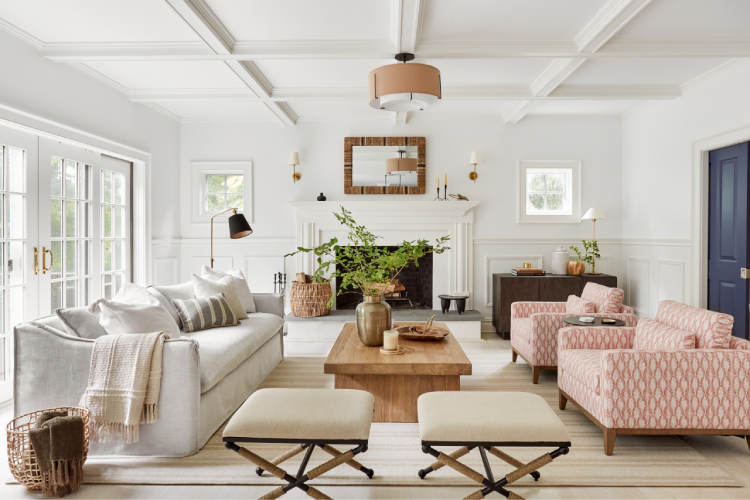
Ignoring the ceiling. McGee interiors consistently have interesting ceilings — painted trim, a statement light fixture, occasionally an architectural treatment like beams. In a rental or a home where the ceiling can’t be changed, a great light fixture does the same work at fraction of the cost of an architectural intervention.
Skipping the rug because good rugs are expensive. A bad rug — or no rug — undermines everything else in the room. McGee & Co’s wool rug options are the ones worth spending on for living rooms. The lower-priced options hold up for bedrooms but not for the daily foot traffic and use a living room gets.
The Realistic Budget for Getting the Look Right
A living room that actually reads as McGee & Co-inspired rather than just having expensive pieces in it requires:
A properly scaled sofa — $3,000 to $4,500 for the Siena
A statement light fixture — $500 to $900 for the Thea
A properly sized rug — $800 to $2,000 for a quality wool option
Throw pillows and a blanket — $300 to $600 for a well-layered sofa
A coffee table that works at the right scale — $800 to $1,500
That’s $5,400 to $9,500 for the core living room. Not cheap. But it’s one-time investment territory for pieces that last years, and the effect of getting all five elements right simultaneously is significantly more than the sum of buying them piecemeal over time.
That’s $5,400 to $9,500 for the core living room. Not cheap. But it’s one-time investment territory for pieces that last years, and the effect of getting all five elements right simultaneously is significantly more than the sum of buying them piecemeal over time.