
HexClad Review: The Most Innovative Hybrid Cookware — With Specific Expectations You Need to Set Before Buying

HexClad’s most credible two-year durability update comes from Taste of Home’s reviewer Katie, who has been testing HexClad for two years as of June 2026: “Most of my skillets have held up like a dream. I have three, and only the small one has a noticeable scratch in the coating. They still perform beautifully for nonstick searing and high-heat cooking. Maintenance has been pretty simple, too.” Two years of “held up like a dream” from a reviewer who cooks every meal at home daily — and who tried ceramic, stainless steel, cast iron, carbon steel, and conventional nonstick before concluding HexClad is “hands-down my favourite” — is the most credible available long-term quality endorsement for the brand. The honest counterpoint from Prudent Reviews’ independent testing: a buyer who bought the 12-inch hybrid eight months ago, used only silicone and wood utensils, hand-washed, and followed the seasoning instructions documents “the nonstick parts between the hex pattern are starting to wear and food is sticking in spots where it didn’t before. There are also scratches I can feel with my fingernail.” Eight-month nonstick wear from a careful user following all instructions is the most important documented HexClad durability question — and the honest answer is that some buyers experience it while others don’t, with technique and heat management appearing to be the documented differentiating factor.
Quick Highlights
✅ “Held up like a dream” at two years — Taste of Home daily home cook update June 2026. The most credible available HexClad durability signal: a reviewer who cooks every meal at home daily documents two years of “held up like a dream” performance across three pans — with only one small scratch in the smallest pan’s coating. Two-year daily-use durability from a cook who specifically tried multiple cookware alternatives before choosing HexClad is the highest available independent quality benchmark.
✅ The Kitchn month-long test — “performed exceedingly well, specifically in nonstick capabilities.” The Kitchn’s August 2026 independent one-month test documents HexClad as performing exceedingly well — specifically eggs sliding around the pan with ease and whites cooking evenly on the bottom. Egg cooking is the most demanding available nonstick test and “slid around the pan with ease” is a documented quality outcome that many conventional nonstick pans struggle to match at the same price point.
✅ Homes and Gardens 3-month test — “hands-down the best nonstick I’ve used.” A former recipe editor and trained cook who specifically tested HexClad at home for three months after using it in professional recipe test kitchens documents HexClad’s nonstick as “hands-down the best I’ve used.” Professional kitchen context combined with home testing is the most credible available comparison baseline.
✅ Patented hexagonal TerraBond ceramic nonstick — PTFE-free and PFAS-free documented. HexClad’s TerraBond coating is documented as PTFE-free and PFAS-free — the two chemical concerns most commonly cited by buyers who want to avoid traditional Teflon-type nonstick coatings. The PTFE-free and PFAS-free credential is verified by HexClad’s own documentation and is the specific health and safety differentiator from conventional nonstick.
✅ Hybrid hexagonal design — stainless steel peaks for searing, ceramic valleys for nonstick. The patented hex pattern is the engineering basis for HexClad’s hybrid claim: raised stainless steel hexagonal peaks provide the heat distribution and searing capability of stainless, while ceramic nonstick valleys between the peaks provide food release. The result is documented as usable at higher heat than ceramic-only nonstick while providing more food release than stainless-only surfaces.
✅ Metal utensil safe — documented as resistant to metal scratches within the hex pattern. The stainless steel hexagonal peaks protect the ceramic valleys from metal utensil contact — documented as making HexClad genuinely more metal-utensil-resistant than flat-surface ceramic nonstick alternatives. The Prudent Reviews customer service documentation confirms the metal-utensil-safe claim as accurate for the hex pattern’s protective function.
✅ Oven-safe to 500°F — high-heat oven capability documented. HexClad’s 500°F oven safety is a specific temperature credential — the same ceiling as Made In stainless and above most ceramic nonstick alternatives. For stovetop-to-oven cooking at high temperatures, this ceiling covers all standard home cooking applications.
✅ Gordon Ramsay endorsement — uses in his own kitchen, not just a paid spokesperson. The Kitchn specifically notes that Gordon Ramsay uses HexClad in his own kitchen — not just in paid advertisements. A Michelin-starred chef who chooses HexClad for personal cooking beyond contractual obligation is a more credible endorsement than a paid spokesperson who doesn’t use the product privately.
✅ Tri-ply construction — aluminium between two stainless steel layers. HexClad’s tri-ply construction — high-quality aluminium core between two layers of stainless steel — is the same construction basis that makes Made In and All-Clad’s heat distribution strong. The aluminium core provides fast, even heat distribution that stainless-only or cast-iron alternatives can’t match for speed.
✅ Induction compatible — works on all cooktop types. HexClad’s stainless exterior makes it compatible with induction, gas, electric, and ceramic cooktops — the standard compatibility expectation for premium cookware confirmed.
✅ Re-seasoning restores nonstick performance — documented recovery method. Homes and Gardens documents the re-seasoning process as an effective recovery method when nonstick performance declines: deep clean with HexClad’s recommended process, then reapply seasoning oil. The documented ability to restore nonstick performance distinguishes HexClad from coating-based alternatives where degraded coating cannot be recovered.
✅ Prudent Reviews customer service tested — 6-minute response, honest about limitations. Prudent Reviews documents testing HexClad’s customer service by email — receiving a response in 6 minutes with honest answers about the hybrid’s strengths and limitations, including a real answer on an underrated product (the 8-inch pan) rather than evasive marketing responses. Fast, honest customer service documentation is a specific positive.
❌ Nonstick wear at 8 months — careful user following all instructions, food sticking in spots. Prudent Reviews documents the most important available HexClad durability concern: a buyer who used only silicone and wood utensils, hand-washed, and followed all seasoning instructions documents nonstick wear and food sticking at 8 months. “Kinda surprised since the whole selling point is that it’s more durable than regular nonstick.” Eight-month nonstick wear under careful use is documented and cannot be attributed to user error when all instructions were followed.
❌ PissedConsumer 2.0 stars from 233 reviews — 74% unfavorable, frequent sticking and peeling. PissedConsumer’s 233-review aggregate at 2.0 stars documents “frequent reports of food sticking and coating peeling” and “poor customer service, slow or no response on exchanges, refunds, warranty” as the most common documented issues. 74% unfavorable is a significant dissatisfaction rate that contrasts with the positive independent reviewer experiences — reflecting the gap between buyers who use HexClad correctly and those who encounter the nonstick degradation pattern.
❌ “Not like a regular nonstick pan” — technique-dependent performance. An eBay verified buyer who praises HexClad’s heat conduction and searing capability specifically documents: “eggs still stick. If you are looking for a nonstick pan, there are better options.” The hybrid design’s nonstick is documented as conditional — performing well with oil and appropriate heat management but not matching the passive nonstick of a dedicated flat-surface nonstick pan without technique investment.
❌ High price — 12-inch pan $180-230, 12-piece set $600-plus. HexClad’s pricing is premium — a 12-inch fry pan at $180-230 and the 12-piece Hybrid Pots and Pans Set at $600-plus. For buyers who are comparing against Made In ($95-115 for a 10-inch stainless) or Lodge cast iron ($30-50) — HexClad’s premium is significant and requires documented quality justification that the nonstick degradation concern complicates.
❌ Lifetime warranty claims — slow response, poor resolution documented by PissedConsumer. Despite a documented lifetime warranty, PissedConsumer specifically flags “poor customer service, slow or no response on exchanges, refunds, warranty” as a documented pattern. A lifetime warranty that is difficult to claim in practice is a documented consumer protection gap — particularly for buyers who experience nonstick wear within the first year.
❌ Performs best on low to medium heat — HexClad’s own documentation. HexClad’s own customer response in PissedConsumer documentation states: “It is important to remember that our pans perform best on low to medium heat.” For a pan marketed as capable of high-heat searing — the brand’s own guidance that it performs best at low-to-medium heat is a documented positioning tension. High heat is documented as a cause of build-up, staining, and accelerated nonstick wear.
Why Trust This Review
This review draws on The Kitchn’s August 2026 month-long independent HexClad 12-piece set test, Taste of Home’s June 2026 two-year HexClad skillet update (Katie’s daily home cook assessment), Homes and Gardens’ 3-month independent hybrid frying pan test (former recipe editor), Prudent Reviews’ April 2026 HexClad review including customer service email test and 8-month nonstick wear documentation, PissedConsumer hexclad.pissedconsumer.com (233 reviews, 2.0 stars — sticking and peeling pattern), and eBay verified buyer reviews (searing and egg sticking documented). No affiliate relationship with HexClad exists.
Full Review Breakdown
The Hybrid Technology — What It Actually Is
HexClad’s patented technology is genuinely distinct from both standard nonstick and standard stainless cookware. The laser-etched hexagonal pattern on the cooking surface creates two distinct zones: raised stainless steel hexagonal peaks that provide high-heat searing capability and structural protection, and ceramic nonstick valleys between the peaks that provide food release. The cooking surface is literally a hybrid of two materials — not a coating applied over a single-material surface.
The tri-ply construction underneath — aluminium core between two stainless steel layers — provides the heat distribution speed that makes searing effective. The total construction is: tri-ply stainless-aluminium-stainless base, with a laser-etched hexagonal surface that creates stainless peaks and ceramic nonstick valleys, finished with HexClad’s TerraBond PTFE-free, PFAS-free ceramic coating in the valleys.
This is genuinely innovative engineering — not marketing language applied to a standard product. The question is not whether the technology is real, but whether the ceramic valleys’ nonstick performance is maintained over time.
The Nonstick Reality — What to Actually Expect
HexClad is not a conventional nonstick pan and should not be used like one. The most important pre-purchase expectations adjustment:
You must season HexClad with a neutral oil before first use — and re-season periodically when nonstick performance declines. This is documented as an effective performance maintenance step by Homes and Gardens — but it is a care requirement that conventional nonstick pans don’t have.
You must use some oil during cooking — HexClad is not designed to cook eggs without any fat, despite what some marketing implies. The eBay buyer who documents eggs still sticking is reflecting the documented gap between the marketing’s implication and the product’s actual performance without oil.
HexClad performs best at low to medium heat — HexClad’s own documentation confirms this. High heat accelerates nonstick valley wear, builds up residue, and is the documented mechanism behind the sticking complaints from buyers who use HexClad like high-heat stainless.
The 8-month nonstick wear documented by the Prudent Reviews buyer who followed all instructions is the most important honest caveat — because it occurs under careful use. Some HexClad buyers experience this wear pattern; others document two years of held-up-like-a-dream performance. The difference appears to be cooking habit and heat management, but it is not entirely within the buyer’s control.
The Gordon Ramsay Endorsement — Honest Context
Gordon Ramsay’s HexClad partnership is commercially documented — he is a paid partner. The Kitchn’s note that he uses HexClad in his own kitchen beyond the contractual obligation provides the most honest celebrity endorsement context. A professional chef who uses HexClad privately and professionally has a different relationship to the product than a celebrity who endorses it for payment alone. The endorsement is real in the sense that Ramsay genuinely uses the product — but the commercial relationship means it is not independent.
When HexClad Delivers Maximum Value
The documented buyer profile that gets maximum HexClad value is specific: buyers who cook frequently at home and want a single pan that can sear proteins at higher heat than ceramic nonstick while providing more food release than stainless steel. The Taste of Home daily-home-cook two-year update and The Kitchn’s month-long test both reflect this specific buyer profile — and both document HexClad as genuinely delivering on its hybrid promise.
The documented buyer profile that gets minimum value: buyers who want a fully passive nonstick experience without technique investment, buyers who cook at consistently high heat without the low-to-medium recommendation, and buyers who are comparing against basic nonstick pans at a $30-50 price point where HexClad’s $180-230 premium requires deliberate performance justification.
The Re-Seasoning Process — The Performance Recovery Method
Homes and Gardens documents the re-seasoning process as the documented method for recovering nonstick performance when it declines: deep clean with HexClad’s recommended cleanser, apply a thin layer of neutral oil to the cooking surface, heat until the oil just starts to smoke, let cool, and wipe away excess. This process is documented as effective for restoring nonstick performance — distinguishing HexClad from coating-based alternatives where degraded coating cannot be recovered. The ability to maintain and restore performance through re-seasoning is the documented mechanism by which the Taste of Home buyer achieves two-year “held up like a dream” performance while other buyers document 8-month wear.
Best HexClad Products Worth Buying

rudent Reviews customer service specifically identified the 8-inch pan as the underrated product — but the 10-inch is the most versatile everyday cooking size for one or two people. Best for buyers who want to test HexClad on a single pan before committing to a full set. Searing proteins, sautéing vegetables, and egg cooking with appropriate oil — the documented use cases where HexClad’s hybrid performs best.

The most tested size across The Kitchn, Taste of Home, and Homes and Gardens independent reviews. The 12-inch is the documented test product that generates “exceedingly well,” “held up like a dream,” and “best nonstick I’ve used” endorsements. Best for households of 2-4 people and cooks who need a larger cooking surface for proteins and vegetables simultaneously.

The complete set that The Kitchn tested across one month — three fry pans (8, 10, 12-inch), two saucepans, and an 8-quart stock pot with matching glass lids. Best for buyers who want to replace their entire cookware collection with HexClad and who are committed to the technique adjustment that maximises the hybrid’s documented performance.
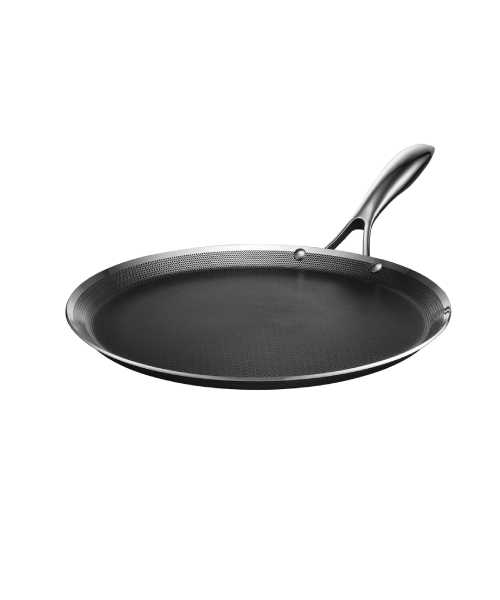
The flat griddle format — best for pancakes, bacon, and large-surface cooking where the hybrid’s even heat distribution across a large cooking area is the primary requirement.

The wok format for high-heat stir-fry cooking — where the stainless peaks’ high-heat tolerance and the ceramic valleys’ food release combine for the specific demands of wok cooking. Best for buyers who frequently cook stir-fry and want the hybrid advantage in a wok shape.

Beyond cookware, HexClad has expanded into knives. The Kitchn’s reviewer specifically mentions being gifted the HexMill Pepper Grinder and swearing by it — suggesting the brand’s product quality extends beyond the core cookware range.
What Customers Actually Think
“Most of my skillets have held up like a dream. I have three, and only the small one has a noticeable scratch in the coating. They still perform beautifully for nonstick searing and high-heat cooking. Maintenance has been pretty simple, too.” — Taste of Home Katie, June 2026 two-year update
“Overall, the HexClad cookware performed exceedingly well, specifically in its nonstick capabilities. When frying eggs, the whites cooked evenly on the bottom and slid around the pan with ease.” — The Kitchn month-long independent reviewer, August 2026
“HexClad’s non-stick is impressive — hands-down the best I’ve used. It’s sturdy and well-made without the cumbersome weight of cast iron, the delicate coating of ceramic, or the sticking issues of stainless steel.” — Homes and Gardens former recipe editor, 3-month test
“Bought the 12-inch hybrid about 8 months ago. Been careful with it, silicone and wood utensils only, hand wash, followed the seasoning instructions. But the nonstick parts between the hex pattern are starting to wear and food is sticking in spots where it didn’t before. Kinda surprised since the whole selling point is that it’s more durable than regular nonstick.” — Prudent Reviews documented 8-month wear buyer
“Conducts heat very well. Great for searing steaks. Easy cleanup. The advertisement shows scrambled eggs can just fly off with an oil spray and a light puff of air. Don’t believe it. Eggs still stick. If you are looking for a nonstick pan, there are better options.” — eBay verified buyer
“Frequent reports of food sticking and coating peeling. Poor customer service, slow or no response on exchanges, refunds, warranty. High price level versus perceived quality.” — PissedConsumer aggregate documentation, 233 reviews.
Is HexClad Worth It?
Best for: Frequent home cooks who want a single pan capable of searing proteins at higher heat than ceramic nonstick while providing more food release than stainless — specifically buyers who are willing to season the pan, use some oil during cooking, and manage heat at low-to-medium settings for daily use. The Taste of Home two-year daily-use endorsement and The Kitchn’s month-long professional test are the most credible available quality signals for this buyer profile.
Not ideal for: Buyers who want fully passive nonstick without technique investment, buyers who expect HexClad to cook eggs without any fat based on marketing impressions, buyers who regularly cook at high heat and are not prepared for accelerated nonstick wear at these temperatures, and buyers who are comparing against basic nonstick pans at $30-50 where the $180-230 premium requires significant performance justification.
Most important technique guidance: Season before first use with neutral oil. Use some oil during cooking — HexClad is not a zero-oil nonstick. Cook at low to medium heat for daily use — reserve high heat for specific searing applications. Re-season when nonstick performance declines rather than accepting the decline as permanent.
HexClad vs Competitors
Feature | HexClad | Made In Stainless | All-Clad D5 | Caraway Ceramic | Our Place Always Pan | Tramontina |
Hybrid Technology | ✅ Patented hex pattern | ❌ Stainless only | ❌ Stainless only | ❌ Ceramic only | ❌ Ceramic only | ❌ |
PTFE and PFAS Free | ✅ TerraBond documented | ✅ No coating | ✅ No coating | ✅ Ceramic | ✅ Ceramic | ⚠️ Some |
Price (12-inch fry pan) | $200–$230 | $115–$135 | $190–$220 | $95–$115 | $150–$180 | $30–$50 |
2-Year Durability (Documented) | ✅ Taste of Home | ✅ Prudent Reviews 3yr | ✅ Strong | ⚠️ Some | ⚠️ Some | ✅ Good |
8-Month Nonstick Wear Risk | ⚠️ Documented | N/A (no coating) | N/A | ⚠️ Similar | ❌ Documented | N/A |
Metal Utensil Safe | ✅ Peaks protect valleys | ❌ Not nonstick | ❌ Not nonstick | ❌ | ❌ | ❌ |
Re-seasonable | ✅ Documented recovery | N/A | N/A | ❌ | ❌ | N/A |
Gordon Ramsay Endorsement | ✅ Personal use + paid | ❌ Bobby Flay | ❌ | ❌ | ❌ | ❌ |
Lifetime Warranty | ✅ (enforcement mixed) | ✅ Strong | ✅ | ⚠️ 1 year | ⚠️ 1 year | ✅ |
Induction Compatible | ✅ | ✅ | ✅ | ✅ | ✅ | ✅ |
FAQs
Is HexClad actually worth the price?
For daily home cooks who want the hybrid searing-and-nonstick capability — documented as yes by Taste of Home’s two-year daily-use review and The Kitchn’s month-long professional test. For buyers who want basic nonstick without technique investment — documented as no, with better options available at lower prices. The $180-230 price is justified by the hybrid technology and documented two-year durability when used correctly, not by passive nonstick performance alone.
Does HexClad nonstick last?
Some buyers document two years of held-up-like-a-dream performance; others document 8-month nonstick wear under careful use. The documented differentiator is heat management — cooking at high heat consistently is documented as accelerating nonstick valley wear. Low-to-medium heat daily use with periodic re-seasoning is the documented approach for maximum longevity.
Is HexClad actually PTFE and PFAS free?
Yes — HexClad documents the TerraBond coating as PTFE-free and PFAS-free. This is a specific, documented claim rather than a vague “non-toxic” marketing statement. The ceramic coating in the hexagonal valleys is genuinely free of the chemicals associated with traditional Teflon-type nonstick coatings.
Do you need to season HexClad?
Yes — before first use and periodically thereafter. Apply a thin layer of neutral oil, heat to just smoking, cool, and wipe away excess. This is documented as an effective performance maintenance step that most conventional nonstick pans don’t require. Homes and Gardens documents re-seasoning as an effective nonstick performance recovery method when food starts to stick.
How does HexClad compare to Made In cookware?
Different use cases. Made In’s 5-ply stainless steel is the documented dollar-for-dollar quality leader for pure stainless cooking — searing, sautéing, and high-heat applications where you don’t need nonstick release. HexClad is the choice when you specifically want more food release than stainless provides while retaining higher-heat capability than ceramic-only nonstick allows. Made In is cheaper for the stainless line ($115-135 vs $200-230) — HexClad’s premium is specifically for the hybrid nonstick capability.
What heat level should I use for HexClad?
Low to medium for daily cooking — HexClad’s own documentation and PissedConsumer response confirm this. High heat is suitable for specific searing applications but accelerates nonstick valley wear and causes build-up when used consistently. This is the most important documented technique adjustment for HexClad buyers coming from either conventional nonstick or stainless steel.
Final Verdict
HexClad is the most genuinely innovative hybrid cookware product available in 2026 — patented hex technology that combines stainless steel searing peaks with ceramic nonstick valleys in a PTFE-free, PFAS-free, metal-utensil-safe, oven-safe construction is a real product differentiation, not marketing language. The Taste of Home two-year daily-use endorsement, The Kitchn’s one-month professional test conclusion of “exceedingly well,” and the Homes and Gardens “best nonstick I’ve used” from a trained cook with professional kitchen context all document genuine quality for the right buyer who uses the pan with the right technique. The honest qualifications are specific and non-negotiable: HexClad is not a passive nonstick pan — it requires seasoning, some oil during cooking, and low-to-medium heat management for daily longevity; 8-month nonstick wear is documented for careful users who may not fully control the accelerating heat variable; and the $200-230 price per pan requires deliberate justification against the alternatives. Season before first use. Cook at low to medium heat. Re-season when performance declines. For buyers who commit to this approach — HexClad is documented as the most durable and most capable hybrid nonstick available. For buyers who want passive nonstick without technique — a dedicated flat-surface ceramic nonstick is the documented better choice.
Category | Score |
Hybrid Technology Innovation | 9.5/10 |
Searing Performance | 9.0/10 |
Nonstick Performance (With Technique) | 8.5/10 |
Nonstick Longevity (All Users) | 7.0/10 |
PTFE and PFAS Free Credential | 9.5/10 |
Metal Utensil Resistance | 9.0/10 |
Re-Seasonability | 8.5/10 |
Value for Premium Price | 7.0/10 |
Warranty Enforcement | 6.5/10 |
Overall | 8.3/10 |