
How to Cook Steak on a Pit Boss Pellet Grill – Getting the Perfect Crust and the Right Internal Temperature
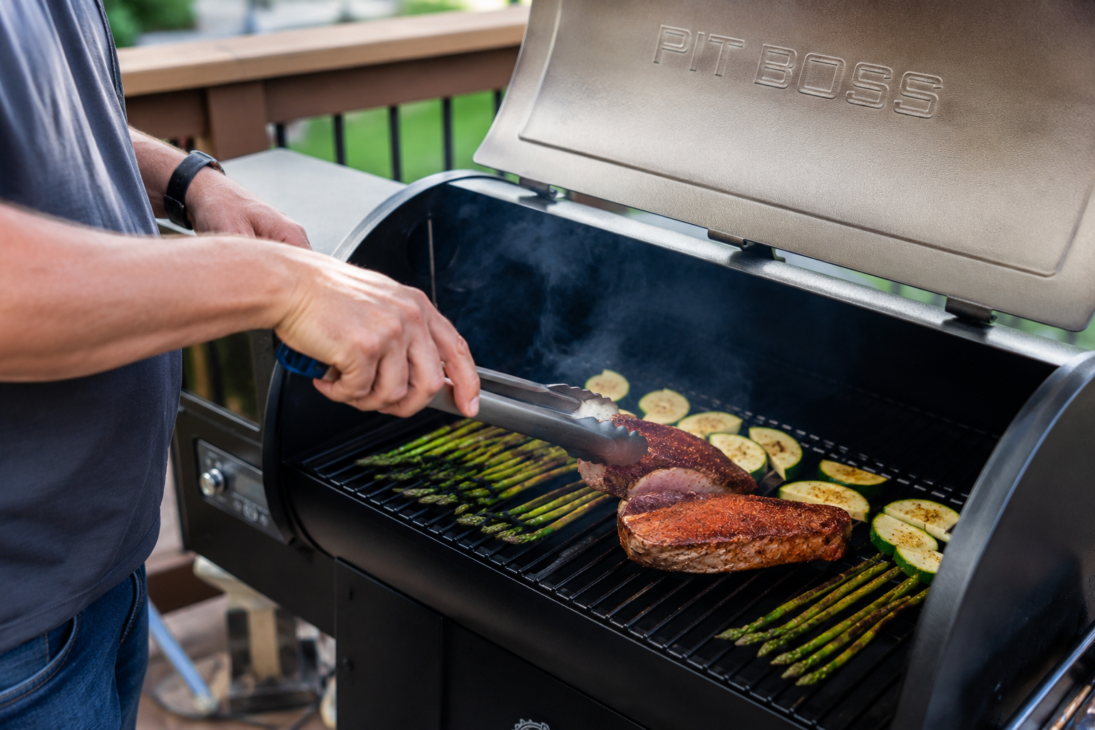
People who say you can’t cook a great steak on a pellet grill haven’t figured out how to use a pellet grill correctly. That’s the honest starting point of this guide.
The common criticism of pellet grills for steak is valid but solvable. The concern is that pellet grills don’t get as hot as gas or charcoal grills, and a hot sear is what produces the Maillard reaction — the browning that gives a steak its crust, its flavor, and the reason it looks and smells the way a properly cooked steak should. The criticism is true. The default pellet grill temperature range of 225°F to 450°F doesn’t match the 600°F+ that a charcoal chimney at full roar produces.
The solution is the reverse sear method, which takes this apparent limitation and turns it into a genuine advantage. When you understand what the reverse sear is doing and why, you’ll cook better steak on your Pit Boss than most people cook on any grill.
Choosing the Right Steak
Not every steak is equally suited to the pellet grill or to the reverse sear method.
Best choices for the Pit Boss:
Ribeye — The most popular steak on a pellet grill for good reason. The fat content in a ribeye (the eye of fat in the center, the marbling throughout the muscle) provides self-basting during the cook and an intensely beefy flavor that stands up to smoke beautifully. A 1.5-inch ribeye on a Pit Boss with a proper reverse sear is one of the best things you can eat.
New York Strip — Less fat than the ribeye, firmer texture, beefy flavor. The strip has a fat cap on one edge that renders down beautifully during the smoke phase. Slightly less forgiving than the ribeye if overcooked because there’s less fat to provide moisture, so temperature monitoring is more critical.
Tomahawk — The ribeye with the long rib bone still attached. Visually spectacular, cooks exactly like a ribeye but takes longer because of the bone’s effect on heat transfer. The bone also conducts heat through the thicker part of the steak which can affect cooking evenness if you don’t know to expect it.
T-Bone and Porterhouse — A strip and a tenderloin separated by a T-shaped bone. The challenge is that the tenderloin cooks faster than the strip, so the two different muscles will reach different temperatures at the same time. Manageable but requires attention.
Filet Mignon — Beautiful cut, extremely tender, very little fat. Works on the Pit Boss but is the most expensive cut and the least smoke-appropriate because the mild flavor of the tenderloin doesn’t gain as much from smoke exposure as the more robustly flavored cuts. If you’re cooking filet, a shorter smoke time and more emphasis on the sear is the right approach.
Thickness matters more than anything else: Thin steaks (under 1 inch) are not candidates for the reverse sear. They cook too quickly at low temperature and don’t have enough mass to develop any smoke flavor before they’re done. For steaks under an inch, skip the reverse sear and cook directly at high heat.
The sweet spot for the Pit Boss reverse sear is 1.5 inches to 2 inches thick. If you’re buying steaks for pellet grill cooking, ask your butcher to cut them to this thickness. Most grocery store steaks are cut thinner than this for display purposes; a butcher will cut to your specifications.
Seasoning
Great steak doesn’t need much. The goal is to enhance the beef flavor, not cover it.
Minimum approach:
- Kosher salt — applied generously, at least 45 minutes before cooking or the night before
- Coarse black pepper — applied just before the steak goes on the grill
That’s it. Salt and pepper is the foundation that every more complex steak seasoning is building on.
Why salt in advance: When you salt a steak and let it sit, the salt draws moisture to the surface (you can see a wet puddle on the steak within a few minutes). This moisture then slowly reabsorbs back into the meat over 30 to 45 minutes, taking the salt with it and seasoning the meat rather than just the surface. Salt applied immediately before cooking sits on the surface and draws out moisture that doesn’t have time to reabsorb, which can make the exterior wet and interfere with browning.
If you don’t have 45 minutes, salt immediately before the steak goes on — you’ll lose some of the deep seasoning benefit but you won’t have the wet surface problem either. What you want to avoid is salting 10 to 20 minutes before cooking, which is the worst of both worlds.
For more complex flavor:
- Garlic powder (not garlic salt — it already contains salt and will make the steak too salty)
- Smoked paprika
- Onion powder
- A small amount of cayenne if you like heat
Some people apply a light coat of olive oil or avocado oil before the rub to help the seasoning adhere and promote browning. Both work. Avocado oil has a higher smoke point than olive oil, which matters more during the sear phase than the smoke phase.
Pellet Selection for Steak
Beef is robust enough to handle stronger smoke woods than chicken or fish.
Hickory — The classic beef smoke wood. Strong, assertive, slightly sweet. For steaks specifically, where the smoke exposure time is shorter than a brisket cook, hickory works extremely well.
Oak — The most versatile beef smoke wood. Post oak in particular is the traditional smoke wood of Texas barbecue culture. Medium intensity, slightly nutty, never overpowering. Excellent with steak.
Cherry — Adds a deep mahogany color to the exterior of the steak and a mild, slightly sweet smoke flavor. Works well blended with hickory or oak to add color while the oak or hickory provides the primary smoke character.
Mesquite — The most intense smoke wood in common use. Works for steak only because the smoke exposure during a reverse sear is brief enough that mesquite doesn’t have time to turn bitter. If you love that campfire, southwest Texas smoke character, mesquite on a short steak cook is one place it works. Avoid it for longer cooks.
The Reverse Sear Method — The Approach That Changes Everything
The reverse sear takes the conventional grilling order — sear hot first, then finish at lower heat — and inverts it. You cook the steak slowly at low temperature first to bring it close to your target internal temperature throughout the entire thickness of the meat, then you sear it at maximum heat at the end to build the crust.
Why does this work better?
When you sear first and finish at lower heat, the outside of the steak goes through a temperature gradient. The crust is above 300°F while the center might be 70°F when the sear starts. By the time the center gets close to target temperature, the outer portion of the steak has been cooked through a range that can result in a thick gray band of overcooked meat surrounding a smaller perfect center.
The reverse sear eliminates this. By bringing the entire steak to near-target temperature slowly at 225°F, the whole thing is at nearly the same temperature edge-to-edge before the sear starts. The sear then happens over less surface area that needs heat, and it happens faster, creating the crust without continuing to cook the interior. The result is a steak that’s the right temperature from edge to edge with a perfect crust rather than a bullseye cross-section of overcooked-less overcooked-perfect-less overcooked-overcooked.
The steps:
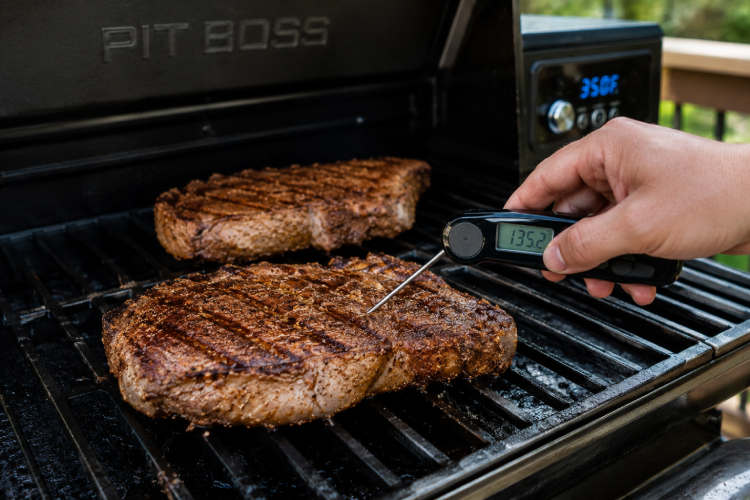
Step 1: Set the Pit Boss to 225°F and let it fully preheat. Place the seasoned steaks on the grill and insert a probe thermometer into the thickest part of one of them, horizontally through the edge of the steak so the tip is at the center.
Step 2: Smoke at 225°F until the internal temperature reaches the target pull temperature. This varies by your preferred doneness:
- Rare: Pull at 110°F to 115°F
- Medium-rare: Pull at 120°F to 125°F
- Medium: Pull at 130°F to 135°F
- Medium-well: Pull at 140°F to 145°F
At 225°F, a 1.5-inch ribeye takes approximately 25 to 40 minutes to reach these temperatures. Check after 20 minutes and then every 5 minutes.
Step 3: Remove the steaks from the grill. Crank the Pit Boss to maximum temperature — the highest setting, typically 450°F to 500°F. On some Pit Boss models there is a sear mode or a slide plate that gives you direct flame access; use this if your model has it. It takes 15 to 20 minutes to fully preheat to maximum temperature. While the grill is preheating, let the steaks rest uncovered.
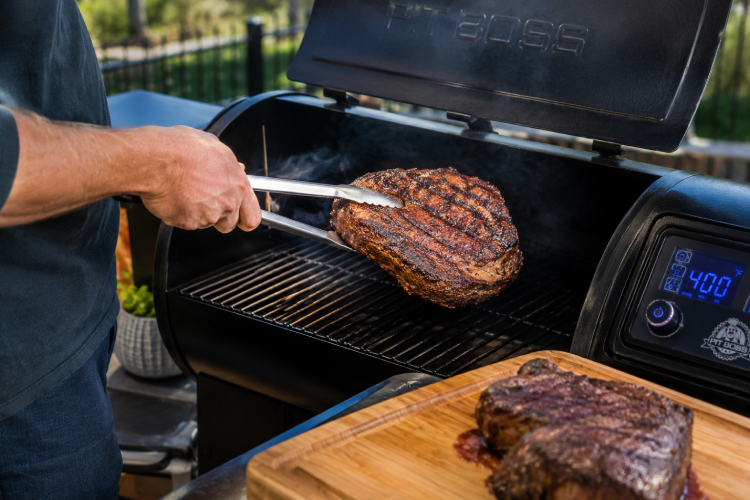
Step 4: When the grill is at maximum temperature, put the steaks back on. Sear for 1 to 2 minutes per side. You’re not cooking them further — you’re developing the crust. Don’t leave them on longer than this or you’ll push past your target internal temperature.
Step 5: Remove and rest for 5 minutes.
Direct High-Heat Method (for thinner steaks)
For steaks under 1 inch thick, the reverse sear doesn’t have enough time to work correctly. For these steaks, cook directly at the highest temperature your Pit Boss can produce.
Lorem ipsum dolor sit amet, consectetur adipiscing elit. Ut elit tellus, luctus nec ullamcorper mattis, pulvinar dapibus leo.
Set to maximum temperature and preheat for 15 to 20 minutes. Place the steaks directly on the grates. Cook 2 to 3 minutes per side for medium-rare, monitoring temperature throughout. At high heat, a thin steak goes from undercooked to overcooked faster than you expect.
Finished Internal Temperatures
These are the finished temperatures after the rest period:
- Rare: 120°F to 125°F (very red center, slightly warm)
- Medium-rare: 130°F to 135°F (pink center, warm throughout)
- Medium: 140°F to 145°F (slightly pink center, fully warm)
- Medium-well: 150°F to 155°F (very little pink, fully cooked through)
- Well done: 160°F+ (no pink, fully grey throughout)
The USDA recommends cooking whole muscle beef to 145°F internal. A medium-rare steak at 130°F is below the USDA guideline — this is the choice most steak-eating adults make daily with full understanding of the trade-off. If you’re cooking for someone with a compromised immune system, elderly individuals, or children, cooking to at least 145°F is the responsible choice.
The Butter Baste
This is optional but not really optional if you want the best possible steak. During the sear phase, a butter baste adds flavor and helps produce a more even, glossy crust.
In a small cast iron skillet or disposable aluminum pan on the grill during the sear phase, melt 2 tablespoons of butter with a smashed garlic clove and a sprig of thyme or rosemary. As the steaks sear, spoon the hot butter over them repeatedly. The butter promotes browning, the garlic and herbs infuse into the crust, and the result is a steak that tastes like something you’d pay $60 for at a restaurant.
Resting
Steak needs 5 minutes minimum rest. For large steaks over 1.5 inches thick, 8 to 10 minutes is better.
The standard advice about “the juices need time to redistribute” is accurate but it’s also worth noting what’s actually happening. Muscle fibers contract during cooking and squeeze liquid toward the center. During rest, the fibers relax and reabsorb some of that liquid. Cut in immediately and the liquid pours out; rest first and it stays in the meat.
Don’t tent the steak with foil during the rest unless the room is cold — foil traps steam and softens the crust you just worked to build.
Serving
Cut against the grain. This is the rule that matters as much as the cook itself. Find the direction of the muscle fibers and cut perpendicular to them. The same steak cut with the grain requires significantly more chewing than the same steak cut against the grain — the grain-against cut shortens the fibers, the grain-with cut means you’re chewing through long, intact muscle fibers.
For ribeye and strip steaks, the grain typically runs lengthwise through the steak. Cut across the width in ¾-inch to 1-inch slices.
Finish with a pinch of flaky salt (Maldon or similar) over the cut surface. The flaky salt adds crunch and pops the beefy, smoky flavor in a way that the kosher salt applied before cooking doesn’t replicate.
Quick Reference
Doneness | Pull temp (smoke phase) | Finished temp |
Rare | 110°F–115°F | 120°F–125°F |
Medium-rare | 120°F–125°F | 130°F–135°F |
Medium | 130°F–135°F | 140°F–145°F |
Medium-well | 140°F–145°F | 150°F–155°F |
- Pellets: Hickory, oak, or cherry
- Smoke phase: 225°F, 25 to 40 minutes
- Sear phase: Maximum heat (450°F+), 1 to 2 minutes per side
- Rest: 5 to 10 minutes
- Slice: Against the grain