
Caraway vs HexClad: 3 Months of Real Cooking. My Honest Take
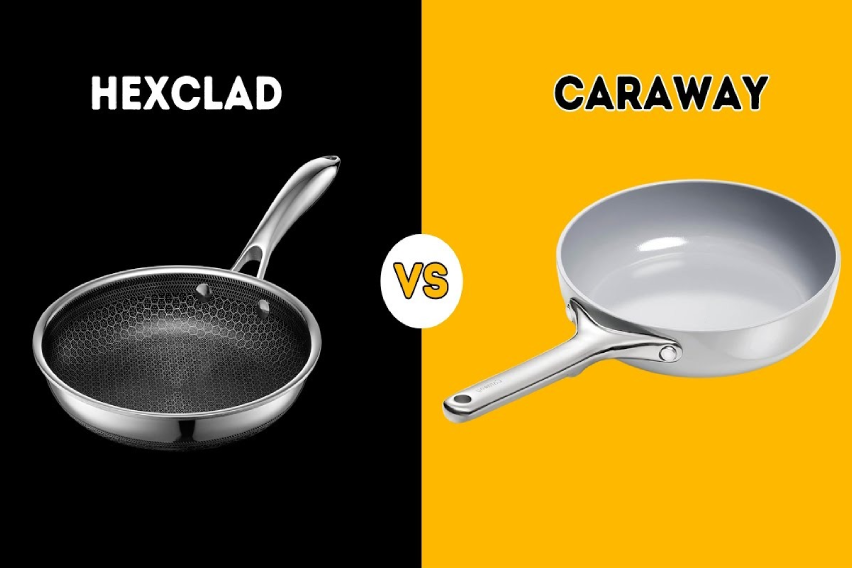
I want to start with something nobody says in these comparisons: both of these pans are better than what most people are cooking on right now.
That’s not a hedge. I genuinely mean it. If you came here expecting me to tell you one of them is a scam — the Gordon Ramsay hype machine or the Instagram-pretty ceramics that fall apart in six months — I don’t have that story for you. What I have is three months of cooking eggs, searing chicken thighs, making pasta sauce, burning garlic twice, and washing dishes more than I’d like to admit. Both pans survived. Neither was perfect.
Here’s what actually matters.
Why I Tested Both
I’d been using a scratched up nonstick set I’d had since 2021. It did its job for a few years and then started doing that thing old nonstick does — food sticking in little patches, the coating looking vaguely questionable up close. Time to replace everything.
I had roughly $400 to spend and two choices that kept coming up everywhere: Caraway’s ceramic set, which my friend had been raving about for a year, and HexClad, which I’d seen in what felt like every other kitchen video since Gordon Ramsay attached his name to it.
So I bought both. Tested them for three months. Cooked the same types of meals on both. And then made a decision.
Quick Highlights
- ✅ Caraway: PFAS-free, PTFE-free ceramic coating — independently tested, genuinely clean
- ✅ Caraway: Beautiful design, excellent for eggs and delicate foods at low-to-medium heat
- ✅ Caraway: Magnetic pan rack storage system is genuinely clever
- ✅ HexClad: Metal utensil safe — the raised steel hexagons protect the nonstick underneath
- ✅ HexClad: Handles high heat and searing in ways ceramic simply can’t
- ✅ HexClad: Lifetime warranty vs Caraway’s one year
- ❌ Caraway: Ceramic coating starts degrading with regular high-heat use — some users report within 9–12 months
- ❌ Caraway: No metal utensils, no dishwasher, handles get hot
- ❌ HexClad: PTFE lawsuit and $2.5 million settlement over “non-toxic” claims (for pans made before 2024)
- ❌ HexClad: New TerraBond coating is proprietary — no full third-party ingredient disclosure yet
- ❌ HexClad: Significantly more expensive
Best for Caraway: Home cooks who prioritize non-toxic certification, cook mostly at low-to-medium heat, and want something beautiful on the stovetop.
Best for HexClad: People who cook hard and often, need metal utensil compatibility, want to sear properly, and plan to keep the same pan for many years.
The Background on Each Brand
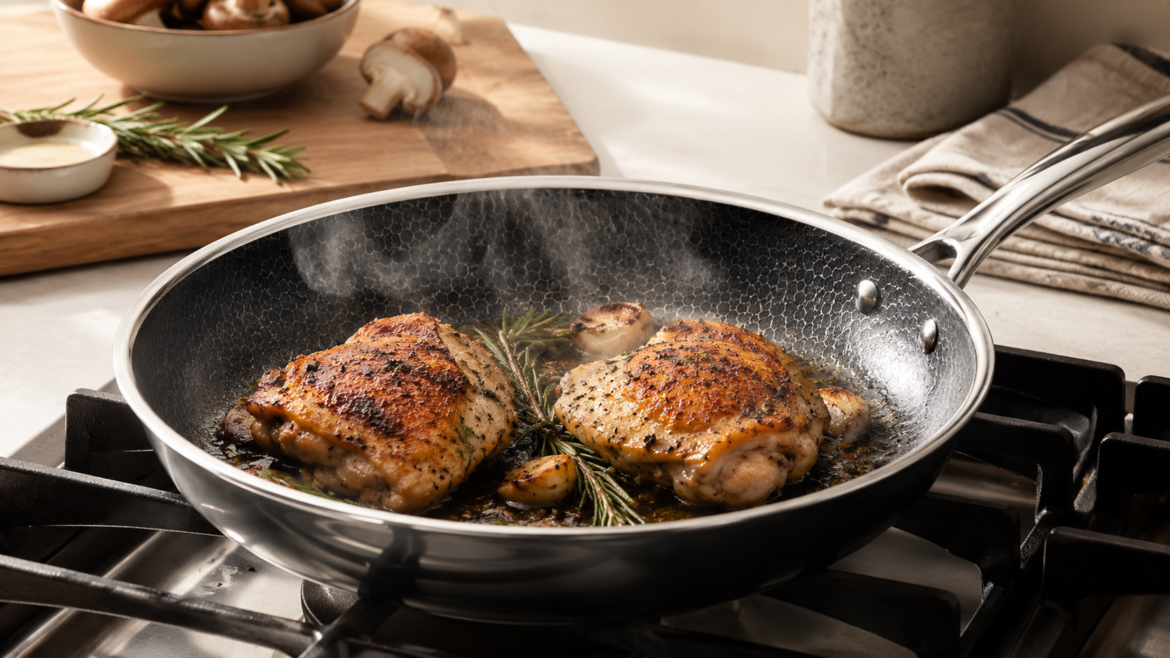
Caraway launched in 2019 with a clear positioning: nonstick cookware without the chemicals you’ve been reading about. PFAS-free, PTFE-free, PFOA-free, lead-free, cadmium-free. The coating is a mineral-based ceramic and independent lab testing — including through Light Labs — has confirmed no detectable PFAS or heavy metals. The brand grew quickly on Instagram because it looks genuinely beautiful. Sage green, cream, periwinkle, navy. The pans photograph well and look better in real life than most cookware on the market.
HexClad has a more complicated story going into 2026. The brand built its reputation on a hybrid design — raised stainless steel hexagons protecting a recessed nonstick coating — and Gordon Ramsay’s endorsement. The problem: their original nonstick coating was PTFE, which is a PFAS compound, and they marketed the pans as “non-toxic” and “PFAS-free.” A class action lawsuit followed. They settled for $2.5 million in early 2025 without admitting wrongdoing, and as part of that settlement they had to stop using those claims for PTFE-containing pans. They also switched to a new ceramic coating called TerraBond starting in 2024/25, which they say is PTFE and PFAS free. The transparency issue: TerraBond’s full composition is proprietary and no independent third-party testing has been publicly released. We know what HexClad says it doesn’t contain. We don’t have full independent verification of what it does.
That context matters when you’re spending $200-plus on a single pan.
Three Months in the Kitchen — What I Actually Found
Eggs
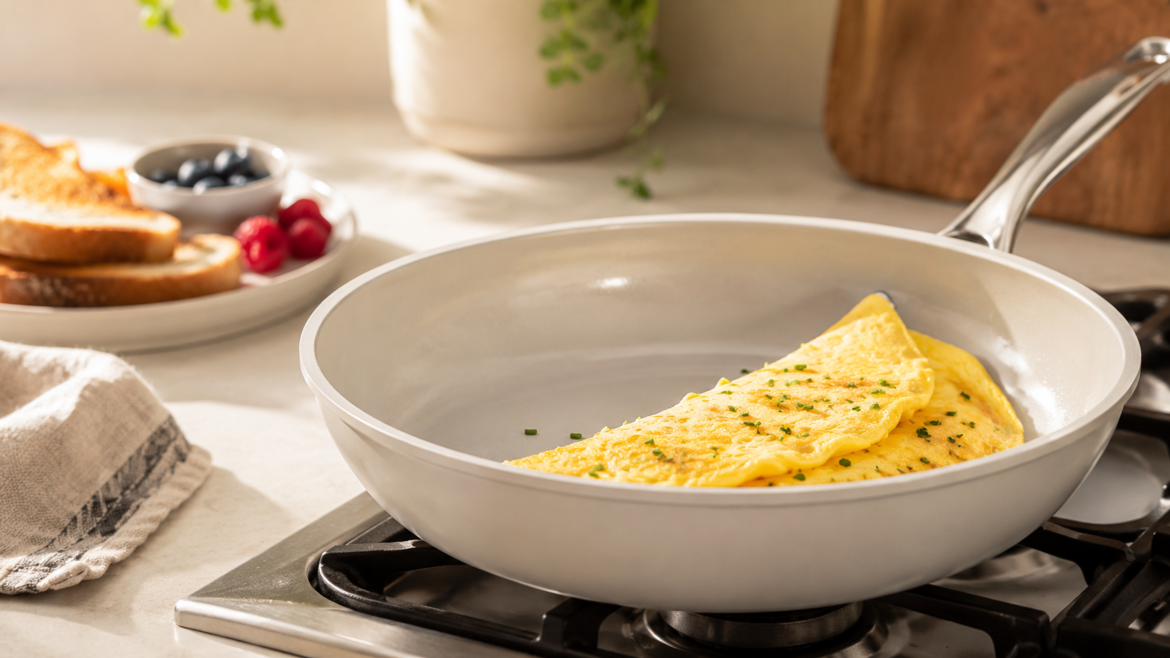
Caraway wins here, clearly. The first morning I used it, a two-egg omelet slid out of the pan with so little resistance I actually laughed. No oil. No spray. Just a pan that worked exactly the way nonstick is supposed to. This is what ceramic nonstick does best — delicate, low-heat cooking where you want food to release cleanly without any fat.
HexClad with eggs requires a bit of technique. You need to preheat properly, add some oil or butter, and get the temperature right before you add the eggs. Get it wrong and you’ll have eggs stuck in the hexagon pattern, which is annoying. Get it right and the result is excellent. But there’s a learning curve that Caraway simply doesn’t have for eggs.
Caraway: ✅ HexClad: takes practice
Searing Chicken and Steak
Caraway is not the pan for this. I tried twice. The ceramic coating is not designed for high heat and you can feel it — the coating technically handles up to 550°F but real-world sustained high heat degrades it over time. Using Caraway for aggressive searing is how you shorten its lifespan. I stopped doing it.
HexClad is genuinely excellent at searing. The raised stainless steel sections hit the food first and create real Maillard reaction browning — not the steam-cooked grey you sometimes get with nonstick. A chicken thigh came out of the HexClad with skin that was actually crispy. That’s the whole point of the hybrid design and it works.
Caraway: ❌ HexClad: ✅
Pasta Sauce and Braising
Both are fine here. Medium heat, some liquid, occasional stirring — neither has an issue. The Caraway was slightly easier to clean after a tomato-based sauce because ceramic releases more readily from acidic foods. HexClad cleaned up without much trouble either.
Push: roughly equal
Cleanup
Caraway is genuinely easy. Warm water and a soft cloth and you’re done. The ceramic releases food cleanly and doesn’t trap residue in a textured surface. The instruction to hand-wash is real — dishwasher use will shorten the coating’s life — but hand-washing Caraway is genuinely faster than most dishes.
HexClad’s hexagonal texture traps small food particles. I needed a brush rather than a cloth to get into the recesses after anything with a lot of seasoning or fond from searing. It cleans up fine but it takes more effort than Caraway. To HexClad’s credit, metal utensils and dishwasher are technically fine — the steel protects the coating — which Caraway cannot claim.
Caraway: ✅ HexClad: more effort
Durability
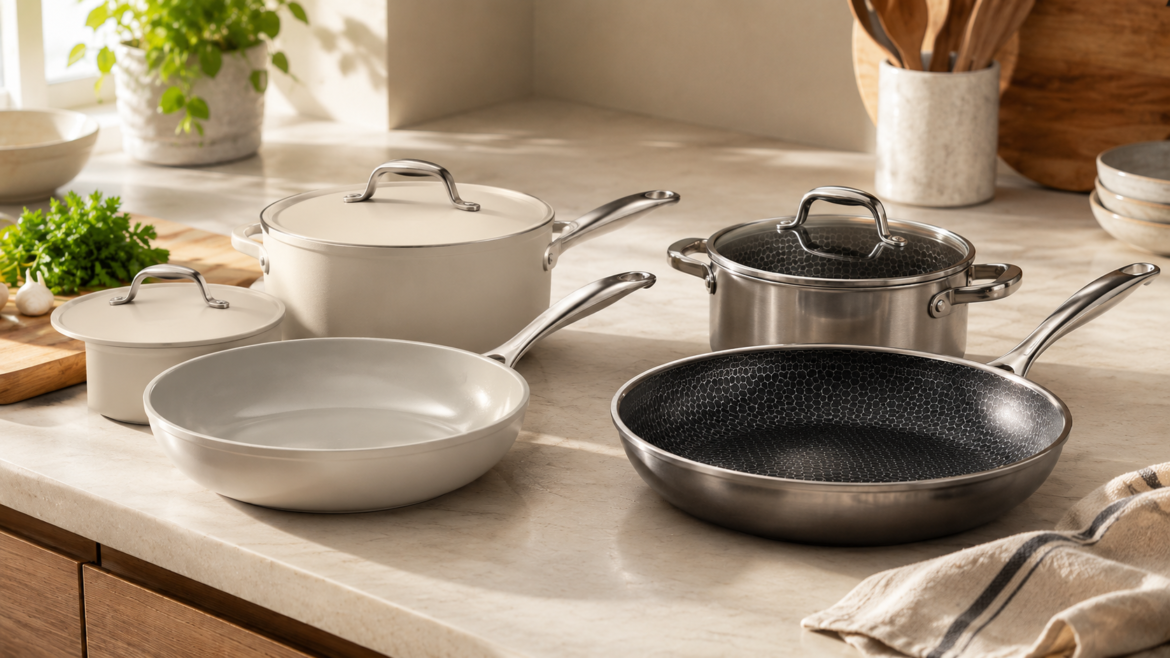
This is the big one and also the one I can’t fully answer after three months because three months isn’t long enough.
What I can say: Caraway’s ceramic coating is the known long-term concern. Reports from multiple independent reviewers describe coating degradation, scuffing, and reduced nonstick performance starting around 9–12 months under regular use. I haven’t hit that yet. But it’s documented enough to plan for. At Caraway’s price and with a one-year warranty, that timeline means you might be replacing pans more often than you’d like.
HexClad’s raised steel design protecting the recessed nonstick is genuinely clever for physical durability. Scratching the coating is much harder than with exposed ceramic. The lifetime warranty backs that up. The unknown is whether TerraBond ceramic performs long-term the way stainless-protected PTFE did — that data doesn’t exist yet because the coating is too new.
The Safety Question
I can’t write this comparison without addressing it directly.
Caraway: Third-party tested by Light Labs with no detectable PFAS, PTFE, lead, or cadmium. This is the most transparent safety record of the two. If non-toxic certification verified by independent labs matters to you, Caraway has it and HexClad doesn’t — at least not yet.
HexClad: The older pans (pre-2024) contained PTFE. The lawsuit confirmed this. The new TerraBond coating claims to be PTFE and PFAS free. What’s missing is independent third-party verification of the full ingredient list. HexClad says it’s proprietary. That’s their right. It’s also a reason some buyers will remain cautious until independent testing catches up.
This isn’t me saying HexClad is unsafe. The FDA considers PTFE safe under normal cooking conditions, and the new coating may be perfectly fine. But if you’re specifically buying cookware to move away from chemicals you can’t identify, Caraway’s transparency record is meaningfully stronger right now.
Price
Caraway Cookware Set (4 pieces): roughly $395 at regular pricing, often on sale for $295–$345. Includes fry pan, sauté pan, sauce pan, Dutch oven, magnetic pan racks, canvas lid holder.
HexClad 7-Piece Set: regularly $599, sometimes lower during promotions. Individual pans start around $120–$200 each.
HexClad is more expensive. The lifetime warranty partially justifies that if durability delivers on the promise over many years. Caraway’s one-year warranty at its price point is the weaker value story long-term.
Head-to-Head Summary
Caraway | HexClad | |
Coating material | Ceramic (PFAS-free, PTFE-free) | TerraBond ceramic (PTFE-free, 2025+) |
Independent safety testing | ✅ Light Labs verified | Not publicly available |
Best heat range | Low to medium | Low to very high |
Metal utensil safe | ❌ No | ✅ Yes |
Dishwasher safe | ❌ Not recommended | ✅ Yes |
Best for eggs | ✅ Excellent | Requires technique |
Best for searing | ❌ No | ✅ Excellent |
Cleanup ease | ✅ Easier | More effort |
Warranty | 1 year | Lifetime |
Price (full set) | ~$395 | ~$599+ |
Coating durability concern | 9–12 months reported decline | Unknown — coating too new |
Aesthetic | ✅ Genuinely beautiful | Functional, industrial |
What I Actually Decided
I kept both. Not as a dodge — because they genuinely serve different purposes in my kitchen.
The Caraway is my morning pan. Eggs, pancakes, reheating leftovers, anything delicate and low heat. It does those things better than anything else I’ve used and I don’t have to think about it.
The HexClad is my weeknight dinner pan. Chicken, stir fry, searing anything that needs real heat. It handles abuse in a way the Caraway can’t and shouldn’t.
If I could only keep one: for how I actually cook — more weeknight dinners than weekend brunches — it would be the HexClad. The metal utensil compatibility alone removes a kind of kitchen anxiety that’s not worth carrying. And the searing performance is genuinely excellent.
If you cook mostly at home for one or two people and your diet leans toward eggs, vegetables, fish, and lighter proteins at medium heat — Caraway will make your kitchen more enjoyable and your cleanup faster. Just be realistic about the coating’s lifespan and treat it gently.
The One Thing I'd Tell Anyone Buying Either
For Caraway: Treat it like the delicate, beautiful thing it is. Medium heat maximum. Never a metal spatula. Always hand wash. Do those three things and it will reward you. Ignore them and you’ll be replacing it within a year.
For HexClad: If you’re buying new — and you should buy new, not old stock — you’re getting the TerraBond ceramic rather than the PTFE-containing pans from the lawsuit era. Make sure of that. And once you have it, learn the preheating technique before you expect it to behave like pure nonstick.
Neither pan is perfect. Both are genuinely good. Which one is right for you comes down to how you actually cook, not how you imagine you cook.