
Smoking Brisket on a Pit Boss Pellet Grill — How to Actually Get It Right
Brisket is the cook that sorts people into two groups. The first group tried it once, pulled a tough, dry, grey slab off the grill after eight hours and never went back to it. The second group figured out what went wrong, adjusted, and discovered that properly smoked brisket is the best thing you will ever eat off a grill. The gap between those two outcomes is almost entirely process.
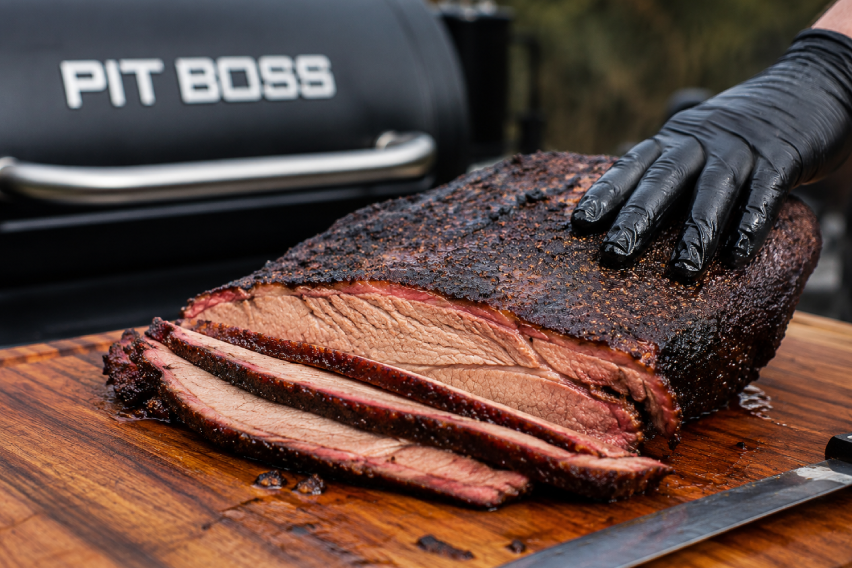
Brisket is unforgiving of shortcuts in a way that other cuts aren’t. A chicken breast you pull 10 degrees too early is still edible. Brisket pulled too early is shoe leather. But when brisket comes off the Pit Boss exactly right — the flat sliceable and moist, the point falling apart, the smoke ring pink through the first quarter inch of meat, the bark dark and slightly crusty on the outside — it’s worth every hour it took.
This guide covers everything from buying the right brisket to slicing it correctly. Read through it completely before you start. Brisket is the one cook where you really need to understand the full picture before the meat hits the grill.
Choosing the Brisket
Brisket is a primal cut from the lower chest of the cow. The full packer brisket includes two distinct muscles: the flat (the leaner, thinner portion that most people picture when they think of brisket slices) and the point (sometimes called the deckle — a thicker, fattier muscle that sits on top of the flat and is the source of burnt ends if you’re making them separately).
Buy the full packer, not just the flat. A flat-only brisket cooked on a smoker almost always dries out because it lacks the fat protection of the point. The full packer allows the point’s fat cap to baste the flat during the cook. If you can only find a flat at your butcher, ask them to leave as much fat on it as possible.
Grade matters:
USDA Select is the minimum grade brisket in most grocery stores. The fat marbling is minimal and the results on a smoker are variable at best.
USDA Choice is what most competition pitmasters use and what you should aim for. Better marbling, more moisture in the flat, more consistent results.
USDA Prime is the top tier, with the most fat marbling. If you can find it at a price you’re comfortable with, it’s worth it — the additional intramuscular fat makes the flat significantly more forgiving during the long cook.
Wagyu brisket exists and is extraordinary if you have the budget. It’s also expensive enough that most people rightfully decide to get their technique sorted on Choice grade before spending Wagyu money.
Size: A full packer brisket typically runs 12 to 18 pounds. After trimming and shrinkage during the cook, you’ll lose roughly 30 to 40 percent of the raw weight. A 15-pound raw brisket yields approximately 9 to 10 pounds of finished meat. Plan for about ½ pound of cooked brisket per person.
Trimming the Brisket
This step takes 15 to 20 minutes and makes a meaningful difference to the finished result. Don’t skip it.
The fat cap — the thick layer of fat on one side of the brisket — needs to be trimmed down to approximately ¼ inch thick. This is enough fat to protect the flat during the cook and render down into flavor. More than ¼ inch and the fat doesn’t fully render, leaving a waxy, unpleasant layer. Less than ¼ inch and you lose the protection.
Use a sharp boning knife or a flexible fillet knife. A dull knife on a brisket is genuinely dangerous because you end up using more pressure and losing control. Sharp knife, slow careful strokes.
Also trim off any hard, white fat chunks that you can see — particularly on the sides and underneath where the flat and point meet. Hard fat doesn’t render well and should be removed.
The brisket will look uneven after trimming. That’s fine. You’re going for a consistent fat cap thickness, not cosmetic perfection.
The Rub
Brisket in Texas — where the smoked brisket tradition is most deeply established — is cooked with nothing but salt and coarse black pepper. This “SPG” (salt, pepper, garlic) approach lets the beef flavor and the smoke do the talking, and it produces extraordinary results.
Classic Texas rub:
- 2 parts kosher salt
- 2 parts coarse black pepper (16 mesh is the standard — this is the grind you want, not fine ground)
- 1 part garlic powder (optional, but most pitmasters include it)
Mix and apply generously to every surface of the brisket. Be more generous than you think is necessary — the brisket is a large piece of meat and a thin application of rub disappears into the bark without contribution.
Some people add additional spices — smoked paprika, onion powder, cayenne. These all work. But if this is your first brisket on the Pit Boss, start simple. Understand what the beef and smoke taste like together before you start adding complexity.
Apply the rub and let the brisket sit at room temperature for 30 minutes before it goes on the grill, or apply the rub the night before and refrigerate overnight uncovered. The overnight approach helps develop bark by drying the surface slightly.
Pellet Selection
Brisket is the cook where oak or hickory belongs.
Post oak: The traditional Texas smoke wood. Medium intensity, slightly nutty, no sweetness. Post oak complements beef without fighting it and has been the pit wood at the great Texas barbecue joints for generations. If you can find post oak pellets, use them.
Hickory: Stronger than oak, with a more pronounced smoke flavor. Works extremely well with brisket. If this is your first brisket cook, hickory produces the “this smells like barbecue” smoke that most people associate with the style.
Oak and cherry blend: Some pitmasters use a 70/30 oak and cherry blend. The cherry adds a slight sweetness and a darker bark color without changing the fundamental beef-and-oak flavor profile.
Avoid: Fruit woods alone (apple, peach) on brisket — they’re too mild for a 12-hour cook and the smoke flavor gets lost. Mesquite has too much intensity for a cook this long and can produce a bitter result.
Setting Up the Pit Boss
Fill the hopper completely. A brisket cook will run 12 to 16 hours. You’ll probably need to refill the hopper at least once — check it every 4 to 5 hours and refill before it runs low. Running out of pellets mid-cook and having the temperature drop significantly is the mistake you most want to avoid.
Temperature: 225°F to 250°F. This is the cooking temperature you’ll maintain through the majority of the cook. Some pitmasters cook entirely at 225°F for maximum smoke absorption. Some cook at 250°F to shorten the overall time slightly. 225°F gives you more time in the smoke and a slightly more pronounced smoke flavor; 250°F shaves an hour or two off the total time. Both approaches produce excellent brisket.
Let the Pit Boss fully preheat to temperature before the brisket goes on. This takes 15 to 20 minutes. Make sure you’re at stable temperature, not still climbing.
Read our full Pit Boss Grill Review!
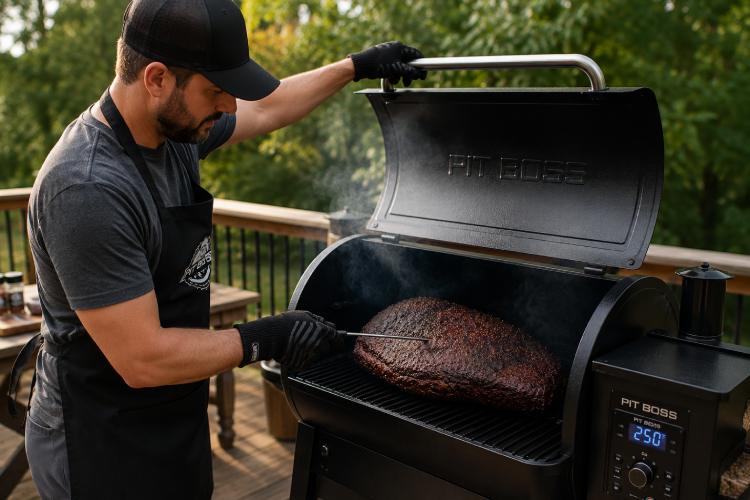
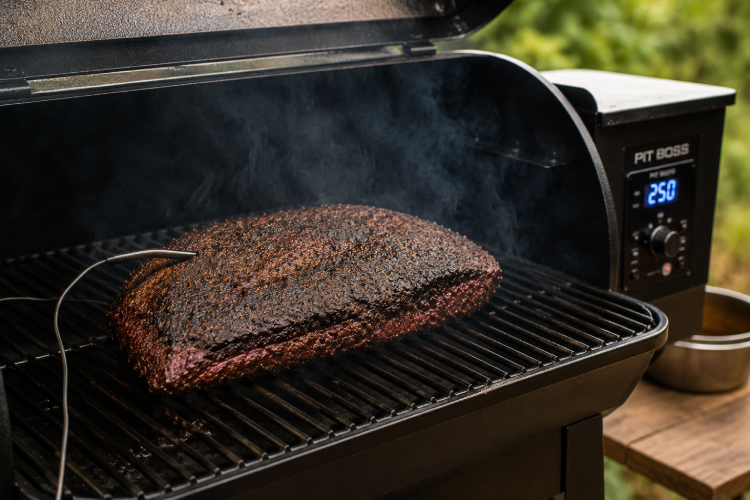
Probe placement: Insert a leave-in probe thermometer into the thickest part of the flat, angled toward the center of the muscle. This is where the flat is slowest to cook and where you’re going to track the temperature through the stall and to the finish.
Placement on the grates: Put the brisket fat-side up or fat-side down? This is one of the most argued questions in barbecue. Fat-side up lets the rendering fat baste the meat as it drips down. Fat-side down creates a barrier between the direct heat from below and the flat. On a Pit Boss pellet grill with its convection-style heat, the heat source isn’t primarily from below the way it is on an offset smoker, so fat-side up works well and is the common recommendation.
The Cook — Phase by Phase
Phase 1: The Smoke (225°F, first 4 to 6 hours)
This is where the magic happens. The brisket is absorbing smoke at maximum efficiency during this phase because the surface is still cool and moist enough to attract smoke particles. Don’t open the lid unnecessarily during this phase — every lid lift drops the temperature 25 to 30°F and extends the cook time. Trust the process.
The bark is beginning to form during this phase. You’ll see the surface darken from the rub and the smoke exposure. This is good. You’re building the exterior crust that’s the defining feature of great smoked brisket.
Phase 2: The Stall
At some point between 150°F and 175°F internal temperature, the thermometer will stop moving. It will sit at the same temperature for what can feel like an alarming amount of time — sometimes 2 hours, sometimes 4 hours. This is completely normal and has a known explanation.
As the surface of the brisket heats up, moisture inside the meat migrates to the surface and evaporates. The energy being put into the brisket by the grill is being consumed entirely by this evaporative cooling effect — the same reason sweating keeps you cool on a hot day. The temperature isn’t rising because the energy balance is in equilibrium.
The stall resolves on its own. You can wait it out, or you can wrap the brisket at this point (see below).
Phase 3: The Wrap (optional but recommended)
Most pitmasters wrap the brisket in butcher paper or foil when it hits the stall (approximately 160°F to 165°F internal). Wrapping traps the heat and eliminates the evaporative cooling effect, pushing the brisket through the stall more quickly and protecting the bark from over-darkening during the remainder of the cook.
Butcher paper vs foil:
Butcher paper (specifically pink or peach unlined butcher paper, not wax paper) is the preferred wrapping method for most competition pitmasters. It breathes slightly, allowing some moisture to escape while still accelerating the cook. The bark holds up better through a butcher paper wrap than through foil.
Foil (the “Texas crutch”) wraps tighter and accelerates the cook more aggressively. It can soften the bark if you wrap too early or leave it wrapped too long. The benefit is a more braised, tender result — some people prefer this.
To wrap: pull the brisket, place it on two overlapping sheets of butcher paper (or heavy-duty foil) fat-side down, pour a small splash of beef tallow or melted butter on top if you have it, and wrap tightly. Return to the grill.
Phase 4: The Finish
After wrapping, the temperature will begin rising again. You’re now cooking to probe tenderness, not just temperature. The target internal temperature for the flat is 200°F to 205°F, but temperature is the starting point for the probe test, not the finish line.
The probe test: Push the instant-read thermometer probe into the thickest part of the flat. It should slide in with essentially no resistance — like inserting a probe into room temperature butter. If you feel any resistance at all, the brisket isn’t ready. Put it back on for another 30 minutes and test again. This “probe tender” test is how you know the collagen has fully converted to gelatin and the brisket will actually slice and eat the way you want it to.
A brisket that tests probe tender at 195°F is done. A brisket that still has resistance at 210°F needs more time. The thermometer reading is a guideline; the probe feel is the actual indicator.
The Rest — The Most Important Step
More than any other cut of meat, brisket needs a proper rest. A minimum of 1 hour. Two hours is better. Some competition pitmasters rest brisket for 4 to 8 hours in a cambro cooler.
Here’s why this matters: brisket is full of collagen that has converted to gelatin during the long cook. This gelatin is what makes the meat moist and gives it that characteristic sticky richness. During the rest period, this gelatin sets slightly and the juices redistribute throughout the muscle. Cut into a brisket immediately off the grill and the juices run out and the gelatin hasn’t set — you get dry, stringy slices. Rest the brisket properly and you get slices that hold together and release moisture in your mouth rather than onto the cutting board.
How to rest: Wrap the brisket (still in its butcher paper or foil) in a towel and place it in a cooler. The insulation keeps it at safe serving temperature for 4 to 6 hours without any refrigeration needed. This is the hack that allows you to finish the brisket ahead of time without serving it cold.
Slicing
This is the final step that most people rush and it matters more than most people expect.
Separate the flat and the point before slicing. The flat and point have different grain directions, and you need to slice against the grain of each independently. Slicing with the grain produces chewy, stringy slices; slicing against the grain cuts through the muscle fibers and gives you tender slices.
Find the grain direction of the flat and slice perpendicular to it in ¼-inch thick slices. These are your primary brisket slices.
The point can be sliced similarly or cubed into burnt ends. Burnt ends — cubed, sauced, and returned to the smoker for another hour — are arguably the best thing that comes from a whole packer brisket.
Quick Reference
- Best cut: Full packer, USDA Choice or Prime
- Trim fat cap to: ¼ inch
- Rub: Kosher salt, coarse black pepper, garlic powder
- Pellets: Post oak, hickory, or oak-cherry blend
- Cook temperature: 225°F to 250°F
- Wrap at: 160°F to 165°F internal (butcher paper preferred)
- Done temperature: 200°F to 205°F, probe tender
- Rest time: Minimum 1 hour, 2 hours preferred