
Caraway vs Made In vs Our Place — Three Months of Actual Cooking. My Honest Take
This comparison started because I had a cookware problem. My previous set — something purchased six years ago from a department store during a sale — had reached the point where the nonstick was so degraded that eggs required more oil than a deep fryer and the handles were loose enough to produce genuine anxiety during anything that went in the oven.
I needed to replace everything. And I was tired of buying things that would need replacing in four years.
I tested Caraway, Made In, and Our Place over the course of nine months — three months each, cooking actual daily meals rather than demonstration recipes. Here is what that experience produced.
What I Actually Cooked
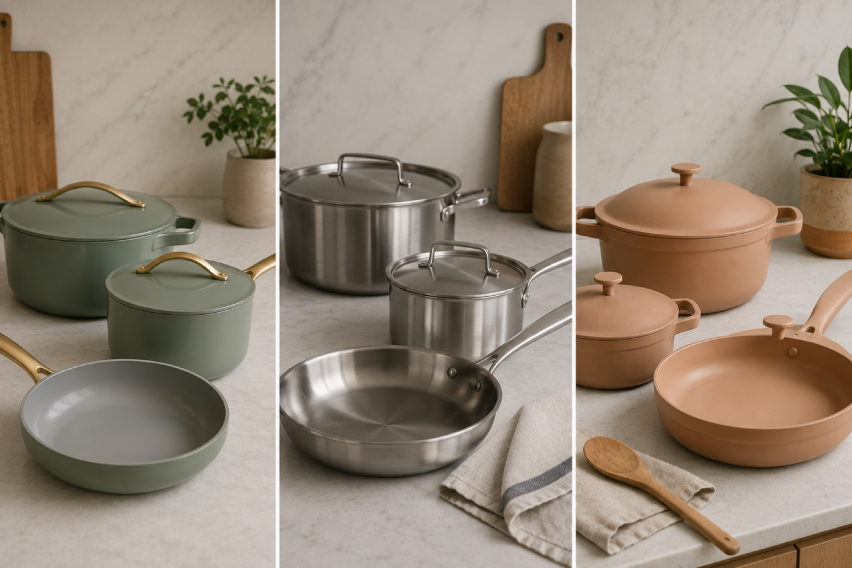
I cook for two people, usually four to five times per week. The repertoire includes: eggs in the morning several times a week, pasta sauces and braises during the week, weekend cooking that involves higher heat and more technique — seared proteins, pan sauces, the kind of thing that tests a pan rather than just using it. This matters for context because cookware that performs for one type of cooking may not perform for another.
The Three Sets
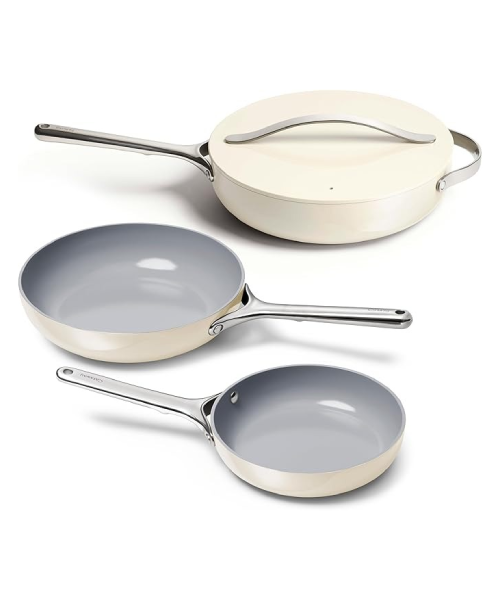
Caraway’s ceramic nonstick is genuinely beautiful. I don’t say that as a throwaway comment — the Dutch oven in sage sitting on the stovetop improved how the kitchen looked in a specific way that sounds vanity and felt meaningful. Cooking is more enjoyable when the things around you look considered.
The performance on eggs and delicate proteins was the best of the three sets in the first three months. Scrambled eggs slid across the surface with a small amount of butter and the specific satisfaction of food releasing cleanly. Fish fillets, which I’d been approaching with anxiety on inadequate nonstick, lifted without stress.
The limitation I hit at around the eight-week mark was heat. I cook chicken thighs regularly and the specific result I want requires a proper sear — higher heat than ceramic nonstick is designed for. The first few times I pushed the heat, the eggs the following morning were fractionally stickier than they had been. By the end of the third month, the coating was performing at about 80% of its new condition.
This is not a product defect. This is ceramic nonstick doing exactly what ceramic nonstick does — it degrades under high heat. Caraway is explicit about this in their care instructions. The question is whether the cooking you do respects these limitations.
Price: £345-495 depending on set
Available at: Caraway Home directly (carawayhome.com), John Lewis
Verdict: Excellent for low-to-medium heat cooking, eggs, sauces, and gentle proteins. Not the right choice if high-heat searing is part of your regular cooking.
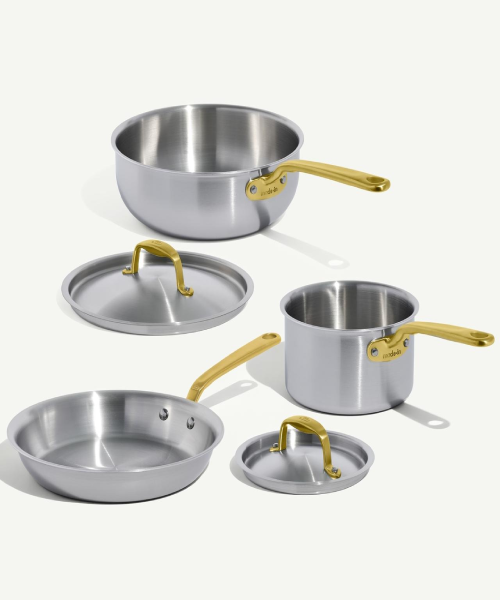
Made In stainless clad has a learning curve. I want to be transparent about this because the first two weeks of cooking with stainless steel after years of nonstick was humbling. Eggs stuck. Fish stuck. I came close to returning it.
What changed everything was learning the water bead test — heating the pan until a drop of water beads and rolls rather than immediately evaporating — and understanding that this was the moment to add fat, not before and not later. Once I understood this, the stainless behaved completely differently.
The sear on chicken thighs in the Made In was the best I’ve produced in my kitchen. The fond — the browned residue that becomes the base of a pan sauce — developed properly rather than steaming off because of trapped moisture, which is what happens in a nonstick pan. I made a pan sauce that would not have been possible with the Caraway.
For pasta sauces, braises, and anything that involves deglazing, the stainless is categorically better than ceramic nonstick. The heat distribution in the five-ply construction is even enough that I have not had a hot spot problem in three months of regular use.
The cleaning is honest work. Burnt-on residue requires barkeeper’s friend and a few minutes of effort. This is the specific trade-off — exceptional performance in exchange for more attention in cleaning.
Price: £399-599 depending on set
Available at: Made In directly (madeincookware.com)
Verdict: The best cooking performance of the three sets for serious home cooks. Requires understanding how to use stainless steel and more cleaning effort. Worth it if you cook with intention.
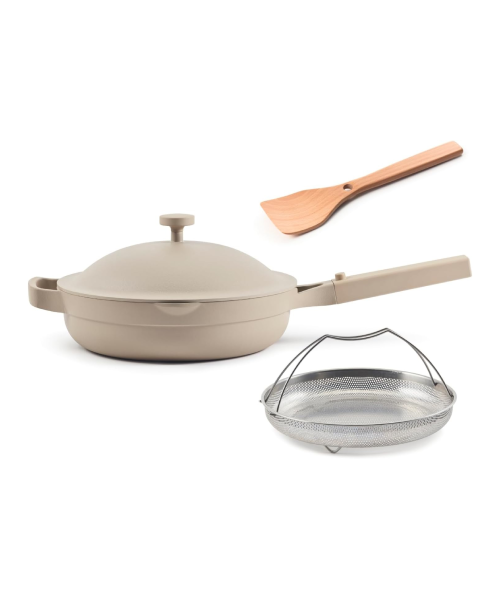
Our Place made its name with the “one pan to replace eight” promise, and the Always Pan 2.0 does genuinely do more things than any other single pan I’ve used. The included steam basket, the lid with built-in strainer, the wooden spoon rest — these are not gimmicks. They work.
What the Always Pan is excellent for: one-pan dinners, steamed vegetables, sauces, smaller braises, cooking for one or two. The size (10 inches) limits batch size in a way that becomes apparent when cooking for more than two people — the pan is genuinely full with a standard pasta sauce for two and the steam function works best with smaller quantities.
The ceramic coating performed similarly to the Caraway over three months — excellent initially, slightly degraded by the end of the test period. I used it at medium heat consistently and the degradation was less than if I’d pushed the heat.
Where the Always Pan genuinely wins is convenience. The number of times I reached for the steam basket instead of pulling out a separate pot, or used the lid strainer instead of a colander for pasta, added up to genuine time savings over the test period.
Price: £145-165
Available at: Our Place directly (fromourplace.com), John Lewis
Verdict: The best option for minimal kitchen setups, single people, or those who cook simple meals and value multifunctionality over cooking performance at the extremes.
The Actual Verdict
These three products are not competing for the same buyer, and I think that’s the honest conclusion.
Caraway is for those who want beautiful, easy-care cookware for everyday cooking that doesn’t involve high heat. It’s genuinely excellent at what it does.
Made In is for those who cook with intention and want the best possible performance from their pans, in exchange for learning how to use stainless steel and accepting more cleaning effort.
Our Place is for those who want maximum functionality from a single pan — the morning egg, the evening steam, the one-pan pasta — in a convenient package.
I kept the Made In as my primary cookware and use the Caraway fry pan specifically for eggs because the nonstick release is genuinely superior for that specific application.